12 minutes ago
Swiss television makes coverage in Kosovo, writes whether Albanians, Serbs can live together
Periskopi(3 years ago)
(3 years ago)If co-existence is discussed between Albanians and Serbs in Kosovo, it is usually about conflict. But while the situation in northern Kosovo has been tense for months, the two ethnic groups live peacefully side-by-side in the rest of the country, writes Swiss SRF Radio Television. Swiss media that came north for them [...]
If co-existence is discussed between Albanians and Serbs in Kosovo, it is usually about conflict. But while the situation in northern Kosovo has been tense for months, the two ethnic groups live peacefully side-by-side in the rest of the country, writes Swiss SRF Radio Television.
The Swiss media that came to the north to see the situation more closely described as “thorn wire strength” the object of the Zvecan municipality.
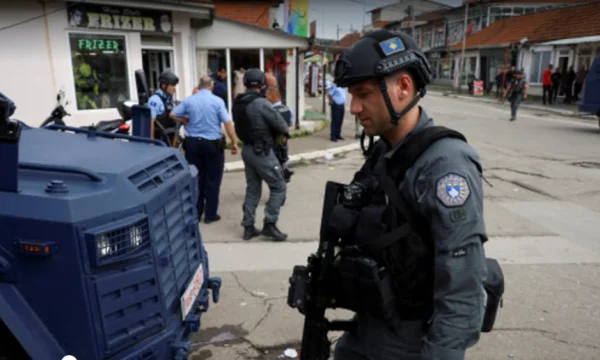
The “soldiers of KFOR's international defence forces stand guard in front of armoured military vehicles. In front of the barriers, which are covered with Serbian flags, local residents sit under red umbrellas on the side of the road. They protest the presence of soldiers. Despite the midday heat, about 30 people are here. They eat and talk”
If co-existence is discussed between Albanians and Serbs in Kosovo, it is usually about conflict. But while the situation in northern Kosovo has been tense for months, the two ethnic groups live peacefully side-by-side in the rest of the country, writes Swiss SRF Radio Television.
The Swiss media that came to the north to see the situation more closely described as “thorn wire strength” the object of the Zvecan municipality.
The “soldiers of KFOR's international defence forces stand guard in front of armoured military vehicles. In front of the barriers, which are covered with Serbian flags, local residents sit under red umbrellas on the side of the road. They protest the presence of soldiers. Despite the midday heat, about 30 people are here. They eat and talk”
KFOR soldiers guard the Zvecan Municipal House.
Zvecani is one of the four majority Serb communities in northern Kosovo. The area has been in world headlines during recent weeks due to conflict.
The worst escalation in years
This is where the most violent escalation in Kosovo has occurred for years at the end of May. At the time, Serbian demonstrators attacked KFOR soldiers with iron bars and self-accused explosive devices. Tens of people were injured, some in serious condition.
Postpoints were set up among the villages.
Protests were sparked when four newly elected mayors wanted to take office in municipal buildings under police protection. Mayors of municipalities are of Albanian descent, while most residents are Serbs. They boycotted the elections. The mayors were selected with a low turnout of less than four percent. Hence, many consider their choice illegal.
Protests Continue
Since then, people have gathered here every day to protest. Tour work ensures that the presence is maintained day and night. The same situation appears in other Serb communities in the north. While here are the mayor and Kosovo police, we will continue”, Milos says. He comes every day to protest. His real name is different, but he doesn't want to make it public.
People protest day and night
Day and night, people gather here to protest the mayors of municipalities of Albanian origin and the presence of Kosovo police.
Jelena also doesn't want to give her real name. The young woman works as a English teacher at local school. She laments that her village has been surrounded since violent clashes. The school is located near the community centre, and until recently it was inside the expulsion zone. Hence, the last weeks of the school year had to be held online.
Conversation with people shows that most people care more than just about mayors. They see themselves as citizens of Serbia and do not want to integrate into the Kosovo state. Here in northern Kosovo, life looks like Serbia. Jelena teaches her students according to the Serbian programme, they are paid with Serb dinars, salaries and pensions are paid to Serbia, including Jelena.
Ovo you Serbia this is Serbia, said in the gang.
Ovo je Serbia ) this is Serbia, says the banner lying across the streets in the Serb community in northern Kosovo.
It refuses integration into the Kosovo school system. Kosovo is rewriteing history, including ours, this is unacceptable”, Jelena says. She wants her school to continue to learn the Serbian perspective of the past.
Kosovo government moves towards parallel structures
Albin Kurti's Kosovo government no longer wants to accept these parallel structures that have grown over the years. Kurti wants to integrate the northern area into the Kosovo state, and he is doing so more decisively than his predecessors. Since he took office, the situation in the north has become increasingly critical until the escalation mentioned came at the end of May.
Since then, a tense calm has returned. The security system is greatly expanded. KFOR soldiers and Kosovo special police are visible on their patrols. On the road between villages, people must go through roadblocks constantly. This presence of security forces, especially of Kosovo special police, by many people here in the north is seen as foreign invasion.
Not all refuse to engage in dialogue
While many see co-operation with the Kosovo state as treason, Nenad Radosavljevic has another approach. He works with the Albanian chairman in his native village. “I'm a realist, even if it's not very familiar right now”, Nenad says. Through his work, he can help secure stability and advance projects that benefit people.
He sees the problem in the governments of Serbia and Kosovo. They wanted to stand out in conflict with their electorate. They don't care about local people's interests. Since most receive salaries and pensions from Serbia, they are open to blackmail and should behave as Serbian President Aleksandar Vuciq requires. So it also stands behind the boycott of local elections. Financial dependence is also why many do not want to give their real names.
Different South situation
While there is almost no exchange among population groups in everyday life in the north, coexistence in the rest of the country functions without any problems. For example, in the Brezovica region of the south.
A board promotes self-made schnapps in three languages: Serbian, Albanian and English.
The mountainous region is known for a large ski zone and is close to the border with northern Macedonia. The area is equally inhabited by Serbs and Albanians.
Nicole's a cook at Tiffany's restaurant.
There are no problems between Serbs and Albanians” in everyday life, Nikola says. 22-year-old is chief kitchen at Tiffany's restaurant. Of course, there are Albanian friends and he likes to go with them to surrounding towns to drink. But you can also see it here in the restaurant owned by Luli, an Albanian.
The owner of the restaurant Luli
Eight years ago, Luli opened the restaurant, which is located right on the road leading to the national park. He deliberately employed only Serbs from the area. He says: “Politics creates problems, not people”. He feels it in his life. Local politicians don't like what he's doing here at the restaurant and continue to put obstacles in his way.
“Tiffany” is en route to the national park.
Conflict Bad for Business
If the conflict in the north reaches the top, it will exert pressure on business. Then we have fewer guests, because they are afraid to come to a Serb majority community”, Luli says. The situation here is not comparable to that in the north.
This is not what the situation is saying on television, says Nicolaus. Because of the media, his friends in Serbia have a wrong life mirror in Kosovo. In any case, he wants to live here in the future. I like it here, says, has a good job, his family and friends live here.