
Under current law, the timetable for such a thing has expired on 5 February.
Kosovo numbers unknown correctly Raped People During the war in 1999, it is believed to be about 20,000.
By February 2018, when the application for recognition of the victim's status was launched, a total of 1,558 have been provided.
Last week, Kosovo's Assembly passed changes to a government-designed law, which, among other things, handles the status and rights of persons raped during the war.
With that measure, the deadline for application has been extended for two years, until May 15th 2025, respectively, with a possibility to last two years.
- Process complicated to the status of victim of sexual violence
- Names of suspected rapists only on paper
- About 400 women and 12 men with sexual violence victim status
But the restriction prompted opposition from Kosovo President Vjosa Osmani to organisations protecting the rights of survivors of sexual violence in the war.
According to them, the application deadline for this status should be unlimited until the victim feels ready for such a step.
The status of the war sex victim provides her with a pension of 230 euros a month and some other benefits, such as free health services and employment priorities.
Under the law in Kosovo, Which was adopted in 2014, such status belongs to every person who manages to convince a government commission that he was a victim of sexual violence during the war in Kosovo, respectively, in February 27, 1998, June 20, 1999.
Dafina, the survivor of sexual violence during the war in Kosovo, says 24 years after the rape, cannot convince herself to stand before a commission and confess its experience. It is certain that such a thing will not be possible for the next two years.
I am not now able to talk [about violence], because of family, children, because I live in family communities. I've been told there are procedures, commissions and I'm afraid I'm being discovered. I don't know, maybe after a while... after four or five years I can do something like that”, says Dafina, whose true identity is known for REL's editing.
Dafina says that besides her husband, no one in her family knows she was raped.
Rape, crime not accepted enough in the Western Balkans
That's exactly why the victims' unwillingness to speak up some require that the deadline for application for the victim's status be out of time.
Kosovo President Vjosa Osmani, who must sign the law to enter into force, has said on July 17th that the “afati application for the status of the victim of sexual violence must be unlimited”.
The nongovernmental organisation, which protects the rights of survivors of sexual violence during the war, has sought the same.
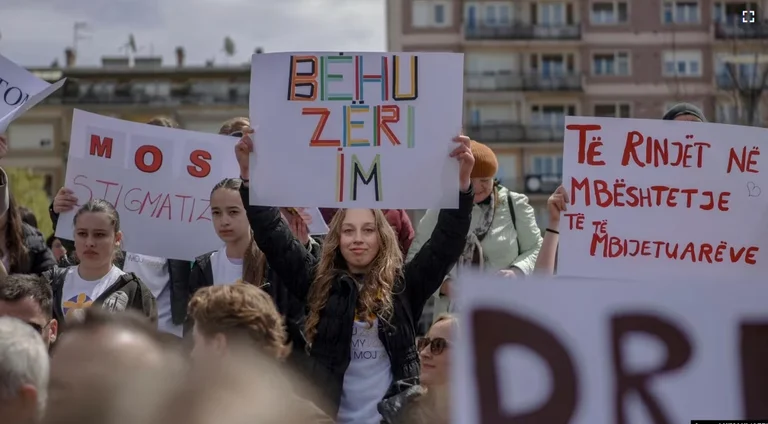
The Kosovar Centre for the rehabilitation of Torture Survivors (QKRMT) in Kosovo, along with members of the platform “be the Voice Im”, have said that limiting the deadline for application for recognition of the status of victims of sexual violence during the war is contrary to international law conventions and principles.
According to international practices, for example in Croatia and Bosnia and Herzegovina, the deadline for recognition of the status of victims of sexual violence in war is not limited.
“The QKRT will continue to address the need for the deadline for application not to be limited but to be limitless, as addressed through non-responsive letters to the Office of the Prime Minister, Speaker of the Parliamentary Groups and relevant Commissions. Thus, the law would be in line with international rights and practices, as well as with the needs and sensitivity of victims that the right to recognize their suffering is not limited at times”, says the QKRMT in a written statement sent to Radio Free Europe.
“We insist that there should be no time restrictions on the law”, says Kadire Tahiraj, director of the Centre for Promoting Women's Rights in Kosovo.Can Changes Be Made in Law?
The head of the Commission for Human Rights in the Kosovo Assembly, Duda Bae, says this body has asked the Government to do different in the draft law, not limiting the deadline, but, according to her, the Government has not considered the requirements.
The “is now late for [changing]. I respect the president's opinion very much, but now it's late that it was voted in the Kosovo Assembly”, Bale says.
The president, with her authority, may not sign a bill adopted by the Parliament and can return it to the Assembly with specific remarks. But even the Parliament could reject a presidential proposal if that law re-enters procedure and is voted 61 for.
The head of the government Commission for recognition and verification of the status of victims of sexual violence, Leonora Selmani, says there should be no delay in decreeing the bill adopted by the Parliament.
According to her, other options about the deadline will be considered later.
“First, the law must be decreed as established in the Assembly and then it is a question that should be discussed whether it should be in a longer term or not. Currently, I think it should be 2+2 [years] and during this period of time they should all mobilise to see how it should be done in the future”, Selmani says.
Earlier, some nongovernmental organisations, through which a certain number of people have applied for the status of the victim of sexual violence, have expressed concern that long expectations for examining cases from the government Commission have caused many victims to give up application for status that could be met. There have been times when a person has waited up to 17 months.
The Problems of Recording Sexual Violence During War
The situation, they say, often challenges physical appearance to the commission, as victims fear stigmatization.
For the application, the victim must complete a form of information and detail for the country and the period when rape occurred, with statements by witnesses and with eventual medical reports. If the commission does not comply, the victim must physically appear before him.