11 minutes ago
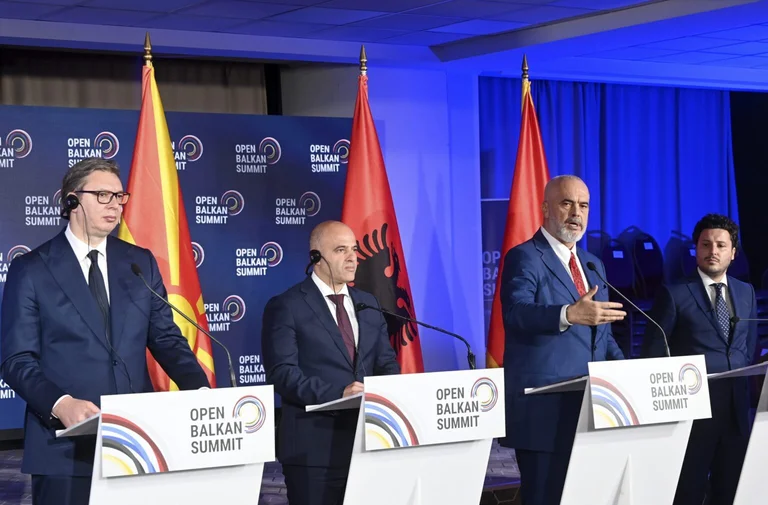
REL: EU would facilitate the extinction of the Open Balkans, Berlin Process would be strengthened
Periskopi(3 years ago)
(3 years ago)Albania's Prime Minister Edi Rama's warning of the merger of ideas of the Balkans Open Initiative in the Berlin Process would be welcomed by many counties in the European Union. So far, Rama has expressed to the media only that the Open Balkans “has completed his” mission and that the ideas of this initiative do [...]
So far, Rama has expressed to the media only that the Open Balkans “has completed its” mission and that ideas of this initiative will be carried to the Berlin Process.
There have been no official reactions to this warning in the EU, but, unofficially, some European diplomats say to Radio Free Europe that “this would be welcomed” and that “would be a great relief for strengthening the Berlin Process and other processes”.
The Open Balkans Initiative, which was originally called Mini Schengen, was undertaken on 10 October 2019 in Novi Sad, and was signed by Serbia's President Aleksandar Vuciq, Albania's Prime Minister Edi Rama and then Northern Macedonia Prime Minister Zoran Zaev.
The initiative has been rejected by the opposition in Albania and rejected by Kosovo, Montenegro and Bosnia and Herzegovina.
Under it some agreements have been reached, both for economic co-operation and free movement.
Regarding Rama's warning of its extinction, Vuciq has said that “cannot believe he [Rama] has said such a thing”. There has been no reaction in northern Macedonia.
What has been the position of the EU?
The EU has been constantly unclear about this initiative.
Formally, it is not expressed against, because, in principle, it supports any initiative aimed at strengthening regional co-operation.
But, on the other hand, many circles in the EU have seen it as a duplication of existing processes, such as: The Joint Regional Market, the Berlin Process, the Regional Co-operation Council, the CEFTA Free Trade Agreement and so forth.
In the question of whether they support the Balkans' Open Initiative, six partners from the Western Balkan region” have always responded to the EU, saying that “as they support any initiative for regional co-operation, which is inclusive” and in which there are six partners from the Western Balkan region.
Considering that in the Open Balkans initiative, even after a few years, only three member states remain: Albania, Serbia and Northern Macedonia cannot be said to be inclusive.
Therefore, many diplomats in the EU, unofficially, have expressed the position that this initiative does not have full support.
Instead, the EU has called for countries in the region to focus on the Berlin Process, even though that process is not formally within the framework of the European Union's institutional action.
The Balkans Open Initiative, meanwhile, has supported countries like: The United States of America, Turkey and Hungary, which have also sent their officials to its meetings.
Even EU Commissioner for Neighborship and Enlargement Oliver Varhely spoke at several Open Balkan meetings.
On the other hand, the Berlin Process has won full support from all six states of the Western Balkan region, as well as international support.
The aim of this intergovernmental initiative is to connect the countries of the Western Balkans and the European Union and help them build bilateral relations on the basis of European values.
The EU has been very active in supporting this process, showing willingness to co-finance some projects.
The Berlin Process includes the six states of the Western Balkan region, naming them all as states, as different from several other processes, where the EU or the countries of the region have the main role and where because of Kosovo not recognised by Serbia and Bosnia they are called “partner” or “
The Berlin process is the German initiative, supported by many other EU states, such as Germany, France, Italy, Austria, Croatia, Bulgaria, Slovenia, Poland and Greece. Even though it is no longer an EU member, part of the process continues to be Great Britain.
All these countries have expressed their willingness to contribute to helping the states of the Western Balkans in their development efforts and closer to EU standards.
The Berlin Process summits have also attended the leaders of European Union institutions, including European Council President Charles Michel, and European Commission President Ursula von der Leyeen.
The Berlin Process has started as the idea of former German cancellara, Angela Merkel. But even her successor, Olaf Scholz, has decided to hold the process as a priority. He has been hosting and organising a summit, where several key agreements have been signed among the six Western Balkan countries.
The statements of Albanian Prime Minister Edi Rama, who will also be host to the upcoming Berlin Process summit, are seen by many diplomats in the EU as the possibility of a “fair path”.
According to them, the three open Balkan countries could say that this idea “has not been in vain” and that it “will prosper the Berlin Process”.
Meanwhile, as diplomats say, pressure will also be lifted on Kosovo, Montenegro and Bosnia and Herzegovina to join a process that has not been joined so far.
In Kosovo, all governments have opposed the open Balkans, while in Bosnia and Herzegovina there have been internal differences, due to which the country has not been able to join.
Montenegro's past government has been opposed, while the June election winners have expressed readiness to consider participation in the Open Balkans. However, even in Montenegro this issue has created division in the internal political spectrum.