12 minutes ago
He almost passed most of his sentence: Nasim Haradinaj soon submits request for early release
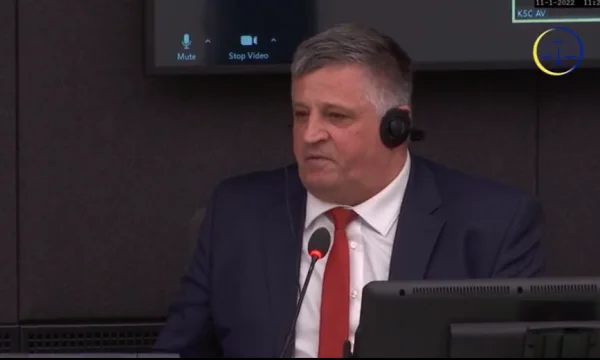
Periskopi(3 years ago)
(3 years ago)Former deputy chairman of the War Veterans Organisation, Nasim Haradinaj, is expected to soon surrender at the request of the Special Court for early release. This, after he soon passes almost two-thirds of the sentence held, accounting for the sentence of four years and three months in prison. The news has been confirmed by the lawyer [...]
Former deputy chairman of the War Veterans Organisation, Nasim Haradinaj, is expected to soon surrender at the request of the Special Court for early release. This, after he soon passes almost two-thirds of the sentence held, accounting for the sentence of four years and three months in prison.
The news has confirmed Nasim Haradinaj's lawyer, Toby Cadman. He has said there will soon be a meeting with Haradinaj to discuss details of this request.
“Z. Haradinaj will have arrived soon two-thirds of his sentence, so he qualifies for easing the sentence, or early release. We are in the process of preparing the request and I will meet with Mr. Haradinaj this week to further discuss the issue. Our view is that there is solid grounds to support his early release request”, attorney Toby Cadman said of Nacional.
Nasim Haradinaj and Hysni Gucati were originally sentenced to four years and six months in prison. Later, The Hague's Appeals Court eased their sentence in four years and three months. They have been arrested since September 2020. His time in custody was counted in the total penalty.
Currently, lawyers have complained at The Hague Supreme Court to request lowering the sentence or the total release of the two leaders of the War Veterans Organisation.
The Special Court had long ago appointed the penalty to be handled. The chairman of this panel is the first appointed Special Court, Ekaterina Trendafilova. And then Judge Christine van den Wygnart and Daniel Fransen.
Appeal's Decision
Court of Appeals' main findings:
The panel first deals with alleged errors regarding court decisions not to reheat or edit materials. The panel finds that materials are not relevant to content but to their confidential nature. Knowing that they were part of the investigation, it was reasonable that a SPS investigator would confirm the confidential status of these documents. The panel notes that the defence had the opportunity to ask SPS investigators questions and that along with support on this evidence, the court confirmed authenticity. The accused have failed to prove mistakes in the court's findings. The procedure followed by the court meets the standards of fair judgment. The panel lowers Mr. Haradinaj.
The discovery of official secrets: The panel undermines Mr. Gucati and agrees to the juro that it is not specifically required that information must have been drawn directly from the head of the criminal act. The panel claims that Mr. Gucati has failed to prove that confidentially handled information should be confidential. The panel lowers defence objections for point 5 of the indictment.
Unauthorized discovery of witness identity: The defense has failed to prove errors in the court's findings. The sixth point of the indictment includes two serious forms of basic criminal activity, only one is relevant to this case, which is the case when criminal acts cause serious consequences for the protected person. The panel finds that the accused have failed to prove that the court relied on the testimony of the appointed witness. The panel finds that the court did not wrong that serious consequences were caused for witnesses who moved to the residence because they were in danger. The panel finds that this applies only to two witnesses.
The court gave no explanation for its findings regarding the publication of a witness's name. For this reason, the Appeals Panel agrees with Mr. Gucati that the court erred and therefore acknowledged the reason for Mr. Gucatit.
Fear during criminal procedure: The Appeals panel thinks that preventing the criminal procedure has nothing to do with Article 387's alternative, and the court did not wrong that the accused used serious threats regarding criminal procedure. Regarding the word a serious threat, he judges that the legal goal was to include any threats to the force, not just the use of force. The interpretation of the court agrees with their provisions and purpose. The panel finds that the accused have failed to prove wrong in assessing the court of criminal acts for intimidation. The panel finds that the intentions of the two accused were intended not to give evidence. It leads to objections to defence against the findings.
The obstruction of official persons in performing official tasks with serious threat: The panel judges that the interpretation is in line with the purpose of the provision. Most of the panel finds that the accused have not proved wrong in a court assessment of this criminal act.
The panel explains there is a difference between forcing the SPS to prove its guilt, and the defence responsibility for presenting evidence to criminal support. The panel notes that the court rightly found out there was no push in criminal work on the prosecution's part.