19 minutes ago
NATO leaders gather in Lithuania, Kosovo outside the agenda
Periskopi(3 years ago)
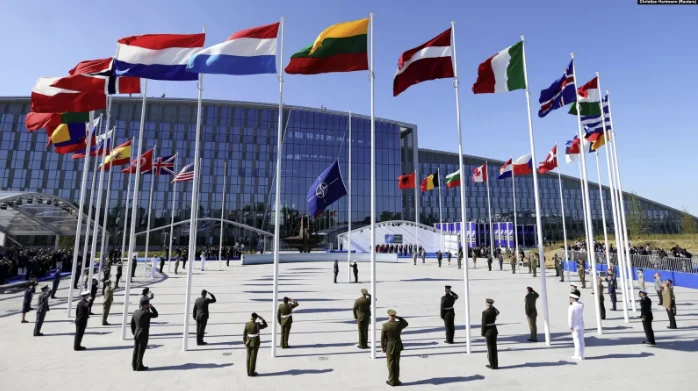
(3 years ago)Leaders of the NATO military alliance gather today and tomorrow in Vilnius, Lithuania. The summit takes place at a critical time for security in Europe, as the war in Ukraine is among Kyiv's counteroffensives. The summit also comes a year after the Madrid meeting, where NATO allies have agreed to a concept [...]
The summit takes place at a critical time for security in Europe, as the war in Ukraine is among Kyiv's counteroffensives.
The summit also comes a year after the Madrid meeting, where NATO allies have agreed to a new strategic concept that has singled out Russia as a direct threat to security.
Leaders of member states of the largest military organisation in the world are expected to discuss a wide range of topics, among which they will dominate Ukraine's efforts to join NATO, as well as Sweden's accession to the alliance.
The decisions we make at Vilnius will bring Ukraine closer NATO... strengthening NATO defence will be at the helm of our summit agenda, as will”, the secretary general said. NATO, Jens Stoltenberg.
As far as Ukraine will be at the top of the summit agenda, Kosovo is not expected to be discussed at all, despite increasing tensions in Serb-run northern Kosovo.
Interestingly, at the time of recent riots in the northern part of Kosovo, in which the troops of the NATO mission in Kosovo KFOR were attacked, it is not officially in the agenda.
KFOR's presence has now increased by 500 troops, bringing the total number of peacekeepers to 4,300, but no discussions on the issue at the summit are expected if one of the leaders does not address it directly.
What Will Ukraine Benefit?
For Ukraine, this summit has to do with avoiding a “ “Bucharesti” refers to the 2008 NATO summit, held in the Romanian capital. It was at this summit that the military alliance declared great that Ukraine (as well as Georgia) would become members of the alliance, but without any deadline or any way mentioned.
Clearly, NATO's statement, at the summit to be held in Vilnius, will not invite Kiev to become a member of the alliance that very day at the summit.
In fact, no one is in the mood to provide a state, which is in the middle of war, guarantees of Article 5 (attack on a NATO member state, is an attack on every member state of the military alliance). However, they will try to find a way to promise Ukraine membership after things have improved slightly.
This is where “Budapesti” comes into play.
It is a reference to a three - year - old memorandum in 1994 in which Russia, the United Kingdom, and the United States granted security guarantees to Ukraine (as well as Belarus and Kazakhstan), in return for Kiev to give up his nuclear weapons from the Soviet era.
While Ukraine awaits possible NATO membership, it requires “garanci” or “to ensure” that the West will continue to support it militarily.
How this support can be expressed remains one of the enigmas of this summit.
Advanced
Most of the NATO representatives I've talked to, agree with “whisperation” that there is only an unbreakable guarantee of security: that of NATO membership. They understood that Finland and Sweden, which applied to join NATO immediately after the war in Ukraine. All other security measures, such as those of security, can essentially be offered only on bilateral grounds by alliance members.
It is possible that a group of states, during summit preparations, but in Vilnius, will pledge military support to Ukraine “as long as it needs to be”, sending more weapons, ammunition, or even training for Ukrainian troops. It is possible that the group of the seven most industrialized states (G7) will make another statement to that end, as all members of this group will be in Vilnius. (The Japanese prime minister, Fumio Kishida, is also expected to attend. )
She's what? NATO will offer as an organisation 500m euros per year for the previous future, to help Ukraine militarily. Even that amount can grow in the future.
Otherwise, what words will be used in the summit is the main problem here: how can a statement be drawn to avoid a different “Bucharest”, not to disappoint Ukraine and reassure caring countries like the US and Germany? As indicated by US President Joe Biden's warning, there is no <x2unification” for Ukraine's membership “at this moment, in the midst of a fight”, they are careful about any commitment to wartime membership against an armed Russia with nuclear weapons.
Another way it might be said that Kiev will join the alliance once the “must have been met, or when the “circumstances” allow. It is possible to also ensure a clear guide; for example, NATO allies can report the situation or review it at the upcoming summit in Washington next summer.
Ukraine is also trying to avoid obligation to submit an Action Plan for Membership (MAP) before it can join. MAP is a form of NATO membership, a “rridor” in which the aspiring country receives a national programme adapted to prepare for future membership, which may include not only safeguards but political, security and legal issues, which the alliance believes should be addressed. Many existing NATO nations from Central and Eastern Europe have been asked a MAP before membership. However, officials have indicated that Kiev will not need one, just as Finland and Sweden were not obliged to have one before the start of the membership process.
Finally, the main question is whether Ukrainians will be pleased with the outcome of the summit. Ukrainian President Voldymyr Zelensky, who is expected to participate, although there have been rumors that he may decide not to go, if you expect the summit is not ambitious enough. However, most expect him to participate and co-chair the first meeting of the NATO-Ukrainian Council a updated political relationship, under which Kiev will sit at the table as an equal partner, with the right to call meetings with the military alliance whenever it sees fit.
Sweden's NATO membership?
This is an issue not many NATO officials expected would drag on so much. Sweden applied to join NATO and Finland in the spring of 2022, as a direct consequence of Ukraine's full invasion by Russia, and many diplomats expected the process to be completed by autumn.
But Ankara had other plans.
Turkey urged Nordic countries, particularly Sweden, to abolish the arms embargo against Turkey, update their laws against terrorism and extradite anyone believed to be involved in terrorism before it approved NATO membership.
At the NATO meeting in Madrid last year, Turkey agreed that Sweden and Finland would join, but Ankara postponed ratification of the Membership Protocols until things improved.
Problems with Sweden, particularly protests in Stockholm, including the burning of the Muslim sign book Koran, broke Ankara-Stockholm relations, then Finland “divided” and joined NATO alone in early April.
Advanced
There are two ways this summit can go: There could be a repeat of the Madrid summit: the meeting between Turkish President Recep Tayip Erdogan, and Swedish Prime Minister Wolf Christersson, in Vilnius, the day before the start of the summit, to seek an agreement to open up the way for ratification in the Turkish parliament in July or autumn; or the parties would end up holding “constructive talks in Lithuania's capital, where this would imply that the parties have yet to do work at different diplomatic levels.
Secretary - General NATO, Jens Stoltenberg, met with the foreign ministers and security and intelligence chiefs of Finland, Sweden and Turkey on 6 July, in an effort to resolve the long-standing details before the summit in Vilnius. He described the meeting later as <x0-productive” and suggested it is “that we have a positive” decision this week.
Erdogan still wants to be recognised as a key statesman and to agree on something when the summit is at the centre of media attention, according to NATO officials with whom I have talked under anonymity. They agree there was low expectations before the Madrid summit, but maintain that negotiations face-to-face at the highest level later made an agreement possible.
However, they stress that a further meeting between Erdogan and Biden may also be required, in which the latter may promise to send F-16 fighter aircraft from the United States to Ankara, which many believe could lead to the sealing of the agreement.
But the burning of more copies of the Koran, which is taking place in Sweden, for example, may still result in a potential injury. Turkey and most of the Muslim world reacted furiously when a person was allowed to burn the holy Muslim book near a Stockholm mosque on June 28th, during a protest that coincided with the celebration of Kurban Bajram, one of the most sacred events of the Islamic calendar.
The protest was allowed by a Swedish court following similar requests that had been rejected, with authorities citing national security risks. At least three permits to burn religious books have been handed over in recent days, and Swedish authorities now face a real problem. The diplomats I've talked to say Swedish officials will tell their Turkish counterparts that the latest fan of the Koran book was at least charged with agitation against a ethnic or national group and that they plan similar charges if a similar incident occurs.
If an agreement is reached in Vilnius, it is believed that the Turkish parliament will approve the ratification instrument before going on vacation until October. Hungary, too, has refused to ratify Sweden's accession protocol, mainly the cause of solidarity with Ankara. Although there is speculation that Hungarian MPs postponed the vote until their fall session, Budapest has repeatedly declared it will not be the last country to ratify it; thus, Sweden could become its number 32 member. NATO early this month.
* In the evening hours of July 10th, after the meeting between Erdogan, Stoltenberg and Christersson, Turkey agreed to support Sweden's NATO accession. The agreement envisions the Turkish Parliament refining “as soon as possible” Sweden's accession to the alliance.
NATO Subtract of Essential Tasks
Perhaps the single most important decision possible to be made at the NATO summit is the approval of the first comprehensive alliance defence plan since the end of the Cold War.
How to protect every centimeter of the territories of 31 member states is what NATO does best. The adoption of 4,000 pages of classified plans involving three main geographical areas is recommended: the north, which includes Atlantic and Arctic regions; the central region, which essentially includes Europe from Baltic to the Alps; and south, which stretches from the Alps to the Mediterranean, and includes NATO states near the Black Sea. Of course, there are also sections devoted to specific topics, for example, cyber security.
If everything goes well and the plans are adopted in the summit, more detailed planning will follow, informing battalions what area the territory or sea should protect precisely in case of an attack.
Advanced
These plans were essentially to be adopted before the summit, but there have been some obstacles that mainly include Turkey. Ankara, for example, has insisted on calling Turkish Bosphorus “wrustic and also has wanted to put more emphasis on the fight against terrorism than simply focusing on the threat posed by Russia.
But the big problem remains how to get over from the planet to the reality, and that ultimately means: Are there sufficient military equipment, soldiers, and financial means to accomplish all of this? Now, NATO is good at commitment. In Madrid last year, the Allies agreed to have nearly 100,000 troops to deploy within 10 days, and 300 thousand within a month. But they have not yet achieved that high goal.
When it comes to defense expenses, they've performed even worse. A commitment to spend 2 per cent of domestic production (PBB) on defence by 2024, the level that all NATO members reached during the Cold War, took place at the NATO Summit in Wales in 2014. The military alliance, in all, is not even close to fulfilling this pledge a year after it had to be achieved.
The 2 percent criteria were reached in 2022, from just seven countries: Estonia, Greece, Latvia, Lithuania, Poland, the United Kingdom and the United States. Finland, youngest member NATO, along with Hungary, Romania and Slovakia, will join the group in 2023. Next year, Germany must reach this point, followed by France in 2025. But some NATO officials stress that many countries can reach the 2 per cent target, only to come under it again, immediately after that.
So the new vow at Vilnius. The 2 percent target must be <x0meli” and not “culm”. This is no problem for countries like Estonia, Poland, and the United States of America, all of which spent 3 percent, or more. For others, however, it can only be an empty promise.
Another issue is that NATO will once again have to return to basics. After 20 years of mainly guerrilla fighting in Afghanistan, a need for investment in aircraft, tanks and artillery is laid out, and this was an immediate need even before many NATO allies began sending such military equipment to Ukraine.
Then comes artillery production. Although European countries are slowly increasing investments, mainly to provide Kiev with more ammunition, Russia is still rising at the monthly rate of artillery production in Europe (currently estimated 20,000-2,000 shells per month) within just one day in Ukraine.
NATO Other Friends
Although Ukraine will undoubtedly receive all the attention at the conference, other non-member NATO countries are also present in Vilnius.
The North Atlantic Council (NAC) and “Partners at risk” in this case, Bosnia and Herzegovina, Georgia and Moldova meet informally on the first day, 11 July, and all will be represented by their foreign ministers.
A meeting NAC with four “Indo-Peace Manager” Australia, Japan, New Zealand, and South Korea will take place on the second and final day of the summit on July 12, and will have the same format used in Madrid in 2022.
Advanced
Because France is not a strong supporter of this idea, NATO has not yet reached an agreement to establish an office in Tokyo, which is an obvious effect of this internal conflict. However, at the meeting, NATO will create new co-operation plans with the four nations of the Indo-Peace area, including topics such as new cyber and maritime technology.
The combination of Bosnia and Herzegovina, Georgia and Moldova seems strange in a session. The first two are potential NATO members, who, like Ukraine, have membership bids in the future but not on a specific deadline. Moldova, on the other hand, has a neutral constitution and has a deeply divided population regarding possible membership.
It's also a kind of underestimation for Georgia. Until recently, Tbilisi and Kiev acted “hand in hand” when it came to NATO membership; that is no longer the case. According to NATO officials I've been talking to, “ex3> simply reflects the fact that the Ukrainian government is putting greater pressure on NATO membership.
At the summit, Allies will continue to make financial promises to strengthen Georgia's defence capabilities, especially in areas known as the CBRN (chemical, biological, radiological, and nuclear protection), and to renew some of its training facilities.
An agreement for Bosnia and Herzegovina is expected for a 30m-euro support package; financing on 12 projects in areas such as cyber security, medical air evacuation and strengthening of its military police.
NATO has planned a so-called <x0paco expanded defence capacity building” for Moldova, which focuses on fighting dezinformation, response to cyber threats and modernisation of the country's defence institutions.