18 minutes ago
Hyseni: 13 years ago Kosovo independence confirmed by SEND
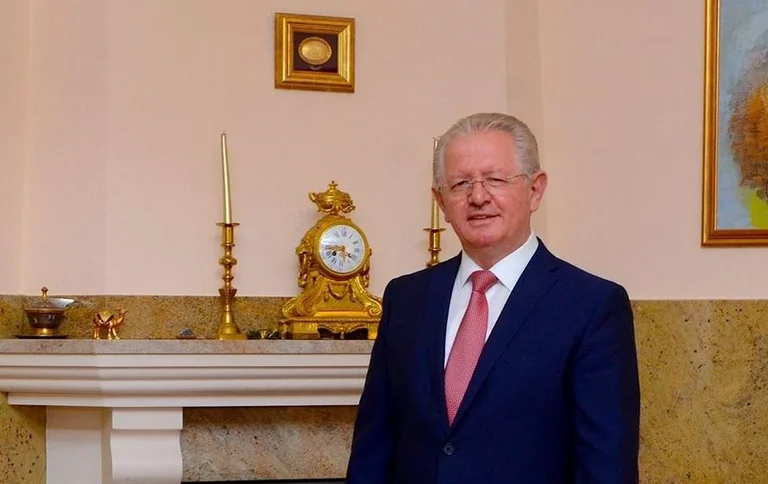
Periskopi(3 years ago)
(3 years ago)Kosovo's former chief negotiator in dialogue with Serbia, Skender Hyseni, has commemorated when Kosovo's independence from the International Court of Justice was confirmed 13 years ago, writes Periscope. The court was also clear regarding UN Resolution 1244: “The declaration of independence has not violated Security Council Resolution 1244)” [...]
Kosovo's former chief negotiator in dialogue with Serbia, Skender Hyseni, has commemorated when Kosovo's independence from the International Court of Justice was confirmed 13 years ago, writes Periscope.
The court was also clear about UN Resolution 1244: “The declaration of independence has not violated Security Council Resolution 1244)” KS Resolution 1244 of KS “was essentially designed to create a temporary regime for Kosovo ... The resolution has not contained any provisions dealing with Kosovo's final status.” Therefore, Kosovo's existence as a sovereign state cannot violate UN UN Resolution 1244”, Hyseni wrote among other things.
Full post of Skender Hysen:
Dear citizens,
Today is the anniversary of the Republic of Kosovo's largest diplomatic victory. Today, July 22nd, 2023, was 13 years from the confirmation of Kosovo's independence by the International Court of Justice, the day when the belief we had preserved in international justice was reconfirmed, as well as deep confidence in the force and substance of our argument in both phases of the process.
The International Court of Justice, on July 22, 2010, with a convincing vote of 10 to 4, came to the conclusion “that the Kosovo independence declaration adopted on February 17th 2008 has not violated international law”. This opinion of the Court was confirmation and affirmation of Kosovo's position and legal arguments throughout the entire advisory process. So the thought leaves no doubt that Kosovo's Declaration of Independence was and is legitimate and in harmony with international law.
The court was also clear in terms of UN Resolution 1244: “The declaration of independence has not violated Security Council Resolution 12441999)” is said to provide direct reasoning: KS Resolution 1244 of KS “was essentially designed to create a temporary regime for Kosovo ... The resolution has not contained any provisions dealing with Kosovo's final status.” Therefore, Kosovo's existence as a sovereign state cannot violate UN UN Resolution 1244.
I am proud to have co-ordinated the whole process, and I have represented the Republic of Kosovo near the JND. So I'm going to stop at this anniversary a little bit longer in the circumstances that I hosted this historic event.
Just months after the declaration of independence, on October 8, 2008, the UN General Assembly at its 63rd session approved Resolution 63/3. Request for an authority of the International Court of Justice on when the universal declaration of independence of Kosovo is in agreement with international Law (Chush for an advisory opinion of the International Court of Justice (GJND) about “Accountability with the International Law of Kosovo's Declaration of Independence)
So, after less than eight months of declaring independence, Kosovo faced perhaps the biggest diplomatic and legal challenge by then.
The Serbian draft resolution was presented by Foreign Minister Seb Vuk Jeremic. It was approved by 77 votes Per, 6 counters and 74 Abstenimes. Of the states that had already recognised Kosovo, only the United States and Albania, as well as four small states from the Pacific, were declared against the resolution. The approval of Resolution 63/3 in October 2008 at the UN -- that is, just a few months after I took over the post of the first foreign minister of the Republic of Kosovo -- had put me on a challenge, following many then, unaffordable. I was at the UN on the day of the resolution's approval, and although my disappointment was great, I decided to take it back with optimism and confidence. It was important that we somehow explode. I was at the centre of accredited media interest in the UN. The media's great interest, from the beginning, approached with positiveness. My first statement after the approval of the Serbian resolution was cut and decided, “I have full confidence in international justice and the International Court of Justice as the UN's main judicial body. At the same time, I firmly believe in the fact that we will present to the Court as soon as the process began, I stressed with full confidence as I was addressing numerous journalists in the lobby of the UN building in New York.
Two days later I returned to Pristina. Time was too short. Immediately, preparations had to begin for the process in the JND. I requested a meeting with President Fatmir Sejdiu. I suggested that Prime Minister Thaci invite him to the meeting. A co-ordinator, who would co-ordinate and organise defence, should urgently be appointed, as well as represent Kosovo before the International Court of Justice.
We talked to the president and the Prime Minister for a long time. We also mentioned possible names that included professional preparation. It happened that I really didn't expect. President Sejdiu and Prime Minister Thaci tasked me with tasking the co-ordinator and representative of Kosovo in the JND process.
For truth's sake, I have to say that in Kosovo those strange days dominated the conviction that the race in the JND was the lost ruler.
There were very few people, whether in institutions or in the judicial community or in civil society, who believed that Kosovo would win the JND. As a result, there wasn't much interest in getting the hot path in hand.” So there was more of a curiosity about who's being handed over to the hot axe.” Even government ministers, without any tact or responsibility for the public word, declared those days that in the best version of decision I JND will be “as meat or fish!!!! ..”
By investigating all of this, I was deeply disappointed with the denial that was emerging in the power of the argument of a state and the people who were fighting for themselves, for their existence, for their freedom and for their existence.
Despite the distrust that everywhere appeared as well as the sceptre if Kosovo won, I accepted the duty and obligation to represent the country in the JND. But knowing that there were few people trusting in Kosovo's success, which therefore meant that I did not have many allies in Kosovo, because without faith you cannot pursue any cause, the president and prime minister asked them to leave my hands free throughout the process, as well as the team's selection and collaborators. It was the greatest responsibility I had ever received in my life. I had the firm belief that with the work we would do as well as with close co-ordination with states which had already declared readiness to participate in the process in favour of Kosovo, we would come out victorious. This belief was only reinforced during the stages of the table. For the sake of correctness it should be said that Sejdiu and Thaci have offered me all the necessary space and conditions needed for work.
Without delay, I had sent letter to the Court on October 15, 2010, at the request that and Kosovo be allowed to participate in the process. Not being a member of the UN, Kosovo could not get part because the JND was a UN legal body, but representation and participation were possible as a representative of “Entity of the Declaration of Single Independence”
The election response was positive. Kosovo was allowed participation in all phases of the process. The victory in the JND also became possible thanks to the unaided support of many states that participated in the defence of Kosovo, US, Great Britain, Germany, France, Austria, Albania, Finland, Sweden, Norway, Denmark, Holland, Croatia, Bulgaria, the Hashemite Kingdom of Jordan, Saudi Arabia, Bahrain. With teams from all these countries we were in constant communication and co-ordination.
We had engaged a peak team of international experts at the helm with Sir Michael Wood, with whom we started preparing statements, respectively, the written parachutes that were to be sent to the tribunal. After a year, on December 1, 2009, the Court called the hearing of oral hearings. To this day, I consider my speech before the court an event with the weight of responsibility in my political life.
I won't stop any longer on what had happened in the meantime because it's largely known. I just want to underline that the Court took eight months from the legal hearings before it went out on the journey, the final councillor's opinion on July 22, 2010. The decision, the advisory thought stated in an extensively “that Kosovo's declaration of independence adopted on February 17th 2008 has not violated international law”
On July 21st, I traveled with my associates to The Hague to share in announcing the decision.
Of course, it is quite understandable that, despite the great confidence that I had that victory is certain, I had decided to resign irrevocable from all the public and political posts I held in case the Court's decision was disparable for Kosovo. In any case, I already carried a signed letter of resignation in my pocket, which I would publicize in case we went missing. Nobody but one of my best associates knew I had decided to resign in case of defeat.
The next day, July 22, 2010, accompanied by our ambassador to the Kingdom of the Netherlands, Nexmi Rexhepi, along with the delegation that was also with Sir Michael Wood, set off toward the court headquarters.
At 10: 00 p.m., that's the long-awaited moment. JND Chairman Hisashi Oweada announced that the International Court of Justice, with a convincing vote of ten to four, had ascertained: “that the Kosovo independence declaration adopted on February 17th 2008 has not violated international law”.
This JND session was broadcast live in Kosovo. Except facilitated for my country's monstrous victory, the joy that Kosovo citizens experienced, waiting nervously near TV screens to announce the decision, only made me cry out of emotion.
Skender Hyseni