7 minutes ago
All you need to know about the Ukrainian ruined dam
Periskopi(3 years ago)
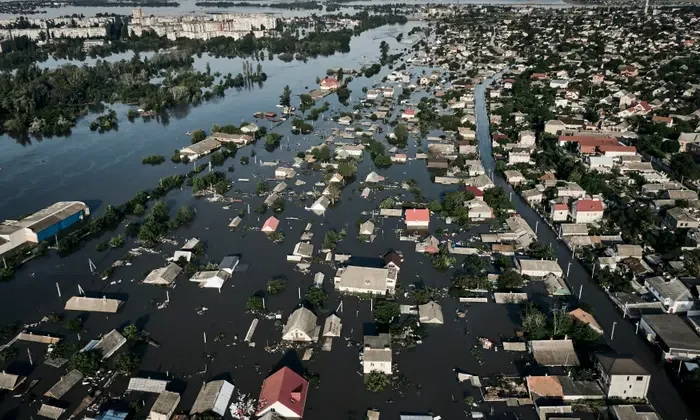
(3 years ago)The Nova Kahovka Dam, Soviet-era hydroelectric plant in the Dnjeper River in southern Ukraine, has been destroyed at midnight on June 6th. As a result of damage, water has flooded villages and towns and resulted in the evacuation of thousands. Ukraine has blamed Russia for this attack, which has controlled the area around [...]
As a result of damage, water has flooded villages and towns and resulted in the evacuation of thousands.
Ukraine has blamed Russia for the attack, which has controlled the area around the dam from the start of the war in February 2022.
The Russian side, on the other hand, has accused Ukraine of destroying the dam, with the aim of drawing attention from the lack of success on the battlefield, as it has said.
Neither side has offered evidence of claims made.
This incident is reported about six months after Ukraine has restored parts of the Herson region west of the Dneper River, including the city of Herson.
Also, these days, there are many rumours that the major Ukrainian counteroffensiva against Russian forces is expected to start and change the face of war.
One thing is certain: floods can turn into the biggest environmental disaster since Russia started the war in Ukraine about 16 months ago.
What happened to the dam?
It's not exactly known.
Built in 1954 to produce electricity for the south of Ukraine, the 3-kilometer dam, known as Nova Kahovka, or simply Kahovka, is one of six hydro plants on the Dnjeper River, which extends to 980 miles [980 km] from Belarus in the north, to the Black Sea in the south.
The dam has been controlled by Russian forces since the war began last year.
It has also been damaged in advance, originally in late October or early November.
Then, about November 11th, an explosion believed to have been caused by Russian troops has destroyed the road to the dam structure.
After these injuries, some observers have warned that there is a chance that the dam will fall itself.
By withdrawing from the west coast, Russian forces have come to the opposite side of the coast, built fortifications, and spread land mines to prevent Ukrainians from crossing that section.
They have also used the West Coast to block the city of Herson and the surrounding regions, terrorising that area after news of the release of Herson from Ukrainian forces in November.
About 3: 00 a.m., on June 6, Ukrainian officials have said that part of the dam has collapsed and then floods have begun.
The national power plant company has said the bridge has been destroyed by an explosion in the engineering part.
“The station can't recover”, she said.
Ukrainian officials have blamed Russia.
Russian terrorists”, Ukrainian President Voldymyr Zelensky said in a post on social networks.
The destruction of the Kahovka hydropower plant just confirms to the whole world that they must be expelled from every corner of Ukrainian soil”.
The intelligence unit in the Ukrainian Army has warned last October that Russian forces have placed mines in some parts of the dam.
Officials installed by Moscow in the region of Herson, still occupied by Russian forces, have accused Kiev of attacking the missile dam.
Other Russian officials in the region, however, have suspected the dam has collapsed itself due to preliminary damage.
Kremlin spokesman Dmitry Peskov has accused Ukraine of “szab runoff” and has warned of “very serious consequences” for residents.
He has said Ukraine has destroyed the dam to draw attention from the lack of success on the battlefield.
What's the rush situation?
Bad. Ukrainian emergency officials have begun to evacuate thousands of people from the area near the western bank of the river after water levels have increased.
A number of recordings made by Ukrainian Radio Europe Free Radio Service and other social networking recordings are seen in numerous water - filled villages.
The city of Nova Kahovka, which had some 70,000 inhabitants before the war, has been partially flooded by water, especially the neighborhoods near the river.
City officials have said they fear that all the animals in the zoo may be dead.
About 70 miles [70 km] away is the town of Herson ʹ the administrative centre of that region, which on the afternoon of June 6th, about 12 hours after the dam was destroyed, has reported on rising water levels in some parts.
The floods have also taken away the remains of the Antonovski Bridge, which has become impassable as a result of the ongoing bombing of Ukrainian and Russian forces.
“Evacuations have started. I ask you to do whatever you can to save lives. Leave the danger zones immediately, said Oleksandr Procudin, leader of the military administration of the Herson region.
In October of last year, the Swedish hydropower company Damningsverket has committed itself to proposing a model of what could happen if the Kahovka dam was destroyed.
It has found that in some parts, water can not only reach the river's mouth but that it can direct the water to the Pivden Bah River in Mikolaiv, an important Ukrainian river port.
“Model, based on the worst possible scenario”, is said in the Swedish company's document, under which “intervals 4-5m long could hit Uren Antonovski, east of Herson about 19 hours later, later there could be floods on the Inhulets River, and after four or five days, there could be floods on the Pjudeny Buch River in Mikolaiv”.
In Micolaev, an emergency train was launched at noon on June 6th to the southeast to help evacuate people who were ready to leave Harrison.
After dam destruction reports, the company's chief, Damningsverket, Henrik Oelander-Hjamlersson, has said that water levels in the reservoir are at the highest levels in the last 30 years, as it is possible that the flood gates have not been opened due to continued conflict.
It's a massive disaster, and I'm deeply upset that the Russians have done it”, said the chairman of Herson, Oleksandr Seenkevych.
It can get worse.
The dam - based reservoir extends over the river, about 60 miles [100 km] north, and then expands to the Kahovka Reserve.
The reserve is the only source of water for the nuclear power plant in Zaporigja the largest in Europe located in the vicinity.
Even the plant, such as the dam, has been under Russian control since March 2022.
Ukrainian engineers and operators have been working under orders from Russian officials since then.
The reactors' work at the plant has been halted and they do not produce electricity from September, as in that period, there have been concerns that fierce fighting by Ukrainian and Russian forces could lead to disaster.
However, dam damage endangers the plant because of lowering water levels and can damage areas that cool the core of radioactive fuel.
Water can reforest, use several times, but if the levels drop high, the water temperature at the plant may increase.
If water reaches the boiling point, the core can melt or explode.
On the afternoon of June 6th, officials in the town of Nikopol, located north of the nuclear plant, have said that water levels have already dropped by 1.5m.
Enerhoatom, the Ukrainian state company, which monitors the Zaporizja nuclear power plant, has said on the afternoon of June 6th that water levels are not jeopardising work.
Even if there is no water in the Kahovka Reserve, the plant has refuel capacity, using underground water”, chief Petro Kotin has said.
The International Atomic Energy Agency has said it is closely monitoring the situation at the plant.
There's no nuclear safety risk at power “, she said through a Twitter post.
The biggest dilemma will exist in summer and autumn, when river levels, in general, will fall, and Ukrainian officials will have to compensate for the amount of release of more water from the top reservoir.
What does this situation mean for crime?
The decline in water levels on the top of the river in the absence of dams can also endanger Crime.
The Ukrainian Crimea Peninsula, which has been under Russia's control since March 2014, is a hot spot and has limited water resources.
Thus, Soviet authorities have built a 402 - mile - long [402 km] channel in the 1960 ' s, which stretches from the city of Tasvisk to agricultural areas.
Because of hot weather and a lack of rain, the North Crime Canal is of great importance.
Following the annexation of this peninsula from Russia, Ukrainian officials have put a dam in the canal, which has resulted in water shortages in the region.
After the start of the war in 2022, Russian troops have mastered the channel and removed the stumbling block, restoring supplies.
In a statement issued on the morning of June 6, the governor of the Crimea, appointed by Russia, Sergei Aksyonov, has said that the region has adequate reserves in reservoirs about 80 percent but has warned that water levels could decline, especially if the region enters the hot summer season.
As for agricultural regions that are under Russia's control, some parts of the regions in Zaporija and Herson ] lack of sufficient water could also be catastrophic.
Who benefits?
The destruction that has already begun at the lower end of the dam could mainly hit Ukrainian-controlled regions in the western part of Dnjepri, although even some regions in the east, including the town of Nova Kahovka, have also been affected.
This, plus the fact that the dam has been under Russian control for more than a year, has influenced many observers to point their finger at Russian authorities.
The discussions on Ukrainian counteroffensives, which are expected to begin at some locations over 1,000 miles [1,000 km], are also added.
It departs from the dnjepri's glut at the border with Russia, as far as northeast of Harkiv City.
In recent months it has been reported that Ukrainian commandos and some sabotage units are in several locations controlled by Russians in Dnjeper.
The floods of the regions can cause them the most problematic transition and offer Russian forces a new protective layer.
Floods and evacuations will also attract attention but also the resources of the Ukrainian authorities, who in another reality could be supporting the counteroffensive.
“They thought that this way, in this way, they could stop the Ukrainian forces' counteroffensive”, said Natalia Humenyuk, spokesperson for the command of the Ukrainian Army in the southern part.
There is a precedent here.
In 1941, as Nazi troops in Germany have attempted to enter Ukraine that Soviet world, Joseph Stalin, has ordered the dam's destruction in Zaporizha city to prevent Nazi advancement.
Such a decision has resulted in the influx of villages on the coast of Dnjepri, leaving thousands dead.
In general, dam destruction will have a long-term impact on how Ukraine will retain and distribute water, not only for energy production, but also for agricultural needs, said Mykhailo Yatsyuk, director of the Institute for Water Problems that operates under the Academy of Agriculture Sciences.
It is necessary to understand that two-thirds of the Ukrainian economy is linked to the helmets of the dnjepri” reservoirs, he told Ukrainian Radio Free Europe.