2 minutes ago
How Turkey's President Erdogan Has Keeped Close Control of Power in Country
Periskopi(3 years ago)
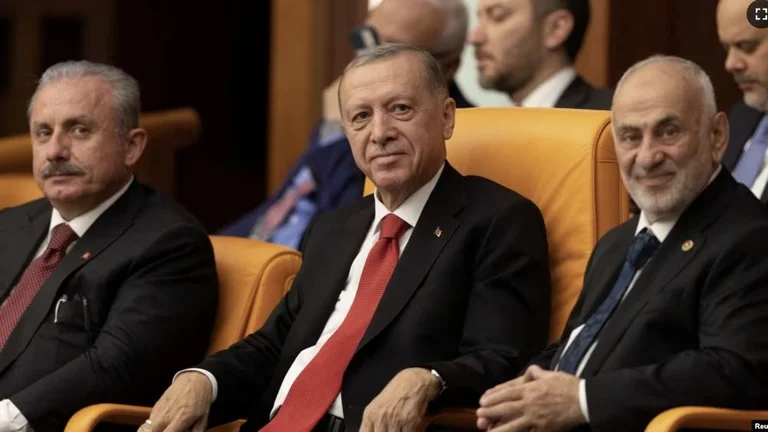
(3 years ago)Turkish President Recep Tayyip Erdogan, an increasingly authoritarian populist, will take the oath and begin his third presidential mandate Saturday. He won the run-off election, which took place 28 May. Recep Tayyip Erdogan, who has led Turkey as prime minister or president for 20 years, [...]
Turkish President Recep Tayyip Erdogan, an increasingly authoritarian populist, will take the oath and begin his third presidential mandate Saturday. He won the run-off election, which took place 28 May.
Recep Tayyip Erdogan, who has led Turkey as prime minister or president for 20 years, won despite the ongoing economic crisis in the country and criticism of his government's poor response to a February earthquake that killed more than 50,000 people.
Known as “reis” or “chief officer” among his supporters, Mr Erdogan 69-year-old is now the longest-lived leader in the history of the Turkish republic. His re-election for a five-year term that lasts until 2028 extends its rule in a third decade, and he may perhaps serve longer with the help of a friendly parliament.
Here is a look at Erdogan's career and some of the reasons for his political life expectancy.
DO NOT IT IS ECONOMIA
Many experts agree that Turkey's serious economic problems result from Erdogan's non-traditional fiscal policies mostly, lowering interest rates against rampant inflation, despite economists' warnings. However, the majority of voters -- he received 52% of the run-off votes -- they did not appear to be influenced by that fact. Inflation in Turkey reached 85% in October before dropping to 44% in April
Erdogan's stability amid a cost-of-life crisis may have resulted from many people who prefer stability rather than change as they try to pay high prices for the required rent and goods.
The president has demonstrated a ability to strengthen the economy in the past. And he has never avoided spending and placing government resources in his political advantage.
Over the past two decades, his government has spent a lot of funds on infrastructure to satisfy voters. In the period ahead of last month's parliamentary and presidential elections, he increased wages and pensions to ease the impact of inflation and approved government subsidies for electricity and gas.
One point of pride for many voters is Turkey's growing military-industrial sector. Throughout the campaign, Mr. Erdogan often cited domestic production fears, planes and a warship known as the world's first “drone transporter”.
WRITER IN THE WORLD CENTURY
Erdogan has attracted many Turks to his side by the way he operates on the world stage. Supporters see in him a path that has shown Turkey may be a major player in geopoliticals, while demonstrating an independent role as it engages with the East and West.
Turkey is a key member NATO because of its strategic location at the crossroads of Europe and Asia, and it controls the alliance's second largest army. During Erdogan's mandate, the country has proved to be a necessary ally and, at times, a painful NATO ally.
The Turkish government has prevented Sweden's entry into NATO and purchased Russian missile defence systems, prompting the United States to pull Turkey away from a US-led fighter aircraft project. However, together with the United Nations, Turkey brokered a vital wartime agreement that allowed Ukraine to resume sending grain through the Black Sea to other parts of the world struggling with hunger.
Recep Tayyip Erdogan has welcomed his re-election, which came as the country prepares to mark the republic's centennial as the start of “The century of Turkey”
KT HIM WRITER IN THE RELIGION I SLAME
Erdogan has cultivated deep loyalty to conservative and religious supporters by establishing Islamic values in a country that has been led by secularism for nearly a century.
It has restrained the force of the military, which was often involved in civil policy whenever the country began to deviate from secularism. He lifted rules that forbade conservative women to wear headscarves in schools and government offices.
He also turned Istanbul's historic object, Haxxji Sophia into a mosque, fulfilling a long-standing request of Turkish Islamists. The Byzantine - era cathedral first turned into a mosque after the conquest of Constantinople, but it had served as a museum for decades.
Recently, he has criticised the rights of the LGBTQ+ community, suggesting they pose a threat to the traditional, conservative notion of what constitutes a family.
CONT ROLL HUNT MEDIA
During his decades in power, Erdogan consolidated control over the media.
Most Turkish news media are now owned by conglomerates loyal to him. He has used his position to silence criticism and despise opposition.
International election monitors noted that the first round of presidential elections on May 14th and the May 28th runoff were free, but not fair.
While voters in the second round had a choice among real political options, the one-sided media coverage and lack of equal conditions gave an innocent advantage to the current president,” said Farah Karim, co-ordinator for the Organisation for Security and Co-operation in Europe.
Erdogan's opponent in the election run-off, opposition leader Kemal Kilicdaroglu, had promised to undo the president's economic policies and turn Turkey into a democratic path by ending the shocks to free speech. / VOA