8 minutes ago
REL: In the EU, reconciliation has main responsibility for boosting crisis in the north
Periskopi(3 years ago)
(3 years ago)The European Union's heads of state and government at the summit in Brussels on Friday called for the immediate extension of the situation in Kosovo and warned “the negative” consequences if nothing is done. In conclusions adopted at the end of the two-day summit in Brussels, a version whose Radio Europe and [...]
The European Union's heads of state and government at the summit in Brussels on Friday called for the immediate extension of the situation in Kosovo and warned “the negative” consequences if nothing is done.
In the conclusions adopted at the end of the two-day summit in Brussels, a version whose Radio Free Europe had previously seen, leaders reiterated “their full and clear dedication to the Western Balkan countries' perspective of EU membership”.
Further, “support for accelerating the accession process based on merit and relevant reforms” was revised.
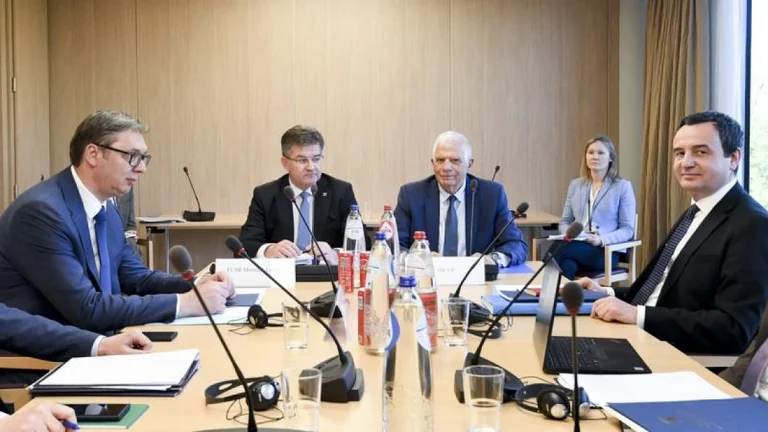
A special paragraph of the conclusions is dedicated to tensions between Kosovo and Serbia, and in the summit the report was handed over to EU leaders by European diplomacy chief Josep Borrell.
The European Council condemns recent violent incidents in northern Kosovo and calls for an immediate extension of the situation, given the key elements the European Union has already highlighted on June 3rd, 2023. The parties must create conditions for early elections in all four municipalities in northern Kosovo. Failure to stress tensions will have negative”, leaders stressed in the approved conclusions.
They stressed that it is essential to continue dialogue with EU mediation and quick implementation of the Agreement on the road to normalisation and its Annex.
In its conclusions, it adds that the formation of the Association of Serb majority municipalities in Kosovo is involved.
Although the conclusions were timed and did not conflict with their content, the adoption was uncertain until the last moment, because it was a package of conclusions with all topics in order during the two days of the summit.
From EU sources it is taught that during the debate over Kosovo and Serbia, some leaders of member states have demanded that the bloc's institutions have balanced access to Pristina and Belgrade, because, as sources said, public discours as well as punitive measures have created the impression that only Kosovo is being sanctioned.
These sources said that “more or less there is reconciliation that the Kosovo authorities have the main responsibility for promoting incidents, and it is clear that the Serb side has responsibility for violence and tensions as well. Slovenia's prime minister, Robert Golob, as well as Croatia's Andrej Pllenkovic has spoken about it publicly, but within the closed meeting, leaders of other states have also spoken of it.
A dynamic discussion for Kosovo
As Radio Free Europe earlier announced, EU leaders had a “dynamic discussion of tensions between Kosovo and Serbia on the first day of the summit in Brussels, 29 June.
On the first day, leaders addressed the situation in northern Kosovo and tensions caused on two occasions: at the start of the summit, when the secretary general attended the meeting NATO, Jens Stoltenberg, and later in the day, at the EU heads of state and government's meeting.
The main message during the entire discussion was that quick action must be taken to defuse the situation, and that should be done by both sides”, an EU official said, speaking to reporters Friday, 30 June.
EU High Representative for Foreign Policy and Security Borell wrote on Twitter:
“Dje reconfirmed our firm support for Ukraine and our readiness to ensure future security engagement. Today, an important discussion about China and economic security. I will report to leaders about recent developments in northern Kosovo”.
On Thursday and Friday evening, a fierce debate on migration and Hungary and Poland on the part of the findings took place, and blocked the adoption of paragraph related to EU migration management.