6 minutes ago
Former EU official for the north: This situation is staining Kosovo's image
Periskopi(3 years ago)
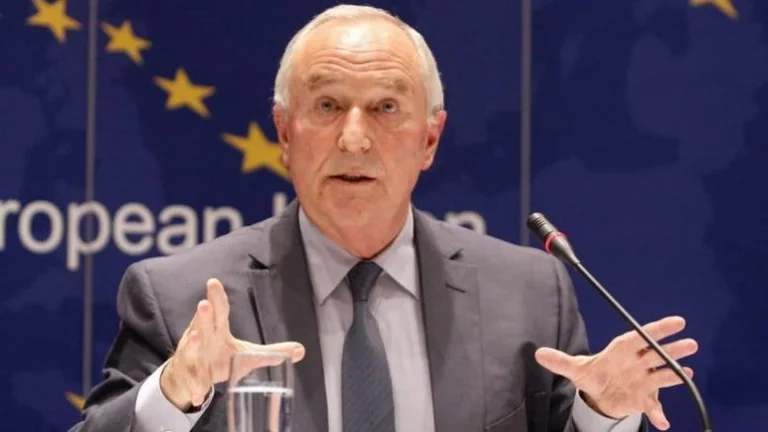
(3 years ago)Former director for the Western Balkans at the European Commission Pierre Mirel, in an interview with the Voice of America, said Kosovo must act quickly in line with international partners' demands about the situation in the north, on the contrary risks seriously damaging its European future. He said the escalation of the situation in the north [...]
Voice of America: As you have seen tensions between Kosovo and Serbia increased this time because of developments in northern Kosovo municipalities. How do you see this situation, Mr. Mirel?
Pierre Mirel: Recent tensions are seen as a direct result of the recent elections in the north. Legal elections? Yeah, but not legitimate. How can four young Albanian mayors lead municipalities in the north, where the population is about 90 percent Serb? This is the real problem because they were selected by 2.5 or 3.5 percent voter turnout, so it was impossible, it wasn't a good decision. But what worries me most and even grieves me is that you know that we have been praised as good friends of Kosovo since declaring independence and others, and it makes me sad to see this situation tarnishing Kosovo's international image, while Kosovo still needs great international support, Kosovo needs five non-recognising countries to recognise its independence. This situation is damaging to me, and it makes me very sad.
Voice of America: What is the best way out of this situation?
Pierre Mirel: I think the only way out is compromise, as usual. I know that the word "compromiss" has negative connotations in the Balkans, while in the European Union it is the basis for European construction now 70 years. But in the Balkans, if we compromise, it means we've lost, but not compromise if done properly represents a two-party situation. So I think there is no other way but to act as the United States and the European Union have asked, to withdraw special police units and organise new elections I think in early September.
Voice of America: Mr. Mirel, the international community has expressed its concerns and criticism of the Kurti government over the lack of co-operation and co-ordination in the north. Do you think this could seriously damage Kosovo's European future?
Pierre Mirel: If a solution is found soon, then, if what has been asked by the United States and the European Union is implemented by Prime Minister Kurti, I think this situation will not be forgotten, but the process will continue to develop easily again. But if it continues this way, without quick decisions or repeated similar situation in the weeks and months under way with such unilateral decisions, without any counsel or co-operation, it would certainly be greatly damaging Kosovo's European future, that is certain.
Voice of America: Is the European Union likely to impose any sanctions or punishment measures for Kosovo for lack of co-operation?
Pierre Mirel: The European Union does not prefer imposing sanctions on the estimated countries to be friendly, with which there is good co-operation, dialogue and others. But if he decided to go to extremes, it would happen if the current situation continued and the government would not accept advice or proposals that have been tabled by the United States and the European Union.
Voice of America: In Kosovo, connoisseurs of developments say Pristina is becoming more pressure on the situation in the north, while viewing Belgrade as the main source of destabilisation in the Balkans and specifically in Kosovo. Do you agree with that view?
Pierre Mirel: Belgrade has never been easy to accept compromises, that is very clear. But there is an issue, in 2013, there was an agreement in Brussels under which Kosovo was to establish the Association of Serb majority municipalities -- ten years ago, while the pledge was renewed in 2015 and again recently in the Ohrid Agreement. Under these conditions, how can northern Kosovo Serbs trust the Pristina dialogue, but also the European Union if for ten years they are told they will have their association and nothing has happened yet? This is unfair and means to give arguments to those who say this dialogue doesn't work, or Pristina doesn't want to work. For me this is the main issue because it also gives Serbian President Vucic arguments, as well as Moscow, so the issue becomes even more serious. In this period of time in the context of the war going on in Ukraine, we must not give Moscow arguments to say, "Look at independence and see the riots in the north against NATO-strong Serbs." This is very, very bad and very, very harmful for all relations in the region.
Voice of America: So in your view, Kosovo should move quickly to the establishment of the Serb majority municipalities' association?
Pierre Mirel: I think yes, there have been ten years waiting for him, that is very important for me in addition to calls for withdrawal of special police units and new elections. In the coming weeks and months, priority must be the establishment of this Serb majority municipality association, which has been expected so long.
Voice of America: Mr. Mirel, this association is a hot topic in Kosovo talks Serbia. Pristina sees it as a threat to a new Serbian republic like the one in Bosnia and Herzegovina, while the United States was recently assessed as opportunities to reduce Belgrade's influence in northern Kosovo. How do you appreciate it?
Pierre Mirel: Those who say that either do not know the institutional adjustment in Bosnia and Herzegovina or want to make people confused. The Dayton Constitution does not specify the competencies of the two entities, Republika Srpska, on one side and the Croat-Bosnian Federation on the other. It lists only two state-level competencies, international relations including trade and defence, nothing else. So over 20 years in Bosnia there is a conflict between those who want to restore a unitary state primarily Bosniaks, and those like Serbs and Croats seeking decentralisation. But this has never been arranged because of the Constitution. But in Kosovo the situation is quite different. Kosovo has a clear Constitution coming out of (Martti) Ahtisaari's plan, with clearly defined competencies, and within that constitution the Association would be established, which would give some competencies to Serb majority municipalities, so it is quite different. And then the issues of what competencies and what kind of authority does the Association have are issues that are handled within negotiations more precisely, that's the idea.
Voice of America: If we return once again to the way out of the situation in these municipalities, the international community is demanding new elections as soon as Prime Minister Kurti recently declared that elections could be held following the establishment of rule of law in the area HINA, meaning bringing the responsible for violence to justice during the protests. What do you estimate has more weight in the context of the current situation?
Pierre Mirel: Whenever I hear people say that in the Western Balkans whether Kosovo, Serbia or any state, there will be no progress until there is full rule of law, I have the feeling that there is never going to be any progress. This is because rule of law is not fully established in any country. There are progress and others, but it shouldn't be a prerequisite because otherwise you and I will discuss these problems again next year and a year after that. It is urgent to create conditions for new elections in early September for people to be voted and elected. Of course, Serbs should participate in the election process, not boycott it. So we would have mayors who would not only be legally elected but also have legitimacy, so they would be able to run these municipalities and restore a peaceful situation, this is an emergency.
Voice of America: Mr. Mirel, Kosovo and Serbia agreed to an agreement this year in Brussels then Ohrid on normalising relations. Despite this tensions remain high, and it seems that this agreement is not fulfilling its goal. How do you explain this?
Pierre Mirel: I see several reasons: the first is what we discussed earlier, so the fact that association has been promised for ten years and has not been implemented on the grounds that it would be contrary to the Constitution of Kosovo and others. That, of course, is the main reason because trust in authorities who once accepted it broke, confirmed in 2015, reconfirmed in Ohrid. So it's the aspect of essential trust in the region. The second reason is that there was progress until 2015 on various issues, then confusion arose with the launching of the idea of exchange of territories. People said let's forget about the dialogue, we'll exchange territories and end up, so this idea created confusion and took a long time to abandon it, practically by now American President Trump did not win elections. Restitution in some form of trust has taken a long time and therefore the resumption of dialogue. I see yet another reason -- in Ohrid, for example, when there was compliance with the agreement implementation plan -- the pen had not dried up yet when statements with very bad language began. When I say bad, it's a soft word because it was almost the language of hate coming from a president. So how can the people understand? You agreed to something and in two days you say it will never be implemented because of President Vucic or who knows who. How do people understand that? How Can Trust Be Restored? That's a fundamental reason for me and maybe false reasoning. I've always said that when I was first part of the dialogue in 2011, that dialogue is a good thing and it has to happen, but it has to be associated with a parallel dialogue with civil society organisations. In my view this dialogue is much like in the bubble, civil society on both sides should be more involved and more interested. Two three years ago there were two groups of women from Kosovo and Serbia that started a dialogue, ten years ago, was the start of dialogue between the chambers of commerce and industry. Such things have not gone on for some reason, I believe, but it's pathetic and it has to come back because people have to meet, discuss and exchange except for the leading parties that agree on something.