 17 minutes ago
Escobar: No meeting this week is expected to happen Kurti Vuciq
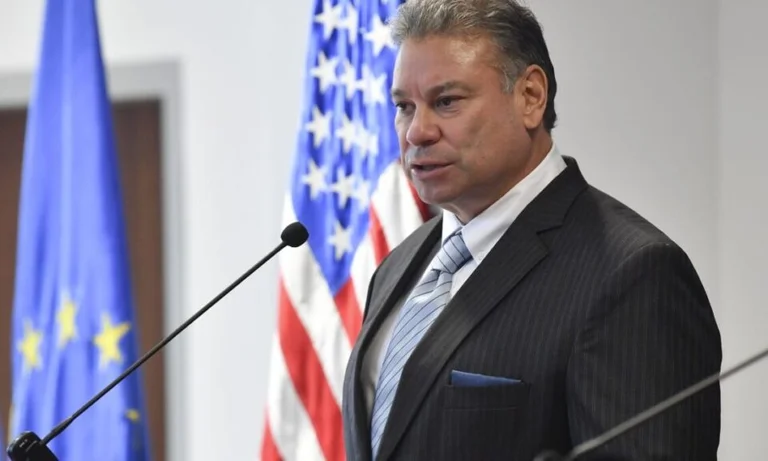
Periskopi(3 years ago)
(3 years ago)US envoy for the Western Balkans Gabriel Escobar says the meeting called by the European envoy for Kosovo talks, Miroslav Lajcak, between Prime Minister Albin Kurti and President Aleksandar Vuciq, aimed at reducing tensions between the two countries, is not expected to happen this week. In an interview for Voice of America, Escobar opposes proposal [...]
In an interview for the Voice of America, Escobar rejects Kurti's proposal, which for the Association of Serb Majority municipalities, the parties will agree in advance on its overall lines before Pristina submits a concrete project.
The situation in Kosovo is ranging from escalation to escalation. How will it be done next?
Escobar: We need to work on a stress reduction plan right away. The European Union has already presented a three-point plan for the mayors to leave the building, KFOR to take over the security of buildings, protesters to leave, people that attacked police and journalists to be held accountable, and new elections called as soon as possible, with Serb participation without any preconditions and immediate return to the dialogue.
Did you have answers from Mr. Kurti's government for him?
Escobar: It's too early to say. We still hope for a meeting in Brussels of the two leaders in the near future.
Kurt said he'd be in the meeting.
Escobar: It's too early to decide if the meeting will take place this week. I'm under the impression it won't happen, but we have to keep hoping for a summit as soon as possible.
Kurti said at a news conference that he is willing to present a project for the Association of Serbian municipalities by but, he said the two sides are far apart in terms of shape, which this association will take in the future and that there is no point in talking now. And he's suggesting that the two sides initially agree on the main principles of association and then he can submit the proposal. What's your answer?
Escobar: He doesn't have to wait for that. I shouldn't wait for that. Our attitude is that it must be a European model. So our attitude, the American stance, has always been that the model of Association should be one to provide municipal services for a national minority of Serbian language. So much municipal service. It should not interfere with the Kosovo Constitution, its legal structure, or its functionality. The European Union's special representative has given them 16 different types of European models, which would function for Kosovo. In none of those models can, for a neighbouring country to enter within the borders of another country and prevent its functionality. So we're not looking for a mathematical tool between two attitudes. We seek a European version. So he doesn't need anything more than that.
Over the past few months, there have been high tensions between Kosovo and Serbia. This coincided with changing Washington's policy, putting more pressure on Pristina. How do you judge this?
Escobar: I think this is a misinformation. Let me introduce it this way: Everything we've done over the past 90 days has been for the good of Kosovo, everything. So we supported the Council of Europe. We saw the need for new choices. We supported them. We supported them even though Serbia was against them. We recognise the election outcome, although there were only 3% turnout. Serbia wanted us to declare it illegal. Serbia wanted us not to recognise the leadership authority. We knew them. When the heads were inaugurated, for us they were heads. We now find ourselves in a difficult position when these heads cannot claim to represent the communities where they are heads. That's why we need new choices. But in the same way, we acknowledged that these mayors have legal authority to continue municipal functions. We had demanded, however, that Kosovo not try to take control of municipal buildings by force. I've been part of the U.S. Federal government since I was 19. I've seen the American government abandon buildings because of fires and floods and the end of my COVID and even because of protests, but no one ever questioned the legitimacy of the American government. The only thing we asked from the Kosovo government is not to raise tensions, trying to go there by force. Yet, they did. So on the one hand, everything we've done has recognised Kosovo's legitimacy. We have always taken sides in all these disputes.
In Kosovo, it would mean that even Vucci has done nothing to reduce tensions, but not without such intense pressure.
Escobar: That's not true. So, like I said, he rejected everything we did over the past 90 days. And yet we moved on. We have also urged Serbia to remove forces from the border unilaterally, unconditionally; to encourage Serbs to return unconditionally. And he's agreed on both of these. So it is not clear what we need other than to progress with dialogue.
And if Mr. Kurt can't hear you? What's gonna happen?
Escobar: This is not a U.S. case, Kurti. Here is the entire transatlantic community that is telling the Kosovo government that we want to co-operate with the government, but we cannot respect unilateral decisions that create tension in an unnecessary, avoidable and predictable manner. That's all we're looking for. / VoA/












