7 minutes ago
Next Sanction: US won't accept Kosovo visits, nor Kurti, does Havenier
Periskopi(3 years ago)
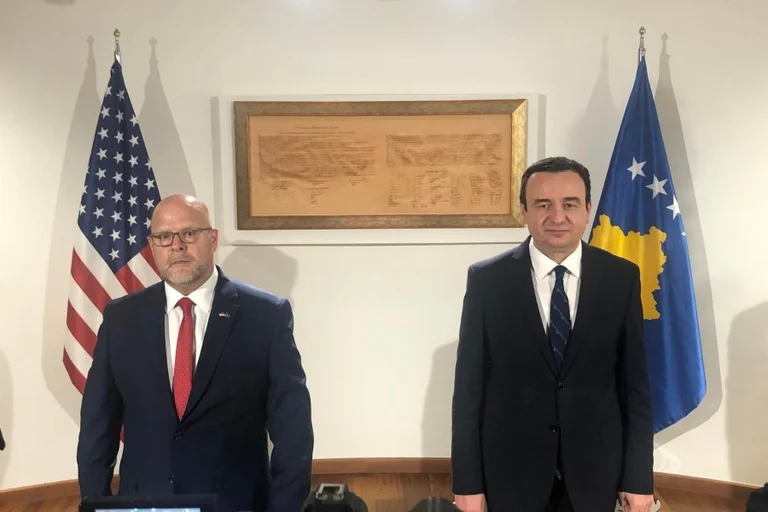
(3 years ago)US Ambassador to Kosovo Jeffrey Havenier has been very tough on Kosovo in a conversation he conducted with media representatives today. In this conversation, the US envoy has indicated that his country has taken a decision that Kosovo be excluded from participation in the “Defeder Europe 2023” exercise. And he [...]
In this conversation, the US envoy has indicated that his country has taken a decision that Kosovo be excluded from participation in the “Defeder Europe 2023” exercise.
In addition, he has said his country will not lobby on non-recognitional states for them to change their stance on Kosovo's independence.
All these actions resulted from the government's decision Friday to send Albanian mayors of three municipalities in the country's north, Zvecan, Zubin Potok and Leposaviq, with police escorts to municipal buildings.
The government's move irritated the local population in the north, which is in the Serb majority, even facing violent Kosovo police forces.
Local Serbs yesterday also faced KFOR forces, leaving at least 30 of those injured.
Hard against this government decision was the entire international community in general, but the US in particular.
US Secretary of State Antony Blinken warned of breaching relations between the two countries.
Such actions have severely and unnecessaryly cleared the situation by undermining our efforts to help normalise relations between Kosovo and Serbia, and they will have consequences in our bilateral relations with Kosovo”, the official communiqué issued by the US State Department reports.
And following the Blinken line, Ambassador Havenier gave details of these implications for Kosovo.
Among other things, he indicated that they have asked Prime Minister Albin Kurti to stop those actions, but stressed that the head of the Kosovo executive has not returned the answer at all.
Below, Klankosova.tv brings the full conversation of Hovenier with local media representatives, this meeting held at the US Embassy in Pristina:
HOVENIERThanks for joining me.
I know there's a lot of interest in how the U.S. is seeing the current situation in the north and I want to talk about it. So we're deeply concerned with the current situation in the north. We believe that there has been an unnecessary crisis. The action taken Friday to ... the operation undertaken Friday to enter municipal facilities through force has not been co-ordinated with the US. When we heard about it, we strongly consulted against that action because we have anticipated the consequences that we now see. We believe that there has been a negative impact on Kosovo's reputation, has turned back our efforts to advance relations for normalisation between Kosovo and Serbia, and as Secretary Blinken has said in his statement and, as we have said, this affects our bilateral relations. The first sign of this has been the decision taken last night by the US-European Command Commander to cancel Kosovo's participation in “Defender Europe ♫23<18x1>, which took place at night and, as you know, there were no interrelated activities with “Defender Euorpe 23” today and there will be no more for Kosovo, this exercise is over.
We're also thinking other implications, I have to say that at this moment we've been asking very directly from Prime Minister Kurti to take immediate steps to escalate the situation in the north. He has not responded to these requests. We are considering other actions. I have to say that at this moment, you will not find much enthusiasm on the part of the US to respond to other Kosovo interests, as is commitment with non-recognitional states or active work to advance Kosovo's European and Euro-Atlantic trajectory. We're so sorry that it's all here, but I have to be honest that this is the situation. We hope Prime Minister Kurti will take our advice and take certain actions to achieve escalation in the north, and to continue with priority issues that are the full implementation of the agreement on the road to normalisation rather than distraction and unnecessary conflict in the north.
With this, I'll take the questions:
ADRITIC KELMENDThank you, sir Ambassador. So, you are reminded of the negative impact, the annulment of Kosovo's participation in “Defender Europe 2023”. You started after strong statements of action. How long will there be to wait for Prime Minister Kurti's response to your demands?
HOVENIER: We think this is a very urgent situation. My comparisons are like having your house on fire. You need to turn off the fire. So, I don't think you'll see much patience on the part of the United States in relation to our expectations for the government to take action to escalate the situation in the north. Let me be clear, there are two things we're asking the government to do to despair, I'm happy to be specific: we believe the government should not insist that the mayors work from municipal buildings, the government was able to find other locations for their oath. We cannot understand why they cannot use the same public or alternative locations to carry out their functions, which are administrative functions. We are “on the record”, these heads have an important role to play in the administration, but this is not a normal arrangement and they don't have strong mandates from their electorate to take strong initiatives, so we don't understand why there is a insistence on working from municipal buildings, and we believe that the presence of the Kosovo Police, which was forced to, is extremely challenging, and we've asked the Government to withdraw police forces from the three buildings. We think this would escalate.
GAZETAR: If KFOR takes over, if KFOR troops and armoured vehicles are deployed, is there a scenario if any Marshal Law, or any scenario prior to 2008 comes into force to take over the situation on the ground?
HOVENIER: I don't like giving you hypothetical answers. What you're describing is not happening right now. KFOR has an important role to play, and its mission is freedom of movement and safe environment, and in this General Riestuccio and his team are focused. Let me express myself to you as I said on Twitter yesterday, expressing my deep sorrow for KFOR's injured personnel, but also deep frustration over what happened there, this attack on peacekeepers there to maintain peace. We expect KFOR to carry out its mission to ensure a safe environment and facilitate freedom of movement, and we expect them to do so. We expect the Kosovo government to take immediate action to escalate the situation in the north.
GAZETARIA: Does Serbia's decision to place troops at the border and at full combat readiness pose a risk to Kosovo?
HOVENIER: It is never a good sign that neighboring countries with tense reports mobilise their forces! But I want to say that at this moment, what we're concerned about is the actions the Kosovo government has taken that have created this crisis atmosphere in the north, and this should be addressed.
GAZETAR: Prime Minister Kurti said yesterday there is good co-operation with you about the north.
HOVENIER: I want to let my first statements speak for themselves. What I said, I think I addressed this very clearly.
GA ZETAR FORTIVECan I change a little, because you're mentioned as President Osman? Is that part of government policy, are they working as a team? You met him?
HOVENIER: I don't know if it's appropriate for me to talk about dynamics within Kosovo government institutions. What I would notice is that President Osmani has consistently stressed the importance of full and close co-operation with the international community, with particular focus with the US. I think she takes this very seriously.
GAZETAR: You have asked the government to withdraw Kosovo Police Special Units from the municipalities...
HOVENIER: Can I correct you? I didn't say that, I said the withdrawal of the Kosovo Police from the three municipal buildings. That's what I said.
GA ZETAR FORTIVE: Okay, sorry. Since there are American KFOR members negotiating with police there in the municipality, is there any indication that police will withdraw? Are there indicators?
HOVENIER: I am not currently aware of the political decision made to withdraw police from municipal buildings.
GAZETARIA: 25 soldiers were injured yesterday, we had KFOR soldiers who died in the past, for none of these deaths, or injuries, no accountability, no one was found, no one went to jail. Will you let the injuries of soldiers last night, including American soldiers, continue without consequences? Are you investigating the injuries of American soldiers?
HOVENIER: Are you asking questions or statements?
GAZETARIA: Will you investigate the injuries of American soldiers?
HOVENIERFirst your facts are incorrect, there were no American soldiers injured yesterday as far as we know. We take it very seriously when peacekeepers... and really don't have to make any distinction between American soldiers and any other soldier, NATO soldiers are NATO soldiers and we as the Alliance appreciate each of them regardless of nationality, we are deeply concerned about actions that resulted in injuries, and in some cases even the serious injuries of some soldiers. I condemned yesterday as all my colleagues have done, but that doesn't change the fact that the soldiers were there to preserve peace, in that scenario, was because of Prime Minister Kurti's decision to get access to the buildings of these three municipalities by force and that's what needs to be addressed in terms of the escalation that we're looking for.
GAZETARAmbassador, do we have any concrete guides on how the situation in the north can normalise, considering not only the recent events but also the people who have left their jobs in the autumn in the police, justice, and why are we seeing that only Kosovo is being blamed?
HOVENIERAgain, as I said using the analogy that if the house is burning, you have to stop the fire before you work on the kitchen renovation or whatever else you have to do. Currently the urgent issue is the escalation of the situation in the north, over the long term we have guides called “the agreement on the road to normalisation of relations between Kosovo and Serbia” and the United States Government has made clear the expectations for both sides to fully implement all the responsibilities they have taken with that agreement. This solves the situation in the north and that's why we ask the Government of Kosovo to move urgently with the negotiations process for association, which would be the means to address many issues in the north.
GAZETAR: You mentioned “Defender Europe” and the lack of enthusiasm for working with non-recognitional states, but I want to ask if you can be more specific about other aspects of what might be a potential consequence for bilateral reports between Kosovo and the US. What other consequences could there be in the short term if the situation does not change?
HOVENIER: I don't know if it makes much sense to speak more specifically now, we are reflecting and our hope is that the Government of Kosovo will respond to our demands and take steps to escalate the situation. What happened was unusual, you've seen Secretary Blinken's tour, it's rare to have that level of language, General Cavoli, commander of all American forces in Europe on behalf of the US, and we hope that Kosovo's government will take it seriously.
GAZETARIA: Do they realize how serious the situation is after Secretary Blinken's tour, after the calls we had from the Quint states and we saw the situation yesterday?
HOVENIER: This is a brilliant question that I cannot answer, but I encourage you to ask Kosovo officials, do they understand how serious this is? Here we're sitting for me to show how serious this is and I've told the prime minister how serious it is.
GAZETAR: Last autumn I remember that the US Embassy told some Kosovo ministers not to travel to the US because of the barricades. Can the Government of Kosovo now be able to co-operate with the US Government if the situation continues this way?
HOVENIER: I would be surprised if under these current circumstances, under the circumstances we are now in, there were readiness for high-level visits, whether from the US here or from Kosovo to the US.
GAZETARAnd for Prime Minister Kurti?
HOVENIER: Like I said, I'd be surprised if in the situation we're currently in, there would be readiness for high-level visits.
GAZETAR: Are new local elections considered an option for resolving the crisis in the north?
HOVENIER: I cannot talk about options which the Government of Kosovo is considering. What I'm saying is we need escalation, and we've presented two things that we think should happen for the immediate escalation of the situation.
GAZETAR: And what do you think would be a possible solution?
HOVENIER: I can't talk about what can work and what can't. Do you think that would help? Do you think the Serb community would participate in elections this time? I can't answer these questions, I can say that in the circumstances under which we find ourselves there are people elected based on the laws of Kosovo, but no one can be happy when less than 4 percent of registered voters vote. It is necessary for these officials to act very carefully, to admit that they do not have a major political mandate to make changes and what we have said several times publicly, in technical or administrative work for administration, while working on creating conditions for another political environment, which would result in another political representation. Part of what we've talked about with the government is how to start the job, so we've had a careful conversation about how they're going to take the oath, and do it in a way that would ensure the communities they serve... and that's part of the reason why our reaction was so strong about what happened Friday, because that's not how these mayors should get the mandate by entering the municipal buildings by force. That's not what we thought, or recommended.
GAZETARIA: My question is not related to this crisis in particular, but we are doing a research on deinformation in the Western Balkans where we have found the Kremlin dezination campaign and the Narratives are reaching Albanian media in Kosovo and Serbian media in Kosovo, social networks, here affecting public opinion in Kosovo. Do you have any information like that, do your findings show this in recent months?
HOVENIER: I'm not sure I'm in a position to answer that very specific question. What I can say is that I think that in the region we are concerned about the deinformation phenomenon. These concerns are not just for the Western Balkans. It happens in other countries as well, but it is no secret that Russia under Putin's leadership is involved in desniform operations and they are sophisticated, and it is not surprising that some of these false narrats Russia publishes are to advance its strategic interests related to the Western Balkans. But I don't have any more information beyond that. At the State Department, we have a Centre for Global Inclusion led by James Ruby, whom you probably know. He takes this matter very seriously and you know, I know that he and the Global Inclusion Centre are looking closely at this issue both for this region and other regions.