13 minutes ago
The German Parliament is reporting: KFOR Mission, Failure or Progress?
Periskopi(3 years ago)
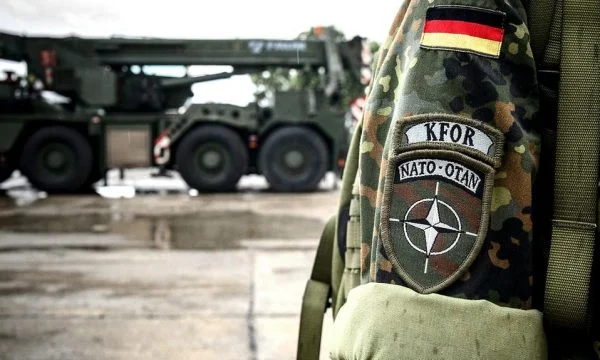
(3 years ago)The German Parliament debated the extension of Bundeswehr's commitment to Kosovo. After Russian aggression in Ukraine, the German government sees stabilisation of peace in the Western Balkans with great geostrategic interest. For 24 years now, KFOR is in Kosovo, and for 24 years the extension of the German Army's (Bundeswehr) commitment mandate in Kosovo must [...]
For 24 years now, KFOR is in Kosovo, and for 24 years the extension of the mandate of the German Army's (Bundeswehr) engagement in Kosovo must be approved by the German Parliament (Bundestag), after two 40-minute debates and a prestigious vote. On Thursday, 11,05.23, the first debate took place on the motion submitted by the German government for extending even one year the mandate of the German soldiers in Kosovo.
Centre left three-party coalition politicians ( SPD, Greenwater, The FDP, as well as those of the largest opposition parliamentary group (CDU/CSU), praised KFOR's contribution in general to maintaining stability in Kosovo. But they also noted the main points that make the mandate necessary: Especially after Russian aggression in Ukraine, the German government sees stabilisation of lasting peace in the Western Balkans with great geostrategic interest, said Parliamentary Secretary at the Defence Ministry Thomas Hitschler, (SPD). “Progress achieved in two decades should not be lost”, he said in front of MPs.
The maximum number of German soldiers who can be engaged under KFOR over the next 12 months remains unchanged, 400. Currently, nearly 70 members of Bundeswehr have been deployed in Kosovo. But the mandate enables the interior minister to increase this number in case of need. Hitschler noted that normalising relations between Serbia and Kosovo remains open, which causes tensions in the north from time to time.
Peter Beyer: We no longer tolerate reasoning against association
Peter Beyer, from the opposition CDU party, said normalising relations is key. He welcomed the Ohrid Agreement's arrival in late March, but criticised the lack of will for implementation. “Arsids can neither listen nor tolerate”, he said, given the procrastination of creating majority Serb municipalities on the part of the current Kosovo government. Beyer warned: “Stabilisation of relations between Kosovo and Serbia is closely linked to stability throughout the Western Balkans”.
Boris Mijatovic, speaker of the parliamentary group, The Green, who himself had just returned from a visit to the region, recalled the wounds of war in the Balkans. He cited numerous missing people and many open issues between the two countries, which make normalisation difficult. Foreign minister's party politician Baerbox focused on successes: Reaching the Ohrid Agreement, though not yet signed, Kosovo's candidacy for EU membership at the end of last year, as well as progress achieved at the end of March with the transition to the Parliamentary Assembly of the Council of Europe's application for membership. So there are successes, but the process is not over, so we need the presence of KFOR” in the future, argued Mijatovic: “is our commitment to peace in the region”.
Left and Alternative for Germany Call KFOR Mission Failed
Politicians of the two extreme parties -- the Left and Alternative for Germany -- chose, as well as in previous years, a diametratively contrary to that of the centre's four parties. Markus Frohnmeier, from AfD, said the truth is that, in fact, there was a “ethnic cleansing” of the Serb minority, in the presence of KFOR.” The rightist politician followed charges against the Kosovo government: Nepotism, like that case Habeck and Gracienne is normal in Kosovo”. He also criticised the German government, which paid developmental aid, and, on behalf of the AfD, rejected the extension of the mandate. He demanded that this service be put to an end “All incubation” for Kosovo, which will last another 25 years.
Jacques Nastic, who spoke on behalf of the Left Party, also rejected the mandate extension. She stressed the situation of the Serb and Roma minority in Kosovo. According to her every year, there are three attacks on them. Nastic, whose party has always deemed NATO's intervention against Milosevic wrong, said the bombings according to her have caused 3,500 victims, but no one has been brought to account for them. And no one has claimed responsibility for the uranium ammunition used during the bombing, as well as the shelling of the Pancevo ammunition factory, which, according to her, has caused the release of a large Mercedes mass.
Germany gives over sixm euros annually to Kosovo
After the 40-minute debate, the motion was passed to the relevant, foreign and defence commissions. German troops have been involved in the KFOR mission since 12 June 1999, with the UN Resolution 1244 coming into force. A broad consensus exists in the German parliament for the extension of the mandate, so the motion is expected to be adopted.
Germany's spending on its soldiers' commitment to KFOR is expected to reach around 6.1m euros for the next twelve months. But Germany's contribution to Kosovo is greater than that. Since 1999, it has spent about 880m euros on Kosovo's development. Co-operation is currently focused on energy fields, sanitation, the surrounding economy, education and sustainable growth. A key project of developmental co-operation is to turn Prizren's camp into an innovation and technology park. / DW/