13 minutes ago
Disagreement or time purchase for Association
Periskopi(3 years ago)
(3 years ago)No one has expected that at the May 2nd meeting in Brussels between Kosovo Prime Minister Albin Kurti, and Serbia's president, Aleksandar Vuciq, there will be reconciliation regarding the resolution of the Serb majority municipalities. Thus, representatives of opposition parties -- the Democratic Party of Kosovo (PDK) and the Democratic League of Kosovo (LDK) -- and [...]
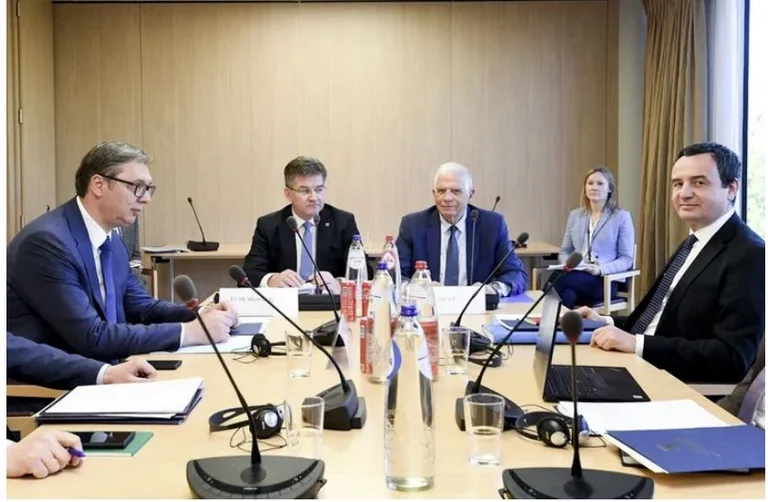
No one has expected that at the May 2nd meeting in Brussels between Kosovo Prime Minister Albin Kurti, and Serbia's president, Aleksandar Vuciq, there will be reconciliation regarding the resolution of the Serb majority municipalities.
Thus, representatives of opposition parties -- the Democratic Party of Kosovo (PDK) and the Democratic League of Kosovo (LDK) -- and political connoisseurs Agon Maliqi and Ognjen Gogic.
At the meeting, chaired by European Union foreign policy chief Joseph Borrell, the Managing Team for the drafting of the Association statute, comprised of four members of the Serb community, has introduced the draft status state for forming association.
Prime Minister Kurti said that “clearly there is a desire for a Republika Srpska in Kosovo, and that wish has written this statute”. According to him, the document, as such, is “currently incompatible with constitutionality”.
Kurti at this meeting has proposed a draft-vision on what values and principles should be like, and what should be the framework that regulates the issue of non-communal communities, respectively, of the Serb community in Kosovo”.
A day later, on May 3rd, Minister of Local Power Management in the Government of Kosovo Elbert Krasniqi said he has relieved members of the Management Team.
Serbia's President, Aleksandar Vuciq, has insisted that Kosovo “will either accept what it agreed to in 2015. (The agreement on the principles of association) will either be the end of all”.
However, Borrell has stressed that with the presentation of the Association draft status from the Management Team, Kosovo and Serbia “took a symbolic step” towards the establishment of the Association and that despite the parties being rejected, “ato agreed to start negotiations on the future of the Association”.
“The European Union will provide last draft” for Association
Rashit Qalaj, deputy of the Democratic Party of Kosovo, estimates that no one has expected the Kosovo side to comply with the draft of association, which the Managing Team has drafted. As he says, the content of that draft does not refer to the Kosovo Constitutional Court's decision, which in 2015 had estimated that the agreement on principles on which the Association would be formed was not in harmony with the country's Constitution.
Well, what Mr. Borrell said, I think it makes sense, because it's just the first step of discussion about the model or statute to be drafted. I believe it will be a long way, because there will be many meetings that will end without success. I believe that the draft, in the end, will be made by the European Union, will be introduced to the parties and will, in some way, be mandatory to implement”, Qalaj points out.
On February 27th, in Brussels, Kosovo and Serbia have agreed to the basic agreement towards normalising relations between the two countries. On March 18th, the parties have also agreed on the Annex for implementation of the agreement, which envisions a certain level of self-awareness of the Serb community in Kosovo.
Lutfi Haziri, deputy chairman of the Democratic League of Kosovo, tells Radio Free Europe that after reaching this agreement, the Serbian side has raised expectations and they go beyond the 2013 Brussels Agreement on forming association, as well as the 2015 Agreement, on principles for its formation.
So March 18 (The Agreement in Ohrid) exceeds these vows. The community's self-defence agreement exceeds them and has prompted further expectations. I believe that you will move towards an intermediate model that will be offered to negotiate with the parties. The document, as such, is negotiated literally. But the mandate belongs to the Management Team and the mediators, to move forward”, Haziri says.
Maliqi: Vuciqi scenario, failure of agreement
Political process analyst Agon Maliqi estimates that Kosovo, despite the rejection of the draft, showed willingness to enter concrete discussion for association, which has been the request of its allies.
According to him, it has been unrealistic to expect that at the May 2nd meeting, the parties could agree on the draft association status, as the management team has drafted. Vuciqi's persistent statements that the Association be formed under the 2013 and 2015 agreements, Maliqi views it as rhetoric for domestic consumption, to raise opinion expectations in Serbia that association is more than actually envisioned in these agreements.
According to him, it is not at all reliable that Vuciqi is unaware that in the Agreement on the principles for forming Association, of 2015, which the parties have agreed to, it is also presupposed to its constitutional constitution on the part of the Kosovo Constitutional Court.
Maliqi points out that Vuciqi, putting together the formation of association “according to his interpretation”, is trying to promote the Kosovo side and its opinion, as he calls it, “malpractice” and thus blame them for failing to implement the entire basic agreement for normalising relations.
I think the most popular Vuciki scenario is the failure of the deal. But, it requires at all costs that Kosovo in a way become a stumbling block. Simply, Kosovo should be cautious and in co-ordination with its allies follow steps carefully. I believe Vuciq also remembers that his every move is monitored by the West, so it's not easy to sabotage the agreement”, Malchi estimates.
Gogic: Vucinqi is buying out time to fail to meet obligations
The polytologist from North Mitrovica, Ognjen Gogich, estimates that the draft status station for Association, introduced by the management team, on May 2nd, in Brussels, is “squared in view of the Kosovo team. According to him, the Serbian side is trying to raise the scale of its demands, which are unacceptable to the Kosovo side, with the aim of it refusing.
I don't think there is a Serbian side's desire to form association. It is a tool in dialogue rather than purpose. This is seen from Vuciqi's statements, which form association, condition it against fulfilling other obligations (of the basic agreement). I think, in fact, he'll do all he can to keep the association never formed. It buys time to postpone the implementation of the remaining”, says Gogic.
Is the escalation of the situation in the north possible?
At the May 2nd meeting in Brussels, Kurti and Vuciqi approved the Declaration of Extinction, through which the solution to the fate of missing persons is aimed at during the recent war in Kosovo.
Also discussed on current issues and the situation on the ground.
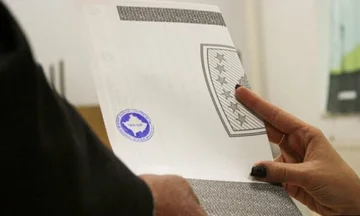
EU foreign policy chief Josep Borrell said he has expressed concern for the situation in northern Kosovo, following elections that were held there 23 April, for the mayors of four northern municipalities (North Mitrovica, Leposavic, Zubin Potok and Zvecan), where there was low exits at the polls.
At these polls, local Serbs generally did not participate.
Borell said these elections “do not provide long-term political situation and that “have the potential to lead to escalation and undermine implementation of the Ohrid Agreement”.
Analyst Agon Maliqi estimates that Borrell's statement is a kind of assessment of the EU and the West in general, of the potential that could cause escalation in the country's north, as well as the unstable situation there, in the context created in recent months.
“They estimate on the basis of their analysis and information, that it is possible that the situation will escalate, whether with initiatives from either parties or any third party. Second, this is a kind of drawback for the parties to focus on the political negotiation process and not use the security situation to undermine the negotiations process”, Maliqi says.
Politologist Gogic voices the opinion that the situation in the north, although feeling tension, will not escalate because the Serbian and Kosovo sides want to show constructive in relation to the European Union's demands. However, according to him, each side wants the other side to look unconstructive.
So let's say that, if there were incidents in the north, the side that would encourage them would be seen as the party that is undermining the dialogue. Nobody actually wants this. So more will be a political race than on the ground”, Gogic points out.
European Union officials have stressed that the parties will continue to discuss the Association at the upcoming meetings of negotiating groups.
Draft-vision, as Prime Minister Kurti has called the document proposed by him, to regulate the issue of the Serb community in Kosovo, refers to the 7th point of the Agreement towards normalising Kosovo-Serbia relations.
The document envisions a draft status, in which “self-awareness will enable members of the Serb community in Kosovo to promote their interests through the single management framework”.
The document, among other things, says that “will promote the nuclear project”, “will provide a direct channel of communication” with the Government of Kosovo, and provide the opportunity to be financed by the Kosovo Government budget, international organisations, third-nation institutions and donations, including from Serbia.
The draft status, as reported in Kurti's proposal, “will fully recognise the constitutional characteristics of the Republic of Kosovo”.