13 minutes ago
What is known and what is unknown about the export of Serbian weapons to Ukraine?
Periskopi(3 years ago)
(3 years ago)The order of claims and the order of bulls for export of Serbian weapons to Ukraine are changed when exports of arms to Ukraine is publicly mentioned in Serbia. Sporadical and partial information about weapons produced in Serbia used by Ukrainian forces was confirmed by a Pentagon report saying Serbia has been hired [...]
The order of claims and the order of bulls for export of Serbian weapons to Ukraine are changed when exports of arms to Ukraine is publicly mentioned in Serbia.
Sporadical and partial information about weapons produced in Serbia used by Ukrainian forces was confirmed by a Pentagon report saying Serbia has agreed to arm Ukraine.
Serbia has not sold and will not sell weapons to the Ukrainian or Russian sides” was the first reaction by Serbia's Defence Minister Milos Vuchev.
The United States Embassy in Belgrade told Radio Free Europe (REL) that they have no knowledge that Serbia sells weapons to Ukraine.
However, it did not rule out the possibility that weapons from Serbia were found in the war in Ukraine.
What is known?
The Reuters agency reported on 12 April that Serbia has agreed to send weapons to Kiev or has already sent them.
Reuters published the information based on what it saw in a confidential Pentagon document. It is part of dozens of classified documents published on the internet in recent weeks.
The media say it could be the most serious discovery of American secrets in recent years. Reuters could not independently confirm the authenticity of the document.
According to the BBC, Pentagon officials have stressed that there is a possibility that some documents are “changed”.
Titled “Europe ) the answer to the current Russia-Ukrainian conflict”, the document in the form of the graph lists the estimated “positions of 38x3> of European governments in response to Ukraine's requests for military assistance.
The graph said Serbia refused to offer training to Ukrainian forces, but pledged to send lethal aid or had already sent it. It also stresses that Serbia has political will and military capacity to offer weapons to Ukraine in the future.
What are reactions from Serbia known?
Serbia's President Aleksandar Vuciq, on April 13th, declared that “Serbia has not exported and will not export weapons to Ukraine”, as well as that “has not exported and will not export” ammunition to either country or Russia.
There is no letter that would show such a”, Vuciq said.
President Vuciq stressed that it is a perfectly safe “ ” that Serbian ammunition will appear “on one side of the battlefield” in Ukraine, though they are exported to Turkey, Spain or the Czech Republic.
The Serbian president said Serbia's arms industry factories have hundreds of millions of euros contracts for arms and ammunition exports, and that they will not give up.
“We will continue to invest in production and factories, as well as continue to export where it is allowed. They see a grenade (in Ukraine), a bullet. And where do they appear? There are several war zones in the world. The ammunition is used in wars to kill people”, Vuciq said.
He reiterated that Serbia is militarily neutral and will not change that stance.
Earlier, Serbian Defence Minister Milos Vuchevic also claimed that “Serbia has neither sold or sold weapons to the Ukrainian or Russian sides, nor to countries around that conflict”.
The obvious goal of someone is to destabilise our country and draw it into a conflict, in which we do not want to participate”, Vuchev said in a written statement on 12 April.
Vuchevic, however, did not rule out the possibility that some weapons, as he said, “in a magical way” can be found on conflict territory.
Serbia's Ministry of Foreign Affairs also dismissed claims about sending weapons to Ukraine. The first deputy prime minister and diplomacy chief, Ivica Dacic, in a written statement, reiterated that since the beginning of the Russian invasion in Ukraine, no weapon has been exported from Serbia to either side in the conflict.
From the US Embassy in Serbia told Free Europe Radio that they cannot comment on alleged confidential information, but added that “according to our knowledge, Serbia does not sell weapons to Ukraine”.
The Ukraine Embassy in Serbia told Free Europe Radio that there is no information about sending weapons from Serbia to Ukraine. They said they are based on the Serbian officials' up-to-date public statements on the subject.
Serbian President Aleksandar Vuciq briefed the public, following the invasion of Ukraine in February 2022, that Serbia will not export weapons to any of the parties in the conflict.
Also, it often commemorated that Serbia condemns the invasion, but will not impose sanctions on Russia.
In his statements, Vuciq has left room for this, however, to happen due to Western pressure on Serbia, which traditionally maintains good relations with Russia.
On the other hand, the Kremlin has already turned its attention to official Belgrade, due to earlier accusations of Serbian weapons.
Since the beginning of Ukraine's Russian occupation in February last year, Vuciq has been trying to balance close ties with Moscow with the aim of joining the European Union.
Serbia is the only one, among the 44 countries in Europe, to refuse to impose sanctions against Russia.
What is known about earlier claims?
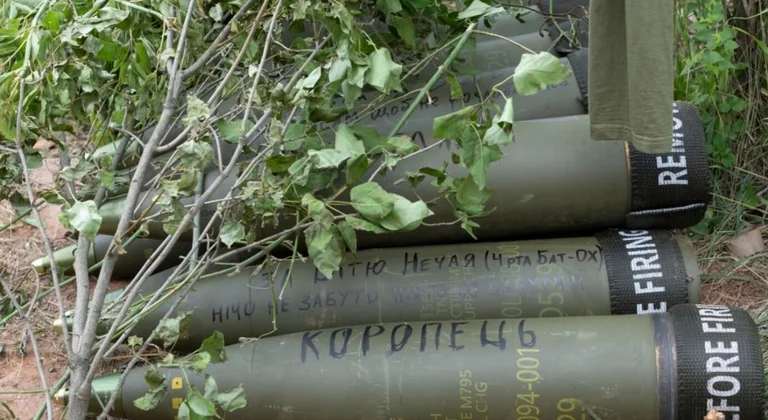
On February 27th, the Russian portal Mass published a video, claiming that it saw 3,500 Serbian missiles Grad, at an arms depot in Bratislava, Slovakia.
The portal said Slovakia is a transitary site for the missiles and that they ended up in Ukraine.
The portal also published documents whose authenticity REL could not confirm, which allegedly indicate that the Canadian company “J NJ Export Import” has ordered rockets from the weapons company “Krusik” from Serbia.
Russian media emphasised that the crates have flown from Serbia to Turkey, where Turkish company “Arca Savunma Sanayi Ticaret”, as mediator, has carried out the transit and through it, cargo has gone to Slovakia, and then to Ukraine.
Later, images and photos spread to social networks and reached the media in Serbia.
The same day, Serbian Defence Minister Milos Vuchevic denied that Serbia exports weapons to Ukraine and Russia.
However, he also said that if private companies buy in third markets and sell to companies in other countries, this is not a question for Serbia.
It's international trade”, Vuchev said at the time.
He, too, said Serbia cannot punish anyone who does not export, only because there is doubt about where, what and how it will end.
Statements rejecting the export of Serbian weapons to Ukraine had then made Serbia's president, Aleksandar Vuciq, and Foreign Affairs Minister Ivica Dacic, as well as local arms factory “Krusik”.
Russian Foreign Ministry spokeswoman Maria Zakharova, on March 2nd, said information on Serbian weapons in the Ukrainian Army arsenal causes the deepest “concern”.
She said Moscow asked Belgrade for an official stance on information that Ukraine had been sent to arms from Serbia.
Zakharova also said the Kremlin “is closely following this history”.
Five months ago, another event caused speculation about Serbian arms exports to Ukraine. On 16 July, the plane “An-12” was established from Nis Airport in southern Serbia and crashed in the vicinity of Cavala, northern Greece.
On that occasion the eight crew members were killed, and soon it was found to be a Ukrainian plane carrying 11.5 tonnes of ammunition from the Serbian arms industry.
At the time, authorities in Serbia clarified that the shipment was owned by the private Serbian company “Valir” and that all weapons were produced and purchased by the state-owned arms factory “Krusik”. Also reportedly, the mediator was a company from Bosnia and Herzegovina. BA-Metaleexport”.
The explanation stated that the final weapon user, or mine for training, should be the Bangladesh Defence Ministry rather than Ukraine.
A similar situation occurred in March 2022, when social networks and some Russian media showed images allegedly showing weapons produced in Serbia were being used in Ukraine.
Authorities in Belgrade even then denied, in a response to REL, that Serbia had exported weapons to that country in the last eight years.
In Serbia's Ministry of Commerce, which is responsible for providing arms and military equipment export licenses, they also stated that during the same period no weapons were exported from Serbia to another country, where the final user would be Ukraine.
What is unknown?
Serbia's Defence Minister's statement, that there is the possibility that Serbian weapons, however, will end in Ukraine, has to do with the issue of respecting the final user's certificate.
In that document, each buyer of the weapon produced in Serbia must declare who the ultimate user of that weapon is.
According to international regulations, observing the certificate of the end user is mandatory.
“This is the issue for those countries that do not respect international norms, contract clauses and business practices”, Serbia's Defence Minister said in his response on 12 April.
However, he did not specify his response further, meanwhile, the defence ministry did not respond to the REL's request for additional clarification.
Links to a sanctioned arms dealer
Researchers journalists from the Balkan Network for Investigative Reporting (BIRN) discovered in August 2022 that a Serbian arms dealer, Slobodan Tspic, who is on the US blacklist, was exporting weapons to that country through two linked companies.
At the time, BIRN stressed that among the buyers there is an American company working for the Pentagon.
Tspic was on the US blacklist since 2017, while at the end of 2019, his associates and several related companies were placed on that list.
The U.S. said that Tessic was sanctioned for bribery and violation of the arms embargo.
Great Britain also placed Tashiqi on the blacklist with a decision on December 9, 2022.
“Slobodan Tespic, a major arms dealer from Serbia, charged with bribery to another country's chief state prosecutor,”, said in the statement of Great Britain.
However, BIRN journalists found that companies linked to Tsshiqi exported weapons to six American companies, including one co-operating with the Pentagon.
Among the two companies that are connected to Tschiqi and that have exported to the US, BIRN mentions the company “Valir”. The other is called “Zenprom”.
Regarding these claims, Tspic has never publicly provided clarification. The Pentagon didn't respond to BIRN journalists.
The company's representative “Valir”, who did not want to be introduced to BIRN's journalist, said claims on ties with Tsshicin are “trination”.
Licenses issued by the Ministry of Commerce
On the Serbian Trade Ministry website, the latest report on arms export and military equipment permits was published in 2020.
It says that 308 licenses, worth a total of about $836 million, were issued that year. According to that report, export licenses have been issued for buyers in 59 countries.
The Ministry of Commerce did not answer the REL question if it has issued permission to export weapons to Ukraine, as well as if it would be possible for weapons produced in Serbia to be exported to Ukraine without official Belgrade's permission.