7 minutes ago
“D”/ Ukraine could launch its offensive against Russia at any moment, Russians prepare the ground, what is expected
Periskopi(3 years ago)
(3 years ago)Ukraine says its preparations for a spring counterattack are almost complete. When it starts, possibly south, it will mark a key moment in conflict. But the Russians have had nearly six months to prepare the terrain and build an elaborate defence group. Depravation will present a challenge to [...]
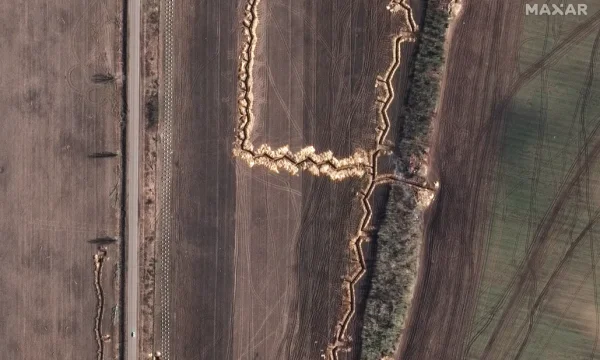
Satellite images revised by CNN and other news organisations show the extent of the Russian defence that have been established in parts of southern Ukraine, layers of antitank ditches, obstacles, mines and holes.
Protection continues for hundreds of miles along the winded southern front, where Ukrainian forces are expected to focus their counterattack in the coming weeks.
The challenge for Ukrainians will be to bypass or overcome such obstacles quickly, creating momentum that causes Russian command and control to melt.
Several satellite images shared with CNN by Maxar Technologists and taken on Wednesday show extensive dialogues east of the town of Polohy in the Zaporizija region. An analysis of Reuters images found thousands of defence positions in a wide area.
They showed that Russia's <x0) functions are the most concentrated near front lines in the southeastern Zaporizhja region, in the east and across the narrow generation of land linking the Crimea Peninsula with the rest of Ukraine”, according to Reuters analysis.
Russian protections included, for example, antitank channels near Polohy that stretched for 30 miles (19 km), as well as additional fortifications around important cities like Tokmak. This area will be critical if Ukrainian forces try to advance toward the city of Melitopol and divide Russian forces south.
Stephen Wood of Maxar says these defences are repeated at a great extent of territory, from Crime in the South to parts of Donetsk.
CNN reported earlier on defence fortifications being built in the north of Crime.
Russia's leader of the Crime, Sergey Aksyonov, said earlier this month that our <x0 armed forces have built a modern, deep defence in the” scan.
Months of Preparations
These defenses began to emerge after Russian forces withdrew from a part of the Kherson region in November, and essentially created a new line of protection that extended to the predominantly rural areas of southern Ukraine. The United Kingdom Defence Ministry said in November that two factories were producing concrete tanks barriers “dragon teeth”.
Such protections, however, are as good as the forces allocated for each sector. In themselves, they are a limited obstacle. That's why the Russians have pushed more units into southern Ukraine. These line of defense have become critical of their overall intentions.
Ukrainian officials have often aired confessions from people in areas occupied by Mariupol and Berdyansk for long Russian convoys and dozens of buildings that have been adopted as military shelters.
Satellite images show that a large Russian base in the Northern Crime, which in February had been full of equipment, including artillery and tanks, was much more empty at the end of March and almost completely empty last week. It is unclear where the equipment went, but they were likely sent north to reinforce Russian defence lines.
However, it is extremely difficult to say how many Russian troops and quality are assigned to each section of such a long front line. It will be critical for Ukrainians to cut off supply lines, destroy ammunition deposits and hit the fuel infrastructure (with many other tasks) ahead of the offensive.
This will make it harder to keep those troops safe. Ukrainians will assess where the Russian weaknesses are, because the moment the counterattack begins will be critical.
No Surprise
Ukrainian officials have acknowledged that unlike last September's sudden spread in much of the Kharkiv region, they may lack the element of surprise in any larger counteroffensive.
Officials named by Russia in Zaporisiza claim there is already a large gathering of Ukrainian forces in the area. Vladimir Rogov, head of “We, along with Russia” in Zaporizhja, said Thursday that some new Ukrainian brigades would reach the front line by the end of this week.
These brigades are being transferred to the 12,000 existing fighters in the area”, Rogov said. His claim could not be verified.
Ukrainian officials do not disclose the movement of units.
NATO officials say 98% of the promised war vehicles in Ukraine are now in place, and Ukrainian Defence Minister Olexia Reznikov said Friday that preparations for counter-offensive are almost complete.
But Ukrainian units will have to master combined weapons maneuvers with this new device, integrate mine clearing, removing tank barriers, and building the bridge with their assault battalions. This is a complex co-ordination.
The US aid package announced in March included bridges issued by armoured vehicles, which would accompany units to advance, as well as ammunition to destruction.
And they will have to work with excellent coordination and communication to succeed. Some analysts have compared what Ukrainians must do to D-Day landings, which German General Erwin Rommel said at the time: “The first nine hours of the occupation will be crucial... for allies, as well as for Germany, will be the longest day. ”
Franz-Stefan Gady, a London-based expert on modern warfare, says the Ukrainian goal should be “to start paralysis in Russian military leadership and panic in Russian ranks... Invulnerable factors such as tactical surprise, battlefield leadership, and martial morale are likely to be crucial in the first 24 hours of an attack”.
In an ideal scenario, he says, Ukraine's “armoured convoys hit Russian defence layered at a weak spot, quickly advance to the Russian back, and threaten command and control knots such as military headquarters and supply centres. ”
But the threat to Ukrainian forces, according to Matthew. Schmidt, associate professor of national security at New Haven University, is that the counterattack becomes a <x0-level division war going on a series of platoon commitments”, with Ukrainians being blocked.
The possession of combined weapons, the use of a number of assets in co-ordination will be crucial, he says. “Attack supply depots in the back, clear mines quickly, coordinate fires and move from the brigade level to the platoon. ”
Ukrainians have the advantage of choosing where and when they go, and with what concentration of strength. Rogov, Russia's official-appointed in Zaporizhja, says he expects Ukrainians to launch several diversion attacks in an effort to confuse Russian defence, especially with the use of small intelligence groups across the Dnipro River in Zaporzhija and Kherson.
Once the attack begins, other factors may come into play: everything from weather to capacity and the desire of the Russians to counterattack and air component.
A Russian counterattack?
One attribute of successful defence is the ability to counterattack, to take out the progressive enemy and force him to send troops where he would not want better. The Russian ability to do this effectively is in doubt. Western analysts believe elite forces such as Russia's VNV (or VDV) parachutists (or VDV) received major losses at the start of the campaign, from which they have not yet been recovered.
Despite the tactical adjustments we have seen from the Russians, we have not yet seen them achieve an operational progress and exploitation during the 2023” offensives, says Mick Ryan, a former Australian general who writes the bulletin of the military strategy Futra Doctrine and recently was in Ukraine.
But the Russians store a visible advantage in the air, and this could be critical in slowing Ukraine's progress.
Despite Ukraine's greatest wisdom and motivation, and despite the amazing losses of the Russians since the beginning of the occupation, Moscow has kept much higher resources in this conflict.
Gay writes on Twitter: “in the long run, the Ukrainian Armed Forces will have a hard time escaping the intersection of this land war focused on artillery”.
And even if they manage to break Russian lines and reach Melitopol and Berdyansk, there is little expectations among Western officials that Russian President Vladimir Putin will change his goals in Ukraine.
Schmidt stresses that the military force functions only when it causes a political effect. This means Putin needs such a big loss that can't avoid him... and that would be crime taking. ”