11 minutes ago
“Russia devastating factor for any agreement between Kosovo and Serbia”
Periskopi(3 years ago)
(3 years ago)The association of Serb majority municipalities in Kosovo has agreed under the auspices of the European Union, but its establishment now requires Russia. The association, which is now ten years old due to clashes between Kosovo and Serbia, could be the subject of discussion in New York, respectively, at the UN Security Council [...]
The association of Serb majority municipalities in Kosovo has agreed under the auspices of the European Union, but its establishment now requires Russia.
The association, which is now ten years old due to clashes between Kosovo and Serbia, could be the subject of discussion in New York, the UN Security Council, respectively.
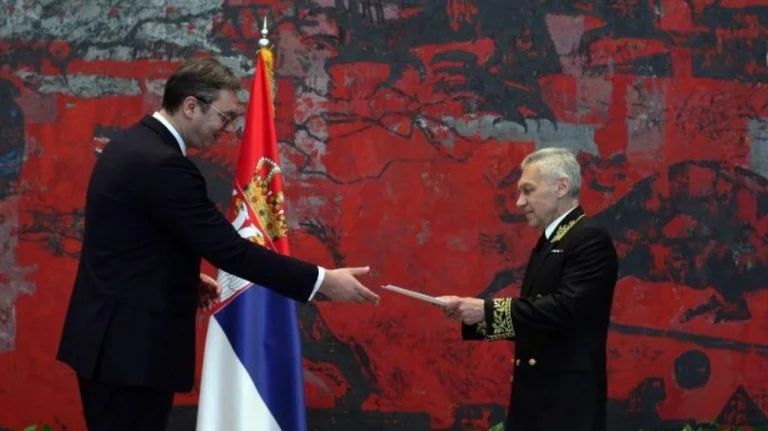
Russia's ambassador to Belgrade, Alexander Botsan-Kharchenko, has warned this.
He has said that the country “is up for a productive discussion on the core of the problems, which are really acute for Serbs, including forming association” of Serb majority municipalities in Kosovo.
Russia, a permanent member of the Security Council with veto rights, has taken over the rotating chairmanship of this body in April.
Its chairmanship coincides with the regular session for Kosovo, scheduled for April 27th.
The European Union has said earlier that it will “counter any misuse” from Russia, during the Security Council leadership.
Russia's “Coming to the head of the UN Security Council is worthy of a 1 April joke. Despite being a permanent member of the Security Council, Russia continues to violate the core of the UN legal framework”, EU High Representative for Foreign Policy and Security Josep Borrell has said.
Russia is under sanctions from the West because of Ukraine's invasion, which began in February 2022.
To date, thousands of civilians have been killed in Ukraine, millions have fled their homes, and dozens of cities have been destroyed.
What does Russia want?
Russia's initiative for the Association of Serb majority municipalities comes after Kosovo and Serbia have reached a new oral agreement on normalising relations in late February.
The agreement has been reached with the European Union's mediation and support from the United States of America.
The executive director of the nongovernmental Institute for European Affairs in Belgrade, Naim Leo Beshiri, describes Russia as a key <x0-fector for any agreement between Belgrade and Pristina”.
“Of course it tries to trouble the waters for the European Union and the United States. Russia tries to challenge any progress in this part of Europe”, Beshiri says.
Under EU mediation, Pristina and Belgrade are in negotiations on normalising relations since 2011. The process must result in a legally binding agreement.
The sides constantly accuse each other of blocking the agreements reached so far.
Russia, which supports Serbia in opposing Kosovo's independence, has accused the EU and the US of being unilateral, representing the interests of official Pristina”.
Russian Ambassador to Belgrade Alexander Botsan-Kharchenko has said that “Pristina has ignored a key obligation for a decade, but that it is still coping with”, thus referring to the formation of the Serb majority municipalities' association.
European mediators have again shown up as were expected their dishonesty”, Botsan-Kharchenko said in a statement broadcast by Belgrade media.
Following Pristina and Belgrade's agreement to implement the new agreement on normalisation of relations in March in Ohrid, the EU and the US have called on the two countries to implement all the agreements they have reached so far, including the 2013 Agreement for the establishment of the majority Serb municipalities in Kosovo.
The last call for the establishment of association was made by Western officials on April 19th, the day it was marked by the signing of the agreement in Brussels.
The United States' special envoy for the Western Balkans, Gabriel Escobar, has said he expects until May 2nd when Kosovo and Serbia leaders meet in Brussels -- the Kosovo government has the proposal for the Association of Serb-run municipalities.
“I hope that by May 2nd there will be an applicable draft”, Escobar said of the Voice of America on April 20th.
How powerful it is Russia The UN?
Since Kosovo has declared independence in 2008, officials in Serbia have refused to recognise it.
So far, Serbia has blocked Kosovo's membership in several international organisations, including the United Nations. In these goals, it has had support from Russia and China.
After Russia's invasion of Ukraine in February 2022, Serbia has supported several resolutions condemning Russian aggression before the UN General Assembly.
But it has refused to impose sanctions on Russia because of Ukraine's invasion.
In addition to the European Union, other Western countries led by the United States and the United Kingdom have imposed sanctions on Russia.
Moscow's support for the Kosovo issue is one of the reasons Serbia refuses to impose sanctions.
According to Naim Leo Beshiri, Russia tries to testify that it is still asked about international relations in the world.
But, given the invasion of Ukraine, it [Russia] is not too reliable to launch any conversation or discussion within the UN”, Beshiri says.
Since the beginning of the Russian invasion of Ukraine, the West has called for the expulsion of Russia from the Security Council.
However, this UN body has not taken preventive or austerity measures against Russia so far.
What is the Association of Serb majority municipalities?
Serbian officials, led by President Aleksandar Vuciq and Prime Minister Ana Brnabiq, have established the establishment of association as the precondition for further progress in talks on normalising relations with Kosovo.
But, while Belgrade insists on an association with broad competencies, Kosovo authorities believe it would be harmful to the functionality of the state.
The Constitutional Court of Kosovo has earlier ascertained that some principles for forming this association are not in harmony with the Constitution and that they should be harmonised with Kosovo regulations.
For Pristina, the question of the jurisdiction of association is questionable whether or not there will be executive competency or not.
The association would have to consist of ten municipalities in Kosovo: Gracanica, Shrpca, Klokoti, Ranillug, Partesh, Novoberda, located south of the Iber River, and North Mitrovica, Zvecani, Leposaviqi and Zubin Potoku, located in the north.
Does Russia love Association?
Beshiri says that Russia's “intervention” for forming association has to do “more with daily political circumstances in Russia and Serbia” than “with the contribution to peace in the Balkans”.
He says the formation of the Association is not compatible with Russia, because such a thing is meant to be done in accordance with Kosovo's laws and Constitution.
If they don't recognise Kosovo, then they don't even know its laws. But perhaps, Russia can use the opportunity to influence the political leaders of Serbs in Kosovo and authorities in Serbia to find ways for the Association to have competencies that can undermine Kosovo citizenship”, Beshiri says.
According to him, it is clear that the Kosovo side will not agree.
We have two opposing requests. On the one hand, Pristina, which views association as something slightly more powerful than a nongovernmental organisation. And Belgrade, which may want to see it as a kind of republican Kosovo body that would have veto” rights, Beshiri adds.
What does the Security Council discuss for Kosovo?
Security Council hearings for Kosovo are held regularly every six months. A report covering the activities of the United Nations Mission in Kosovo (UNMIK) and the situation in this country is presented.
The UN mission in Kosovo was established in 1999 with Security Council Resolution 1244.
The adoption of the resolution has preceded the war in Kosovo and the NATO bombings in the Federal Republic of then-Yugoslavia, aimed at halting the violence of Serb military and police forces in Kosovo.
With this resolution, the withdrawal of the Serbian army, police and administration from Kosovo has been decided.
In addition to the UN civilian mission, the mandate has been given to NATO's military mission, KFOR, to ensure the safety of the population in Kosovo. / REL/