7 minutes ago
Osman for the trial of former KLA leaders: They Protected the Land Against Milosevic's genocide regime
Periskopi(3 years ago)
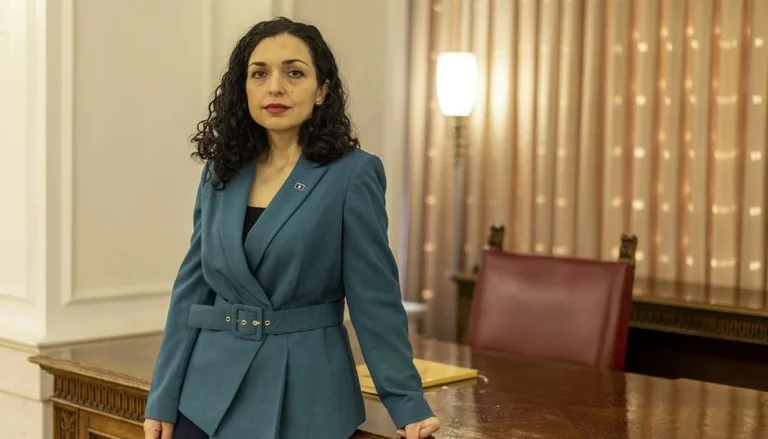
(3 years ago)In an interview for the Austrian newspaper “Die Presse” given days ago, Kosovo President Vjosa Osmani-Sadriou has criticised Serbia's Foreign Minister Ivica Dacic, spoke of successes and red lines in talks with Serbia, and has warned of Moscow's efforts to destabilise. Osman also commented on the launch of the trial process in [...]
Osman also commented on the launch of the trial process in The Hague against former KLA witnesses.
She has said the KLA has fought liberation wars and has protected people without protection.
Total interview:
Die Presse: Kosovo and Serbia have agreed in principle on the EU plan to normalise bilateral relations. Will this approach these two places?
Vjosa Osmani-Sadriu: Not closer to each other, but closer to the EU. Success in the EU-led process will bring more stability to the region. The agreement treats Kosovo and Serbia as equal contracting parties for the first time. Through it, Serbia recognises our territorial integrity in line with the UN Charter, and the agreement ensures mutual recognition of national documents and symbols. Most importantly, the agreement says Serbia will no longer oppose Kosovo's membership in international organisations.
Serbia's Foreign Minister, Ivica Dacic, has recently said in Vienna that Serbia will not agree with Kosovo's UN membership. This is a clear violation of the deal. Article 4 of the agreement makes it clear that Serbia will not prevent Kosovo's accession to any international organisation. But, we know who the real obstacle is -- it's not Serbia, it's Russia. Due to veto rights, it is Russia, which could cause problems with Kosovo's admission to the UN. In time, we'll figure this out. Currently, our priorities are NATO membership, membership in organisations like the Council of Europe and, of course, EU integration.
Dacic has said in Vienna that Kosovo must first implement the old agreement to establish association of Serbian municipalities. Only then will Belgrade take the next steps in implementing the normalisation plan. Such a plan is not involved in the agreement we have reached with Belgrade in Ohrid. But I don't think many people in the international community take seriously Mr. Dachic and what he does. He has already shown that he changes positions every day in his political career.
Why does Kosovo not want to implement the agreement to establish Serbian municipal association? What's the problem?
Vjosa Osmani-Sadriu: The main problem is Serbia. For example, if Austria wanted a special association for Austrians in Kosovo, we wouldn't worry that much. Austria recognised Kosovo as a state. It is not Austria's intention to undermine our independence. Serbia does not want to advance the rights for Serbs in Kosovo. Rather, it uses its illegal structures in northern Kosovo to threaten Serbs living there. They just want to make Kosovo dysfunctional as a state, as they have done with Republika Srpska in Bosnia and Herzegovina. They want a second Milorad Dodik (President of Republika Srpska) in Kosovo.
And how can this be solved?
Vjosa Osmani-Sadriu: If Kosovo respects the pledges under the agreement, it will take care to act in accordance with the constitution. The Constitutional Court's decision also mentions the need to respect the principle of multiethnicity. A Serb community association would also have to respect the rights of other ethnic groups living there. We have a red line: there should not be executive rights for a Serb parallel administrative structure. But at the same time, of course, we will implement all minority rights and freedoms according to European standards. This should go parallel to implementing other provisions of the agreement, such as recognising national symbols. Serbia has indicated it does not want to implement this. We expect that even if Serbia continues with blockades, our partners will support Kosovo's international integration.
How should talks with Serbia continue?
Vjosa Osmani-Sadriu: At the next meeting in April we have to deal mainly with missing persons in the war. As president of Kosovo, I am committed to making this a priority of dialogue. We need an agreement through which Serbia opens its archives to clarify the fate of the violent missing. It's over 1600 people, including women and children.
What impact does war have on Ukraine in Kosovo and the region as a whole?
Vjosa Osmani-Sadriu: Russia has a negative impact in the region, which it is trying to destabilise with the help of its ally, Serbia. Every time there is a crisis in the Balkans, we should look at it from a broader prism: respectively, Russia's claims on hegemony on Europe. We must be careful that this harmful influence does not spread. Kosovo aspires to be on the right side of history, not only economically but politically. We support Ukraine. At the same time, Russia will try to destabilise Kosovo with Serbia's help.
Is the EU doing enough to oppose Russian and Chinese influence in the Balkans?
Vjosa Osmani-Sadriu: If there is an EU presence vacuum, Russia and China will benefit from this. Kosovo did not allow the breach of this influence. We're the only country in the region that doesn't participate in China's Silk Road project. We also do not allow Russia to exert influence in Kosovo. The EU should not accommodate Serbia. I understand that the EU wants to take Serbia away from Russia. But this cannot be done at the expense of Kosovo. Now that Bosnia and Herzegovina is also an EU candidate country, it is time for the EU membership process to open for Kosovo as well. We are ahead of many others. concrete examples are rule of law or protection of minorities. So we deserve to start the membership process.
On Monday in The Hague begins your predecessor Hashim Thaci's judgment. There he is accused of war crimes along with other former KLA leaders. What does that mean for Kosovo?
Vjosa Osmani-Sadriu: I'm sure justice will prevail. And that at the end of this process it will be confirmed that the Kosovo Liberation Army- The NLA has fought liberation wars for protecting vulnerable people. They defended the country and their people against Slobodan Milosevic's genocide regime.