22 minutes ago
Organograms and letters: The special is trying to prove that KLA had hierarchy and organisational powers
Periskopi(3 years ago)
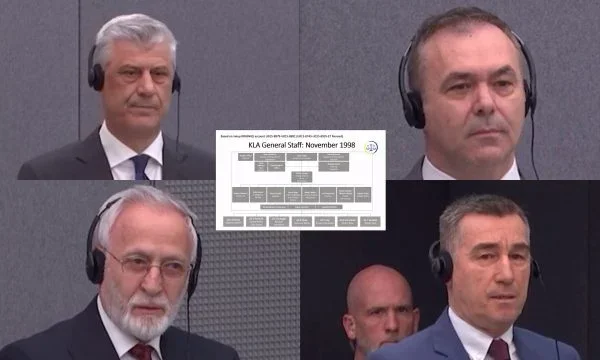
(3 years ago)The prosecution is spending most of its time at the start of the trial against former Albanian war leaders, trying to testify to the organisational power the KLA General Staff had. Hashim Thaci, Kadri Veselini, Rexhep Selimi and Jakup Krasniqi, according to the prosecution, had begun creating “joint criminal establishment” [...]
At the Special Court in The Hague, judgment has been launched against former Kosovo Liberation Army leaders Hashim Thaci, Kadri Veselin, Rexhep Selimi and Jakup Krasniqi.
The procedure has initiated its opening judgment statement, able to present the KLA structure in an effort to prove the organisational power of this rebel organisation in 1998-1999.
Acting attorney Alex Whitting, who is replacing retired Jack Smith, said they will provide evidence KLA evidence, as he said, had hierarchy and for Thaci's authority, Veselin, Selimi and Krasniqi in the General Staff.
Whiting said that during questioning during the investigation, Thaci had said that the General Staff had been <x0functional” and only “on paper”, claiming these statements as untrue.
Making a history of KLA creation, the other prosecutor, Matthew Halling, presented several statements and documents of former KLA leaders. According to him, Thaci, Veselin and Selimi had founded the General Staff and started “this joint criminal enterprise”. Krasniqi was said to be a member of the political directorate.
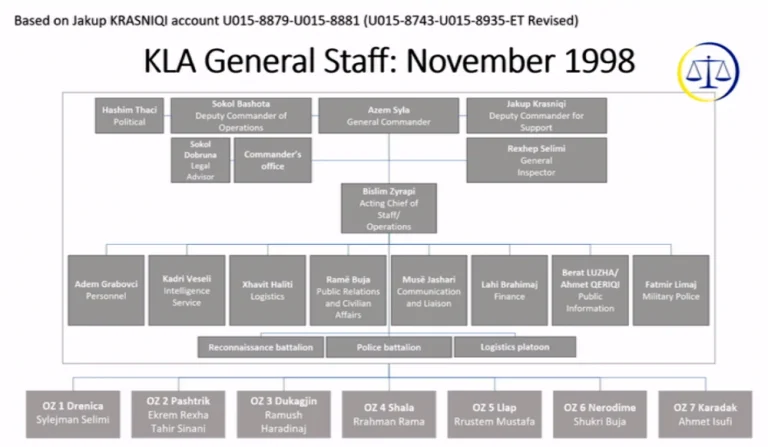
Among other things, prosecutor Halling also presented an organogram of the November 1998 KLA structure, referring to the data, which, according to the SPS, was found at Jakup Krasniqi's house.
You can see Krasniqi suggesting his role as deputy commander KLA and the role the other three indictees had: Hashim Thaci political, Rexhep Selimi general inspector Kadri Veselin the official discovery”, prosecutor Halling said.
Whiting said the motive of committing war crimes and crimes against humanity alleged in the indictment “was to gain power in the war, in Kosovo against persons perceived as opponents of the KLA”.
The “may have carried out for fear that their cause would be undermined by those perceived as opponents. It could have been revenge. You will see evidence of these two”, he said.
“Common criminal intent to target opponents was not hidden at all”, said Whiting.
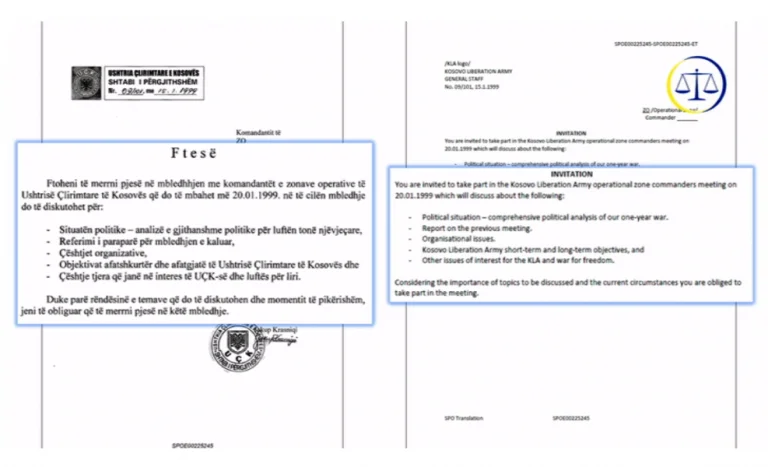
The other prosecutor, Halling, also presented a document that said was found in Jakup Krasniqi's apartment. According to him, how he proves Krasniqi instructed the commanders in the areas to conduct arrests.
“This order of early December 1998, signed by Jakup Krasniqi and found in his apartment, is another example in instructing the local commanders to order the military police to arrest those citizens who show loyalty to the occupants, who wear Serbian police uniforms, because they have thus committed acts of treason against Albanians. The same will be done in the future for any citizen who has been involved with any police force that is not part of the KLA, before the political status of Kosovo is decided”, he said.
Prosecutor Matthew Halling said that during the interview at The Hague by specialised prosecutors, Rexhep Selimi had confirmed the posts the four indictees had had had during the war.
A portion of Selim's interview was broadcast in court, where Selimi had spoken about who wrote the KLA communiqués and who it was about the message coming out of the General Staff.
A book by Jakup Krasniqi was quoted, where he allegedly speaks of the hierarchy that the KLA had and that it “should be respected”.
The prosecution has five hours to enter the trial, and most of this is being spent to testify to the organisational power of the KLA.