35 minutes ago
“The Guardian”: Trial against Kosovo's most prominent politician, will rewrite history
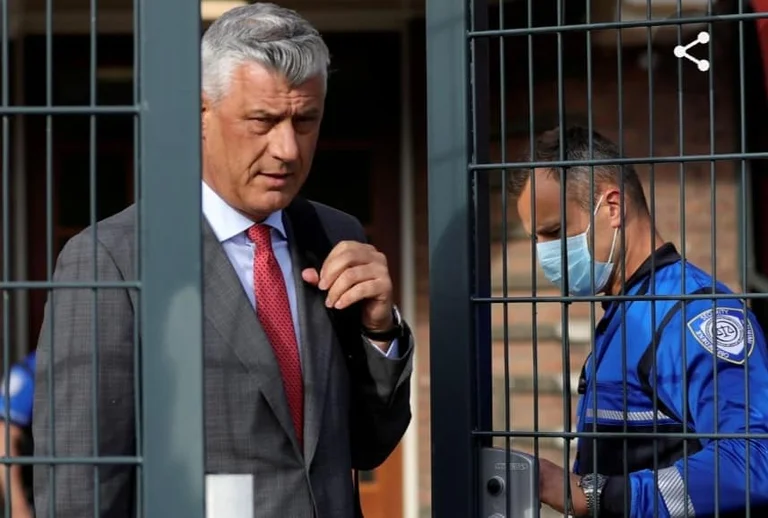
Periskopi(3 years ago)
(3 years ago)The prestigious British newspaper “The Guardian” has dedicated a special trial article in The Hague to the leaders of the Kosovo Liberation Army. The focus of this article is on former President Thaci, whom the newspaper refers to as Kosovo's most prominent politician. Among other things, the newspaper describes the historical events of war and after it as [...]
The prestigious British newspaper “The Guardian” has dedicated a special trial article in The Hague to the leaders of the Kosovo Liberation Army.
The focus of this article is on former President Thaci, whom the newspaper refers to as Kosovo's most prominent politician.
Among other things, the newspaper describes the historical events of the war and after it, as well as their role in them, to the arrest of Specialised Chambers in The Hague.
The following is the complete article from The Guardian:
A quarter of a century ago, in the middle of the war in Kosovo and after that, high international figures managed towards the door of Hashim Thaci, commander of the Kosovo Liberation Army, who would later become the country's most prominent politician.
Thaci hosted former Great Britain Prime Minister Tony Blair, one of the most prominent international KLA supporters. He met with the late Liberal Democrats leader Sir Paddy Ashdown for a beer. Madeleine Albright, then US Secretary of State, was a loud fan and Hillary Clinton met with Thaci later when she took the same position.
However, last week, Thaci, who served as prime minister and Kosovo president, é appeared at the Hague tribunal's dock of indictees along with three prominent colleagues, all charged with war crimes committed during the conflict, including co-operation in killing 102 people.
As prosecutors filed their case against Thaci and other defendants Rexhep Selimi, Kadri Veselini and Jakup Krasniqi all senior figures in the leadership of the KLA during the war against Serb forces from 1998 to 1999 they described an alleged campaign of murder, torture and distress against opponents and members of ethnic minorities led by four men.
The victims allegedly included ethnic Albanian supporters of rival political party LDK, Serb and Roma civilians, who were held without regular process in inhumane conditions at KLA headquarters, were subjected to torture and, in some cases, executed.
The trial, which opened two years after men surrendered to the jurisdiction of the court and is expected to last up to six years, now seems certain to rewrite the history of the conflict.
The procedures, deeply disgruntled in Kosovo and neighbouring Albania, recall the period of brutal conflict between 1998 and 1999, where Serbian and Kosovo armed organisations committed war crimes in the context of the KLA's armed uprising and Belgrade's military response.
In a war originally fought in and around small villages and towns in the KLA's Drenica mountain raid, Thaci, known as “Gjarpri”, was political representative at the KLA General Staff.
Later, at the end of his 20s, he distinguished himself among his colleagues commanders for his intelligence and confidence, later representing the KLA in failed peace negotiations in Rambouille, France, in early 1999 that preceded NATO's intervention in the conflict.
However, in the same villages, with their small houses and farms scattered on mountain pastures, the indictment claims that the KLA and its commanders kept its prisoners in often difficult conditions, subjecting them to beatings and other humiliations, and sometimes killing them. .
Among the catalogue of alleged crimes detected last week is one: events that took place around 26 July 1998 amid a Serbian offensive.
Later, the prosecution document said, KLA members “took approximately 30 prisoners from Lapusnik to the nearby mountains of Berisha/Beriša and divided them into two groups. One group was resolved and released; the other group's detainees were shot and” killed.
If the trial at The Hague is a hit, it is because NATO's intervention in Kosovo was defined as a response to serious war crimes, not least of Racan's massacre by Serbian forces in January 1999, which redefined the extent of military intervention on humanitarian grounds.
Even then, however, it was clear that both sides targeted civilians, even if there was a change in scale, no less large-scale military action launched by Belgrade after the start of NATO bombings that led hundreds of thousands of civilians to leave Kosovo in neighbouring countries.
For some, including Western diplomats who faced Thaci and other KLA commanders during the conflict, as they remember, Western support was a choice of interest formation in London and Washington with the KLA against Slobodan Milosevic in Belgrade, which had already been immersed. Bosnia in horror.
The “all had to do with ridding Milosevic and a post-decision reshuffle for Bosnia”, recalls an official who met with Thaci during the conflict.
Thaci, recalls the former official, had “an atmosphere of authority”, but failed to recreate himself fully as an independent politician, as requested by some of his Western political fans. Instead, he remained in contempt of his old colleagues in the KLA's general command, elections that would eventually leave him vulnerable to prosecution, as unclear questions appeared in the decade after the war over the KLA's own data.
In 2010, then a report by Dick Marty to the Council of Europe was to be published, detailing allegations of serious human rights abuses, including organ trafficking from the KLA, which would lead five years later, to the creation of a special judge of appointed KLA members, including Thaci.
But while the case has continued in court at an almost icy pace, with Kosovo under pressure from its former Western supporters to hand over Thaci and his alleged colleagues, the most surprising claims by Marty's report that the victims were killed and seized by the bodies of dealt with procedures.
Instead, the focus of the case against Thaci and his three colleagues is now that, through “superior responsibility” in the KLA chain of command, they agreed to “plan and policy” that led directly to crimes, “participating, facilitating, adopting,
Encourage them, and fail to prevent crime from happening.
If the prosecutor's form is now clear, so is the defence described by Thaci's lawyer, Gregory Kehoe, last week, in which he said that while Thaci “does not deny that some crimes were committed by ethnic Albanians [for revenge] he refuses that they were committed as a matter of politics [i]. KLA was ... or that they were popular. ”
Kehoe also underlined what would likely be a key issue disputed between the prosecution and defence: how centralised and hierarchical the KLA command structure was.
While the prosecution insists that documents and statements at the time showed a higher concentration of power and direction from the group's general staff, Thaci's lawyer would argue that the KLA was more vague, with Thaci enjoying less influence than claimed in the indictment, in a basic group whose loyalty, he said, was to local commanders.
If this is likely a difficult issue to resolve while the trial continues, it is because even those who had the opportunity to observe Thaci and the KLA closely remain, 25 years later, uncertain how much Thaci had in different periods during the conflict and how much at the centre was organised The KLA.
He was an opportunist,” remember them. “It was part of the command structure, but it had a lot of local rivalry. The question is, what control did he have, and to what extent did he use it?”. /Lajmi