6 minutes ago
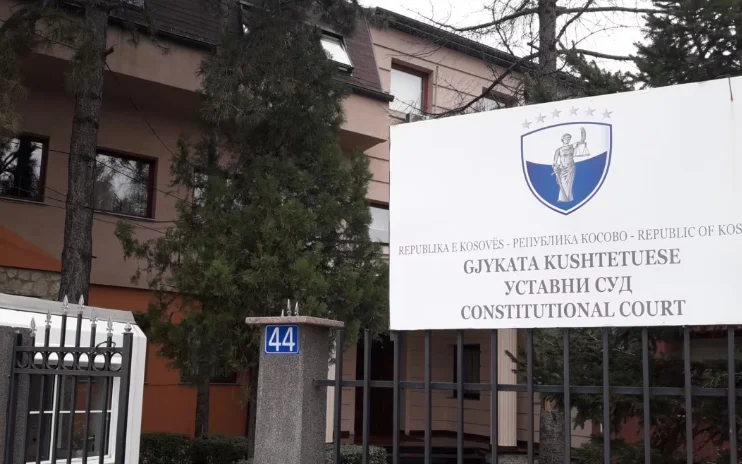
Constitutional Court Decision Comes Up, No President
Periskopi(3 years ago)
(3 years ago)The Constitutional Court has already made the long-awaited decision on a complaint made by non-Serb candidates for deputies, and the decline of the country's president and thus by other institutions, but constitutional spirit was violated. Earlier, there had been reports that the Constitutional Court would declare illegality to two deputies of the non-Serb minority communities. [...]
Earlier, there had been reports that the Constitutional Court would declare illegality to two deputies of the non-Serb minority communities. This was potentially meant to jeopardise the process of electing President Vjosa Osmani on April 4th, 2021, which in the first round had had only 81 deputies participating.
The two MPs -- one from the Egyptian community (Vejton Berisha) and the other from the Roma community (Albert Kinoll) -- had claimed that their counter-Candidians had received more votes than there were residents of these communities in respective settlements.
Such a thing would effectively stabilise the vote in Kosovo, making voting outside the ethnic affiliation vulnerable to voters.
But the Constitutional Court's decision protects the constitutional spirit by allowing voting even outside the ethnic affiliation of citizens. Such a thing will effectively not affect the process of electing President Vjosa Osmani.
“Votes in the Republic of Kosovo are personal, equal, free and secret. The vote cannot be annulled/invalid based on ethnic voter affiliation. ” says in decision.
The bias explains that, the essential issue involving the concrete case, is whether the votes of the citizens of the Republic of Kosovo can be annulled/invalided based on their supposed ethnic affiliation. In this context and based on Article 53 [Information of the Constitution's Human Rights Deposits], the Court emphasises that fundamental rights and freedoms are obliged to interpret in harmony with the ECHR judicial practice and in the context of electoral rights, in line with judicial practice in interpretation of Article 3 protocol No. 1 KEDNJ. Based on this latter, among other things, and as it is staged in the Act of Justice, (i) it is not the role of courts to determine the will of voters; and (ii) any invalid declaration of votes should be based on clear legal basis. Given this judicial practice, the Act further argues whether in the Republic of Kosovo ballots can be declared invalid based on the supposed ethnic affiliation of voters. The” goes on and on.
In the opposite case, as connoisseurs of the country's Constitution had warned, including Enver Hasani ʹ could be at risk.
“If the constitutional right is found to have been violated, as a result two mandates are invalid or not constitutional, that job is not discussed, namely (the president) should hand over the mandate and return to zero point, there can be no other interpretation”, Hasani had said.
Full Court announcement:
20,04,2023
Today, the Constitutional Court of the Republic of Kosovo has decided on the request in the case of KI 69/21, with the forger the United Roma Party of Kosovo (PREBK) and the Egyptian Liberal Party (PLE), represented by Albert Kinoli and Veton Berisha, respectively, regarding the assessment of the Constitution of the Act of Action [A.N.29/2021] of 12 March 2021 of the Supreme Court of the Republic of Kosovo.
The court, unanimously, has decided that (i) the request issued by PRBK, to declare it unacceptable, as a result of the failure of legal means prescribed by law; and (ii) the request issued by PLE, to declare acceptable consideration in merit; whereas, in large part, has decided (i) to establish that Act [A.N.29/2021] of 12 March 2021 of the Supreme Court did not violate the right of the pre-teller, respectively. PLE, to be elected to the Parliament after the February 14th, 2021 parliamentary elections, according to Article 1 of Article 45 [The Election Rights and Turnout] of the Constitution regarding Article 3 (Right for Free Election) protocol No. 1 of the European Convention on Human Rights; and (iv) to establish that this Act has no reform effect and that, based on the principle of judicial security, does not affect third parties' rights. The act will be met with competitive opinion.
The essence of the Action Contract: Votes in the Republic of Kosovo are personal, equal, free and secret. The vote cannot be annulled/invalid based on ethnic voter affiliation.
More precisely, the Act explains that the circumstances of concrete cases relate to early elections for the Assembly of the Republic of Kosovo held on February 14th 2021. Two candidates representing political subjects, PLE and PBEK, respectively, who according to the certified results of the upper parliamentary elections, had failed to win seats in the Assembly, claim that their electoral rights were violated as a result of the respective decisions of the Ances and Parashtre (PZAP) and the Supreme Court, which the prosecutions dispute before the Court by claiming violations of Article 4th 4th paragraph 58. [state responsibility], Article 45 [The Election Rights and Turnout] and Article 64 [the Parliament's exercise] of the Constitution of the Republic of Kosovo.
As for one of the top candidates, the pre-requirer, respectively, P REBK, represented before the Court by Albert Kinoll, explains that the same one has not exhausted legal means as required through Article 7 of Article 113 [Jurisdiction and Authorised Palaces] of the Constitution, because it has not appealed PZAP decisions of 7 and 10 March 2021 to the Supreme Court. As for the next petitioner, respectively PLE, represented before the Court by Veton Berisha, explains that the same contends with the Supreme Court's Act only with the refusal to cancel/nounification of invalid ballots at exact locations in the municipalities of Kamenica, Gracanica and North Mitrovica. However, the PZAP's supplementary decision of March 10th 2021, which he had firmly ruled with Northern Mitrovica, had not appealed to the Supreme Court, resulting in failing to deplete the legal means prescribed by law. Consequently, according to the request for the applicant, the Court's merit assessment is subject to the contested Supreme Court Act only due to the rejection of invalid annulment/responsion of ballots in the locations exacted in the municipalities of Kamenica and Gracanica, respectively.
In the upper context, the Court recalls that as a result of the failure of enough votes to win a seat in the country, in the February 14th 2021 parliamentary elections, the pre-compliancer had handed over the respective complaints/appeles to PZAP and then to the Supreme Court, claiming that the votes won by Romani Initiative were “signed and co-ordinated with” the political list <2> and that, as a result, all the votes that this subject has won and that the vote exceeded the number of voters, the Egyptian community, the Roma community, and the respective elections must be declared.
PZAP and the Supreme Court had based their decision-making based on these claims and referring to paragraph 4 of Article 58 of the Constitution and paragraph 2 of Article 64 of the Constitution, but having overlooked Article 45 of the Constitution, having cancelled/declared invalid ballots in the municipalities of Leposavisic, Novoberda, Ranillug, Partesh and Klokotti, in essence, setting the standard for exercising the right to choose and choose from the judicial order of Kosovo Republic, is the condition of the ethnic voters and the voting vote. More precisely, according to the PZAP and the Supreme Court, (i) regarding the twenty- (20) countries guaranteed in the Assembly, in the context of passive rights, parties, coalitions, civic initiatives and independent candidates, who have been declared to represent the respective communities that are not majority, can be voted only by voters of the same community; and therefore, in the context of active electoral rights, voters can vote only for parties, coalitions, civic initiatives and independent candidates who are declared to represent their community; and (i) vote won for coalitions, coalitions and independent candidates, who are represented by a community that does not exceed the majority of voters who are supposed to be declared as opposed to a single community, because the individual vote has been declared, because they are not allowed to vote, because they have a single-no solution to vote, because they have a single-computed, and then, because they have a single-no rights to vote, because they have a single-mindedly vote. P ZAP and the Supreme Court, calculating the proportion between the number of balloting and voters supposed to represent a community that is not a majority, had based on “ments taken from the Statistics Ent of the Republic of Kosovo 2011, but also on loan reports of O The SBE and the Voters' Books. ”
The applicant before the Court, in essence, claims that (i) the ballots in the respective polling should be annulled/resulted in proportion to the number of voters representing the relevant community because, on the contrary, elected representatives in the “framework undermine objective links with the community” that the same claim represents; and (ii) the guaranteed seats in the Assembly under paragraph 2 of the 64th Constitution can only be won if voted by the same community, which coalitions, civic initiatives and candidates for the countries that represent the countries. In that statement, the demand foreman, himself stresses that the subx2-precious legal base “is missing in the Republic of Kosovo, stressing also that “has no practice and precise international standards” and which expressly determines that the seats guaranteed for communities that are not majority can only be won if voted by the same community they claim to represent. In the absence of this constitutional and legal basis, the forger of the motion claims that, based on paragraph 4 of Article 58 of the Constitution, the Court must force the constitution to take adequate measures through the release of laws, through which, through which, the effective participation of communities that are not majority in Kosovo, so that, among other things, guaranteed seats in the Kosovo Assembly would be won only if the members of the same community, whom they claim to represent, and more precisely, “communities would be registered in the special election lists, so that only voters can be found in the lists that they can vote for representatives of the same communities to make sure they are guaranteed.
In assessing the constitutionality of the Supreme Court's contested Court, the Court, as far as it is relevant under concrete circumstances, has explained (i) the general principles for electoral rights under the Constitution; (ii) general principles for representation of communities that are not majority in Kosovo under the Constitution and the European Council Convention on Protection of National Minorities; as well as (ii) general principles under the Code of Good Practice for Election Affairs of the Venice Commission and the Conferences for the Protection of the National Laws of Public Relations in Life. The court, also, has particularly clarified the European Court for Human Rights's practice (GJEDNJ) in interpreting Article 3 of Protocol No. 1 KEDNJ's in context of (i) procedures needed for cancelling election results, including invalid voter statements; and (ii) electoral rights and national minorities. In context of the latter, the Act also outlines opinions and reports of the Council of Europe and Opinions of the Venice Commission, including but not limiting to (i) the report on Election Rules and Afirmative Actions on the participation of the National Minorities in the Decision Process in the European States; (ii) the Protection of National Minorities and Elections; and (ii) A review of opinion and reports concerning the National Election Systems and Minorities.
The bias explains that, the essential issue involving concrete cases, is whether the votes of citizens of the Republic of Kosovo can be annulled/the invalid mark based on their supposed ethnic affiliation. In this context and based on Article 53 [Information of the Constitution's Human Rights Deposits], the Court emphasises that fundamental rights and freedoms are obliged to interpret in harmony with the ECHR judicial practice and in the context of electoral rights, in line with judicial practice in interpretation of Article 3 protocol No. 1 KEDNJ. Based on this latter, among other things, and as it is staged in the Act of Justice, (i) it is not the role of courts to determine the will of voters; and (ii) any invalid declaration of votes should be based on clear legal basis. Given this judicial practice, the Act further argues whether in the Republic of Kosovo ballots can be declared invalid based on the supposed ethnic affiliation of voters.
Initially and in the context of validity and/or the worthlessness of balloting, the Act explains that (i) based on paragraph 1 of Article 64 of the Constitution, the countries in the country are divided by the number of valid votes won by relevant political subjects; (ii) the Law for General Elections, as long as it does not specify the criteria on which the default of the vote can be found, the PZAP defines as independent organ competent to decide on complaints with the allowed election process (i). P The ZAP has the authority to annul/declared invalid ballots in extraordinary circumstances, but always based on the applicable arrangement, the Constitution, the Law for General Elections and relevant PZAP regulations and the Central Election Commission (KQZ) respectively.
In this context, the Act rules out that Article 45 of the Constitution is the fundamental article regulating electoral rights and participation. The same stipulates that (i) every citizen of the Republic of Kosovo who has reached eighteen years of age, even on election day, enjoys the right to choose and choose, except when this right is limited to judicial decision; (i) the vote is personal, equal, free and secret; and (ii) state institutions support opportunities for participation in public activities and the right of each to influence democratic decisions on public organs.
The indictment explains that based on Article 45 of the Constitution, the active aspect of electoral rights -- respectively -- is subject to only two constitutional restrictions, age and the relevant judicial decision. The same rights are also guaranteed through the General Election Law. The latter, in Head II, defines the right to vote, voter lists and period of opposition and confirmation for the Voters' List. As long as it's relevant to the concrete circumstances, in Article 5 (right to Vote) it also defines certain restrictions that are connected with the right to vote, while Article 7 (List of Voters) determines that citizens are eligible to vote in the Central Civil Register, specifying that the information needed for the voter's list is “, the name, the date of the birth, the address of the vote where he/she is appointed to vote <1x>, which is recorded in the alphabet and in the original languages which are kept in the laws for the use of languages in Kosovo. The ECZ's applicable law and regulations contain no obligation for voters to declare their ethnic affiliation for the purposes of the Voters' List and exercise of active electoral rights. Such an approach, in fact, is in full compliance with international instruments, including as clarified through the Good Practice Code Expedition Report on Election Affairs, and according to which, among other things, neither candidates nor voters should be asked to show their affiliation as a national minority. The characteristics of the vote connected with its freedom and secrecy are guaranteed with all international instruments, as is explained in the Act of Judgment. Moreover, based on the applicable arrangement of the PZAP and the CEC, the invalid announcement of the balloting involved only the circumstances in which (i) the vote has been marked more than a political subject; (ii) the way the target of voters is marked; (ii) the ballots are not sealed with official stamps; and (iv) the voter marks the candidate only and not the political subject. The high-level regulation does not specify any criteria on which ballots based on ethnic voters can be declared invalid.
While in the context of the right to be elected, the passive aspect of electoral rights, Article 45 of the Constitution, respectively, except age and restriction through judicial decision, does not define any other restrictions or condition. However, in the context of parliamentary elections, this article must be read and interpreted along with Article 64 [the Parliament's structure], 71 [Kupalifications and Gender Equality] and 73 [Condition Impossible] of the Constitution, respectively. The first stipulates that, twenty (20) countries in the Kosovo Assembly are guaranteed for parties, coalitions, civic initiatives and independent candidates who have claimed to represent the Serb community or other communities, regardless of the number of seats won, while the second and third, determine the qualifications needed to run and the circumstances of running for Parliament MPs. For the circumstances of the concrete case, the relevant is the interconnection of nines 45 and 64 of the Constitution, respectively.
Furthermore, The Act explains that the secret vote also defines Article 64 of the Constitution, noting also on open electoral lists. This article also stresses that the Assembly has a hundred and twenty-four) deputies elected by a secret vote, based on open lists, where twenty (20) countries are guaranteed for representation of communities that are not majority in Kosovo, in the exact way in paragraph 2 of Article 64 of the Constitution. These guarantees are also indicated in Article 110 (General Submissions) of the General Election Law, under which, among other things, the Republic of Kosovo is considered an electoral zone with many candidates. Procedures related to the registration of political parties and political subjects are identified in Head III (Registration of political parties and the Certificate of political subjects) of this law. None of these procedures determines specific exceptions or procedures in the sense of political subjects competing for guaranteed seats in the Assembly. Such a criterion, based on paragraph 2 of Article 64 of the Constitution, in the context of registering upper political subjects is defined in the applicable rules of the CEC, and which, within the framework of the documentation needed for the corresponding census, also envision the “declarate of the ethnic affiliation of the founder of the political initiative”.
In that sense, guaranteeing the designated seats in the country for communities that are not majority, based on constitutional and legal provisions as clarified earlier, unequivocally includes the obligation of these countries to be won only if they have been voted by the same community that is not a majority, conditioning for active electoral rights in ethnic affiliation. The Venice Commission's reports and opinions, including commentary reports of international instruments as clarified in the Act, clarify electoral systems in all European states, and more broadly in the context of the national minority accommodation, and as much as it is relevant in the circumstances of concrete cases, among other things, stress that (i) there are electoral systems which in the context of electoral rights since they define guarantees and/or additional access to national minorities, including countries guaranteed in the respective municipalities, while in the context of active electoral rights put the emphasis on freedom and vote (i) and exclusion (in particular cases of electoral rights, the active lists of individual elections or electoral votes for individual national minorities, and the laws defined. In the Republic of Kosovo, such a system, which defines the particular electoral system for communities that are not the majority in the context of active electoral rights, is not defined with the Constitutions or the General Election Law. According to the Constitution, the vote is personal, free, equal and secret, while, among other things, according to the Miraj Practice Code for Election Affairs, neither candidates nor voters are obliged to reveal their affiliation as a national minority.
Moreover, the Act also refers to the latest case of the GEDNJ, Bakirdzi and E.C against Hungary, which took a firm form on April 3, 2023 respectively. This case is extremely relevant for concrete circumstances, because, among other things, it concerns (i) the free expression of voter will; (ii) the shortcomings of the national minority voting system that affect the secret of voting; (ii) systems that require a national minority candidate to be chosen only by voters of the same minority; and (iv) systems that allow national minority voters to vote only for their respective national minority lists, and not for general political parties' lists. In this case, and despite the fact that the Hungarian law itself stipulates the interconnection between active rights and election passes with relevant ethnic affiliations concerning specific locations in the assembly, the GEDNJ, in context of the relevant circumstances, found that the electoral rights of national minority voters were violated contrary to the guarantees defined through Article 3 of Protocol No. 1 of KEDNJ, stressing, among other things, that (i) has doubts that a system in which the vote can only be cast for a closed list of candidates and requiring voters to abandon their party affiliations in order to have representation as a member of a national minority, provides “free cuts in the opinion of the people in the election of the legislature”; and (i) the right to hide fully from voting under such circumstances is not available to national minority voters.
Based on the above clarifications, the Act states that (i) in paragraph 2 of Article 45 of the Constitution, the vote is personal, equal, free and secret; (i) according to paragraph 2 of Article 64 of the Constitution, regardless of the number of seats won, twenty (20) countries in the Republic of Kosovo belong to communities that are not exactly the majority in this manner; (i) The constitution, the international instruments detailed in Article 22 [direct implementation of the International Agreements and Instruments], its judicial practice and GEDJ practice, and the General Election Law, in the context of active electoral rights, do not include the obligation of voters to choose only parties, coalitions, civic initiatives and independent candidates declared to represent the community they belong to, and in the context of the post-election rights, nor countries guaranteed in the country of Kosovo for parties, coalitions, civic initiatives and independent candidates, are not conditional only in the vote of the citizens they represent; they are not conditional in the communities they claim; they are not the citizens they represent; and the communities that are. (iv) if the state is defined for such a system, the same must be determined through laws adopted by the Parliament and in accordance with the definitions and constitutional values; and (v) according to the ECDNJ judicial practice, it is not the role of courts to determine the will of voters, and any invalid declaration of the vote should be based on clear legal basis and on the exact procedure followed, as defined in the laws and regulations that are applicable. In the context of the latter, the Act explains that under the electoral system in the Republic of Kosovo, there is no legal basis on which the ballots in certain locations could be declared invalid, given the assumption of ethnic voter affiliation, including the proportion between the number of ballots that may have won a party, coalition, civic initiative and independent candidate declaring that it represents a community that is not a majority, and the number of voters of the same community in place.
Consequently, and in the absence of a constitutional and/or legal basis for mispronounced balloting in the municipalities of Kamenica and Gracanica, respectively, the Court finds that the refusal of invalid annulment/species of ballots in upper municipalities through the controversial Act of the Supreme Court has not resulted in the violation of pre-decisive rights of the demand to be elected in the Kosovo Assembly of 1th under the 45th Constitution in connection with the 3rd protocol. 1 KEDNJ.
In fact, the applicant himself highlights the fact that there is no constitutional and/or legal basis in the Republic of Kosovo to declare invalid ballots based on ethnic voter affiliation. Consequently, it requires that the same decision by the Republic of Kosovo be forced by the Court to take adequate measures, through the provision of laws that could determine separate lists for communities that are not majority, through which the effective participation of communities, so that, among other things, guaranteed countries in the Kosovo Assembly could be won only if voted by members of the same community they claim to represent.
In addition, the Act explains that in the context of the requirements set forth based on paragraph 7 of Article 113 of the Constitution, such as the circumstances of the concrete case, individuals are authorised to set up violations by public authorities of their individual rights and freedoms. While, based on Article 63 [General Principles] of the Constitution, the legislature of the Republic of Kosovo is the Parliament. The latter has full competence to determine the model and specifics of the electoral system through adopted laws. Based on the principle of separation and balance of powers, the laws adopted by the Parliament could submit to the assessment of constitutionality by the Constitutional Court if disputed based on provisions of Article 113 of the Constitution.
In the end, the Act explains three other matters, and it links with the circumstances of the concrete case, such as (i) another Supreme Court Act, and which has decided the same as in the circumstances of the petitioner; (i) the obligation of following the procedures needed for the invalid declaration of votes, including dealing with claims of violations, respectively, criminal acts related to the implementation of electoral rules and procedures, as defined in the applicable laws; and (i) the effects of this bias.
Regarding the first issue, the Act makes clear that the preamble of the request in his parliament has also referred to a Supreme Court Act, respectively. [ Footnote] AA.n.30/2021], which was issued after appeals of political subjects representing the Bosnian community Nasha Initiative; The Bosniak Social Democratic Union and Nova Democraticska Stranka list, which, according to the applicant, based on the same interpretation of Article 5 Article 58 of the constitution, has annulled/declared ballots on all locations that were contested by complaining political subjects. The court explains that this Act has never been contested before the Court, and therefore it has not been subjected to the assessment of its constitutionality.
Regarding the second issue, the Act explains that Article 1 of the constitution's Article 64 specifically refers to “the number of valid votes” in determining the seats won in the Republic Assembly, while the relevant legal bases and the way the declaration of invalid votes is defined in the Law for General Elections and the next applicable election arrangement. The prosecution highlights the fact that, based on the ECHR judicial practice, but also the applicable laws of the Republic of Kosovo, the null declaration of votes, must be based on clear legal basis. Moreover, the Court stresses that criminal acts against voting rights are defined in Chapter X V III of the Criminal Code of the Republic of Kosovo. Claims of violations along the election process, including abuse of voting rights and procedures like the same are addressed, are accurate in the Law on General Elections, but also in the Penal Code and the Criminal Procedure of the Republic of Kosovo.
In the end, and in terms of the third case, respectively, the effects of this verdict, the latter explains that, according to the Court's accuracy in the preliminary bias that links individual rights to post-election disputes that are related to parliamentary elections, in (i) the CI207/19 Act, respectively, with preama Social Democrat, the New Kosova Alliance and the Party of Justice, regarding the assessment of the constitutions [A.U. October 30th 2019 and [A.A.U. Mr. 21/2019 of November 5, 2019, the Supreme Court of the Republic of Kosovo; and (ii) The trial in cases of KI45/20 and Kl46/20, with predeceiver Tinka Kurti and Drita Milaku, regarding the assessment of the constitution of the rulings [A.n. On February 19th, 2020 and [A.r.3/2020] of the Supreme Court's February 19th 2020, based on the principle of judicial security, this Act cannot produce the reverse judicial effect on the declared election outcome pertaining to parliamentary elections on February 14, 2021.