14 minutes ago
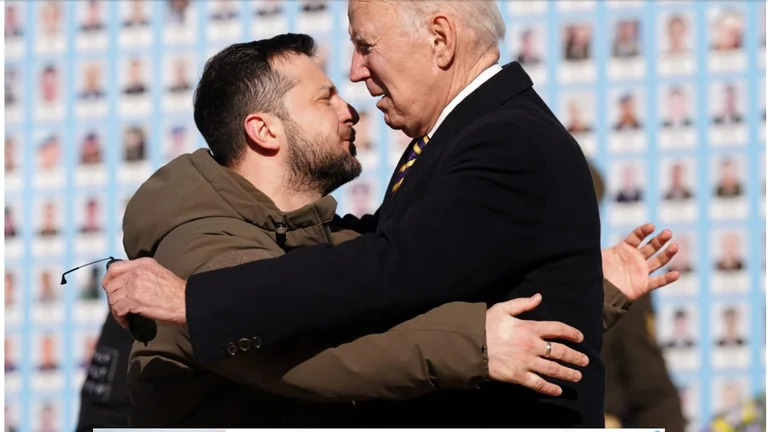
What awaits him after the war Zelensky
Periskopi(3 years ago)
(3 years ago)A number of opposition politicians believe that after the war, President Volodyyr Zelensky will have to pay for the mistakes that they are now closing their eyes on because they do not want to influence the country's freedom struggle. I was on the street during the Orange Revolution in 2004 and 2014. So the tenth anniversary is yes [...]
I was on the street during the Orange Revolution in 2004 and 2014. So the tenth anniversary is approaching, and this is the period in which we tend to start revolutions”, said about politicco.euInna Sovsun, a member of the liberal pro-European party Holos.
Almost ten years ago, hundreds of thousands of Ukrainians protested and knocked down Victor Yanukovych a Russian President Vladimir Putin's doll, broadcasting Telegrafi.
The Maidan Revolution of 2014 had unforeseen consequences, setting in motion events that have brought Ukraine into its current position by defending itself against a Russian invasion initiated by Putin's revenge and discontent. And as much as that multicolored revolution had an echo, so much war would be, creating strong national feelings and creating great expectations for the future and they would be difficult to meet.
Sovsun is not the only one who sees another crash on the horizon.
A former Ukrainian minister said that “E know, Maidan could happen again”. He asked not to be identified so that he could discuss sensitive topics freely. The opposition was cautious as he spoke as he feared he would undermine efforts to release and provide Russian propaganda food.
“This war has raised high hopes and people will be very eager to change”, he said. They will want money and justice as well as the outcome of the reform they demanded in 2014 They'll want to get there soon.
And while sailing into the turbulent post-war political waters would be difficult for any leader, according to the former minister, it would be especially difficult for the Ukrainian president because he became part of the problem as a leader with autocratic trends.
It might sound weird, looking out. After all, for a year now, Zelensky has been praised as the incarnation of Ukrainian resistance, even an icon of democracy. He still applauds for refusing an offer by Americans to leave Kiev, when Russian tanks were 60 kilometers from the capital, and his inspired rhetoric during the war and the fascinating speaking skills were useful in convincing the United States and Europe to support Ukraine at the historic moment of existence.
Zelensky's unmovable leadership, communication skills, and spirit have raised his reputation in Ukraine as well. According to polls, he enjoys high public support only the military is more popular than he is. Experienced observers, however, view the mark as 84 percent as a result of a patriotic rally and predict that numbers will drop soon after the existential threat is removed. A similar thing happened shortly after the former commander became president in 2019, gaining a sweeping election with a promise to protect people's interests against the rich and the ruling class.
Unfortunately, Zelensky couldn't repeat the role as in the TV series, “People's servant” in real life and support fell to only 11 percent after dismissing the reformist-minded prime minister, creating a government of friends and former business partners and achieving nothing against corruption. Instead, some accuse the Ukrainian president of acting increasingly autocraticly and of violating the laws of presidential decrees to sanction opponents, all on behalf of combating Russian aggression, but, some critics say, even to harm his political opponents.
Four months before the Russian occupation, Zelensky and two close associates were also involved in financial activities. Based on Pandora documents hidden documents that reveal the activities of political leaders and other prominent individuals worldwide, it was found that the Ukrainian leader founded companies in fiscal paradise before becoming president but continued to benefit from them after taking office. Zelensky denied any money laundering or lawlessness in the use of these funds.
It is not the time to criticise him for pre-war activities, political opponents say, but when the conflicts go out, questions will arise about everything that happened before its start. An explanation will also be required why Zelensky ignored the Western dramatic warnings of the high probability of a Russian invasion and why he did not prepare the war site earlier.
However, from time to time, these questions were raised even in the middle of the war, and they were finally sparked in August, when a wave of public criticism followed after Zelensky said he minimized warnings of an imminent attack, claiming he had to do so because he did not want panic to spread, so that people could start fleeing and avoid an economic collapse, Telegraph broadcasts.
Opposition politicians and civil society leaders confirmed that Zelensky would also come under criticism for the way he and his close team of old friends and former business partners during the war -- no different from the way they did this before the invasion, trying to establish a pre-eminent <x0democracy with a dominant party.
“Of course, we must support the government and we must remain united”, said Mikola Kniagetski, the opposition representative from the town of Lviv in the western part of the country. “Anyway, I worry about the future of democracy in my country. Even under war conditions, there must be a political opposition, the democratic process must continue, have parliamentary supervision”, he said.
Like others, Kniagetski noted that Zelensky is using the powers of presidential war and the military law to gain more power, control the media, marginalise parliament and ignore legislative oversight of how government funds are distributed, and who. Did the Ukrainian president's business partners benefit or companies linked to members of his ruling party?
Some are also afraid that global praise, Zelensky can turn it into narciss.
“He thinks he's the world's number one politician and that Joe Biden is very, very behind him, and leaders like Macro and Scholz are even further away from”, the former minister said, adding that this is not healthy.
Like others, he cited the fact that the Ukrainian leader does not like to share “the spotlight”, while a former president's assistant stated that Zelensky's office is always analyzing polling records to ensure no one is letting it shine.
Critics say that this very wish can explain why Zelensky rejects calls to form a coalition government at a time when Ukraine needs more harmony.
However, Timofij Milovanov, president of the Belgrade School in Kiev, former economy minister and informal government adviser, dismissed claims that Zelensky has the characteristics of an autocratic leader.
“Zelensky gives people what they want. In my opinion Ukraine is lucky to have him. I believe his predecessors in the presidential post would have surrendered in the first weeks of the war and would have started negotiations”, he said.
Milovanov says Zelensky is building a nation and has no choice but to bypass institutions, which are often confused according to their interests.
No one knows what Zelensky thinks about the future. I think he's been changing his views for the last three years since he became president. I think in a way he understands a lot more than we do at”, he added.
In January, during his address to the nation, Zelensky promised Ukrainians “that things will not return as they were”.
However, the statement followed a corruption scandal linked to excessive military contracts and suspicious payments that led to the removal of a number of high-ranking Ukrainian officials, including five regional governors and four deputy ministers. The scandal was uncovered when an investigative journalist published details of illegal contracts after the government did not respond to the problem. Zelensky's words do not calm even some experienced observers in Ukraine.
” I haven't seen enough effort to address corruption. Maybe there's some exception”, says a former senior American official with extensive experience in Ukraine. “They are really trying to prevent any fraud with the large amounts of assistance they receive from the West. I think they understand the danger, they know it would be a big scandal”.
However, this former diplomat says he was surprised by the fact that many opposition politicians and civil society representatives “on the one hand truly respect Zelensky's strength as war leaders”, but at the same time “are deeply concerned about corruption and authoritarian style”.
“They believe there will be a confrontation once the war is over,” he said, adding that “I think this is probably true”.