10 minutes ago
Wagner symbols seen at Belgrade's rightist protest
Periskopi(3 years ago)
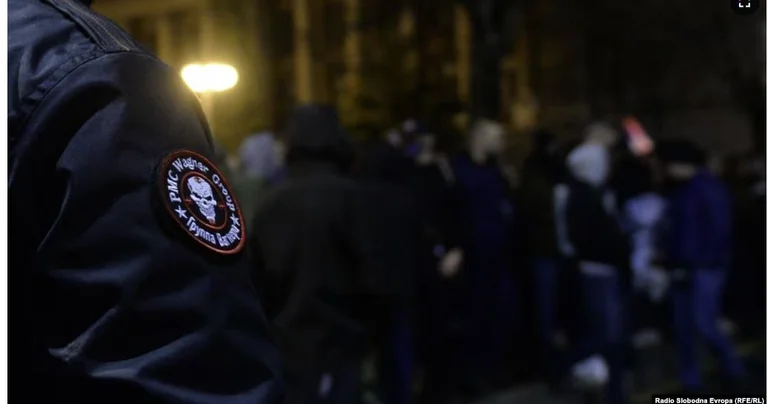
(3 years ago)Under the slogan “no capitulation” and calls “Kosovo is Serbia”, protests were held in Belgrade, Serbia, on 17 March against the European proposal for normalisation of reports between Kosovo and Serbia. A group of masked persons, some of whom wore symbols of Russian paramilitary formation, Wagner, kept an inscription saying: [...]
Under the slogan “no capitulation” and calls “Kosovo is Serbia”, protests were held in Belgrade, Serbia, on 17 March against the European proposal for normalisation of reports between Kosovo and Serbia.
A group of masked persons, some of whom wore pre-milative Russian premilitar symbols, Wagner, carried an inscription saying: “The people and the church in defense of the state against treason, that's the only option of”.
The protest was held a day before Kosovo Prime Minister Albin Kurti, and Serbia's president, Aleksandar Vuciq, met in Ohrid, North Macedonia, to discuss the plan to implement the European proposal for normalisation of reports.
Several thousand people, at the invitation of the right-wing parliamentary parties, gathered in front of the St Sava Church, where they continued their march towards the presidency of Serbia.
Protesters cheered various slogans such as “We will not give Kosovo, “Kosovo is Serbia” as speakers addressed the crowd in front of Russian Carit Nikola II's monument, located in front of the Serbian Presidency building.
Protesters also cheered “Serbia, Russia, we do not need the European bloc” and “Serbia, Russia”.
Parliamentary rightist parties Dverni, Zavetnici and coalition called the protest NADA.
Protesters waved Serbia's flags and cheered slogans against the European Union and said the “Association of Serb majority municipalities is far from”. They also sang this nationalist regarding Kosovo.
The main protestor's request was to reject the European proposal for normalisation of reports between Kosovo and Serbia.
“Today, we have a single message, to protect our homeland, without party symbols, all are welcome”, said Milica Djurdevq-Stamenkovs, leader of the rightist Zavetnici party.
Protesters have also called on Serbia's president, Aleksandar Vuciq, to resign and hold elections at all levels of power.
Right-wing parliamentary groups have 34 out of 250 seats in the Serbian Parliament.
Representatives of these parties have argued that the European proposal is ultimatum for Serbia to recognise Kosovo's independence.
These parties also have close reports with Russia, and in recent months, representatives of the rightist parties have visited Moscow.
The European proposal, which Kosovo and Serbia accepted on February 27th, is seen as a temporary agreement that will lead to the final one between Kosovo and Serbia. While not envisioning mutual recognition, Western diplomats say it is the best agreement that can currently be reached between Kosovo and Serbia.
The proposal includes the parties' pledge to respect all agreements reached so far in the dialogue on normalising relations, as well as their commitment not to prevent each other from integrating processes.
Serbia insists that Pristina form the Association of Serb majority municipalities, meanwhile, Kosovo wants the final agreement to include mutual recognition.
Dialogue between Kosovo and Serbia on normalising the reports started in 2011. The European Union brokers the process, meanwhile, the United States, though not a party to dialogue, supports it.