24 minutes ago
Thaci's lawyer: This man sacrificed everything, we hope to bring his release
Periskopi(3 years ago)
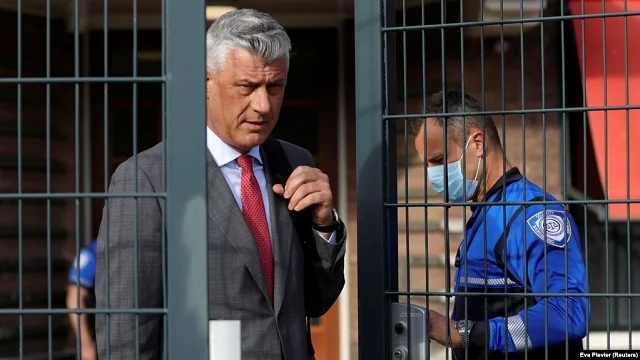
(3 years ago)Former Kosovo President Hashim Thaci, considered hero by fellow countrymen for leading the 1998-99 uprising against Serbian rule that led to independence, will face trial Monday for alleged war crimes during the war. The news agency “Reuters” writes that a special Kosovo court filed at The Hague indicted [...]
The news agency “Reuters” writes that a special Kosovo court filed in The Hague indicted Thaci in November 2020 on 10 counts of war crimes and crimes against humanity, including persecution, murder, torture and forced disappearance of people during the uprising.
Thaci, 54, resigned as president shortly after that and was transferred to custody in The Hague. Three of his closest associates, including two former Parliament Speakers, face the same charges as former Kosovo Liberation Army members (UÇK).
The four are accused of participating in a joint <x0 criminal enterprise ... that carried out wide or systematic attacks on Serbian minority civilians in Kosovo, as well as against Kosovo Albanian opponents, opponents of the KLA.
Gregory Kehoe, an American lawyer in Thaci's defence team, said prosecutors would be given two years to complete presentation of evidence.
This man sacrificed all these years and we hope we will be able to get him into the courtroom and prove that he was an honest, honest man and bring his release”, he told Reuters.
As fighting decreased in intensity and Serbian forces withdrew from Kosovo under NATO bombings, Thaci exchanged his green uniform for a blue suit and a tie. When Kosovo declared independence in 2008, he was prime minister, and in 2016 he became president.
Before the trial, throughout the small Balkan country, Thaci's photos and former Prime Minister Kadri Veselini could be viewed with the “War and PeaceHeeros”
War veterans and other nationalist Kosovo groups warned a protest in support of former KLA indictees for Sunday.
Mass grave
Olga Bozanic, a Kosovo Serb, hopes the trial will be a chance to learn what happened to the two brothers, Todor and Lazar Kostic, whose remains were found in a mass grave in a village of western Kosovo in 2005, which is covered by the indictment.
“From witness confessions, we know they were taken from their house along with all the men from the village on July 17th 1998 and that they were tortured”, Bozanic told Reuters. “But we don't know when and how exactly they were killed. Maybe during the trial we'll get some new evidence showing the details”.
The Kostic brothers were in a larger group of Serbs arrested in July that year and later killed on the edge of a rock and an army jeep was placed on them to hide their remains, said an investigator who spoke on condition of anonymity.
But in 2005, a team of forensic experts led by the United Nations discovered the mass grave.
Along with her two brothers, 15 of Bozanic's cousins were arrested and later killed by the KLA, she said. I expect all those responsible for the killings to be punished in order not to kill and torture again”.
Kosovo's Specialised Chambers, headquartered in the Netherlands and staffed by international judges and lawyers, were established in 2015 to handle cases under Kosovo's law against former KLA members, Klankosova broadcasts.tv.
Many Kosovo Albanians believe court is unilateral against The KLA and interested in denigrating its past.
But Ehat Miftaraj from the non-governmental Institute of Kosovo for Justice said the trial should be understood as a “case against certain individuals of is h - U n CK, not a trial against U n The CK or the values the people of Kosovo represent”.
The court was established separately by the former UN Constitution for the former Yugoslavia, also located in The Hague, where it tried and convicted mainly Serbian war crimes officials committed in the conflicts of Croatia, Bosnia and Kosovo.
More than 13,000 people -- most of them Kosovo Albanians -- are believed to have died during the 1998-99 war, when it was still a province of Serbia under then President Slobodan Milosevic.
Milosevic went to trial before a separate UN tribunal in The Hague for war crimes against Kosovo Albanians in conflict, but he died in 2006 before a decision was made.
Several top Serbian officials, including then army chief Nebojsa Pavkovic and Deputy Prime Minister Nikola Shainovic, were sentenced to long prison terms for war crimes in Kosovo.
The fighting ended after NATO air strikes on Serbian forces and Kosovo declared independence a decade later, though Serbia continues to refuse recognition of its citizenship.
Kosovo has adopted legislation to pay Kosovo and foreign lawyers for the protection of Thaci and his colleagues, and 16m euros so far have gone to their defence fund.