an hour ago
Why does Pigozin have disagreements with Russian officials over the funeral of Wagner's warriors?
Periskopi(3 years ago)
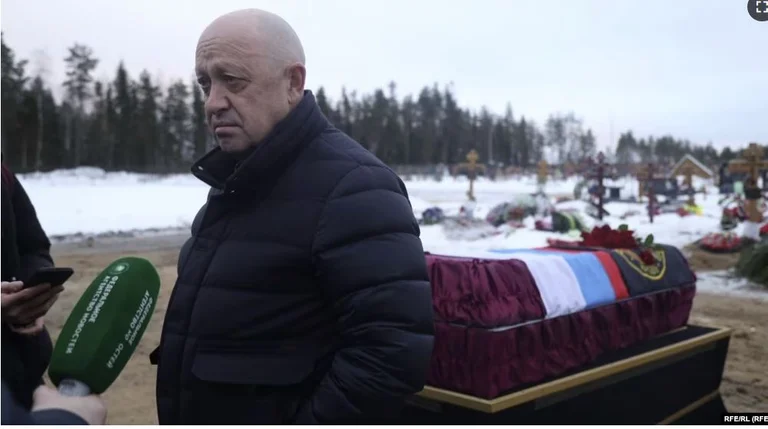
(3 years ago)Like most Russian mortar ceremonies, one held north of the city of Goriac had colorful crowns, portraits of those killed, red giraffes, and coffins covered with flags. But this ceremony, held on March 19, was impressive in [...]
But this ceremony, held on March 19th, in the region that is best known for thermal baths and minerals, was impressive in another way: a public struggle between local administration and the founder of the Wagner Group merc company Yevgeny Prigozhi.
The mayor of this town said there were a lot of Wagner soldiers buried in this place and it would be better for them to be buried elsewhere. Enraged, Prigozy and his allies opposed the chairman and held the ceremony in which the dead were honoured and the local administration was criticised.
Conspiracy over burials comes amid growing doubts about the political future of Prigozhin, which has become one of Russia's most notorious public figures in the middle of the 13-month invasion of neighbouring Ukraine. The former prisoner, who created his fortune through the opening of restaurants in St Petersburg, later linked lucrative food contracts to the Kremlin before establishing the Wagner Group.
The group of mercenaries, who have fought in Syria, Africa and elsewhere, has become a powerful war force in Ukraine. Although Wagner has suffered major losses, Prygozhi has publicly clashed with senior commanders in the Russian Ministry of Defence, criticising the conduct of operations on the battlefield.
And this has prompted speculation that the establishment of Prigozhin is quietly adopted in the Kremlin, and if its rise may be to the end.
“As soon as it became clear that [Pigozin's] influence was dropping, the mayor of the city, after consulting with the leadership, received approval to refuse to allow the organisation of other burial ceremonies”, said Ivan Preobrazensky, a Russian politician, but now acting abroad.
This is probably a direct message from the presidential administration. Instead, it is most likely someone inside the Russian bureaucratic system who has realized that Pigozin is simply not as scary”, he told Radio Free Europe.
Too many graves?
Graveyards, which were at the centre of the recent political clashes for the first time, appeared in an opinion at the end of last year when activists unexpectedly published the appearance of dozens of graves. Since February, more than 300 new graves are in the Bakinskaja cemetery, meanwhile activists have said they have documented 570 new graves open this month.
Almost all these graves are believed to be of soldiers who fought for Wagner in Ukraine.
Western officials have estimated that Wagner has suffered a large number of losses, separately around the town of Bahmut in Donba, the town that has been the focus of a bloody attack that started last August. Wagner's troops, including the thousands of prisoners recruited to fight, have been the head of this attack. The White House has said that as many as 30,000 Wagner warriors have been killed or wounded so far.
While Pigozin's fame has increased, his supporters -- most of whom are hardline nationalists -- have attempted to glorify the efforts of Wagner's slain warriors.
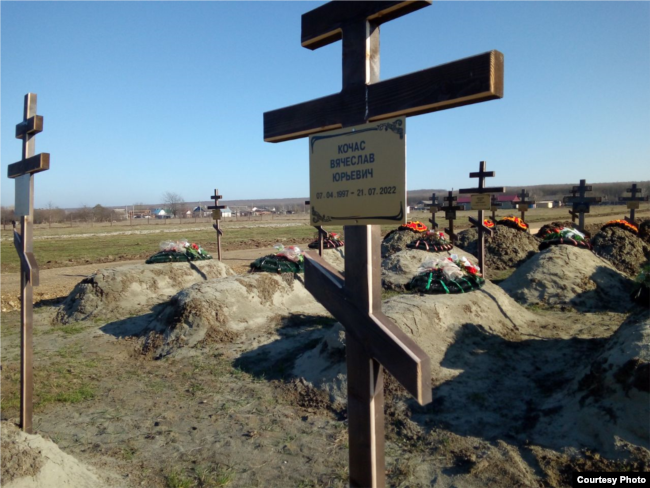
Two weeks ago, when Wagner officials tried to hold another public funeral for their eight fighters at the Bakinskaja cemetery, municipal officials in Goriac Kluc stopped them, calling out that public opinion was expressed against continuing burials.
In his Telegram account, Prigozhin published on March 18th what he claimed was a recording of a telephone among Wagner representatives and chairman Sergei Belopolsky, in which Belopolsky explained why he did not give permission for the new funerals.
Shortly after, Belopolsky published his statement on this dispute, and said that since “respects fighters”, he does not think that this city, which is the resort of thermal baths, is the right place for further burials. He said he has better locations in this region for this.
However, the funeral was held, according to videos posted on various accounts on the telegram. The ceremony included the release of a audio message from Prigozhin, which called local officials “the ruins that are hidden in office”.
Some local lawmakers attended the funeral, even though no party representative backed by the Kremlin, United Russia, were present at the ceremony.
The following day, Prygozhin published a new statement saying that the governor of Krasnodar, where Goriaci Kluc, is located, had promised that there would be no more obstacles to the funerals of Wagner's slain warriors.
Andrei Panyushkin, a local activist, told Radio Free Europe that he has doubts that public opinion rejects funerals. He said that there are an unknown number of local residents who have gone to fight in Ukraine, so residents may not object to mortar ceremonies. Two men from the two families his neighbor's joined Wagner. He said they were killed in combat.
Vitaly Votanovsky, another local activist, attended the mortuary ceremony. He said that people with car records from many countries in southern Russia had come to this ceremony.
Votanovsky also attended on behalf of families of Wagner's killed soldiers, and he has complained that families are not receiving compensation from the Russian government.
Publicity
Prygozyni's public disagreements, as well as public answers to the Kremlin and the Ministry of Defence, have been viewed carefully after the war in Ukraine has taken off and Wagner's forces are continuing to suffer great human losses.
Earlier this year, Wagner's ability to continue recruiting convicts from Russian prisons to fight in Ukraine appears to have diminished. Prigozhin himself said he would stop recruiting convicts.
The Russian Defence Ministry, meanwhile, has reportedly started recruiting itself in Russian prisons, taking this process from Wagner's hands.
Pigozin has also complained that his forces are not being given enough ammunition, which he has said has hampered efforts to capture Bahmut. The Ministry of Defence has denied this charge.
Last week, the Bloomberg news agency, citing the nearby “Kremlin members and intelligence services”, reported that Pigozin has been aiming to reduce Wagner's operations in Ukraine and focus on Africa, where his mercenaries are reportedly found in four different states. Pigozin has dismissed these claims, through a sarcastic statement published on the telegram on March 24th.
“Prigozhin itself realizes that publicity is his only resource”, said a politicologist who talked about REL under the condition of anonymity, due to the restrictive laws in Russia. Especially if a populist plays with the dislike of local bureaucratic”.
“Prpgozhin... is learning the hardest lesson in the Kremlin policy”, said Mark Galletti, expert on Russian security services. He made these comments by means of an authorial text published during March before discussing funerals. “No matter how necessary you were yesterday, the important thing is how necessary you can be tomorrow”. / REL