21 minutes ago
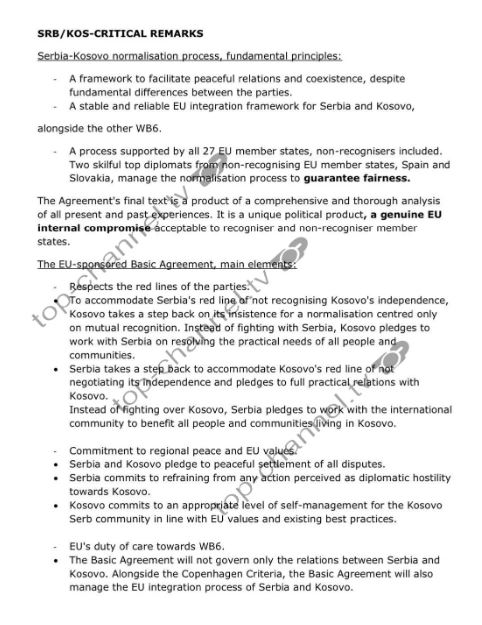
This is the document that was presented to Vuchy Kurt in Ohrid.
Periskopi(3 years ago)
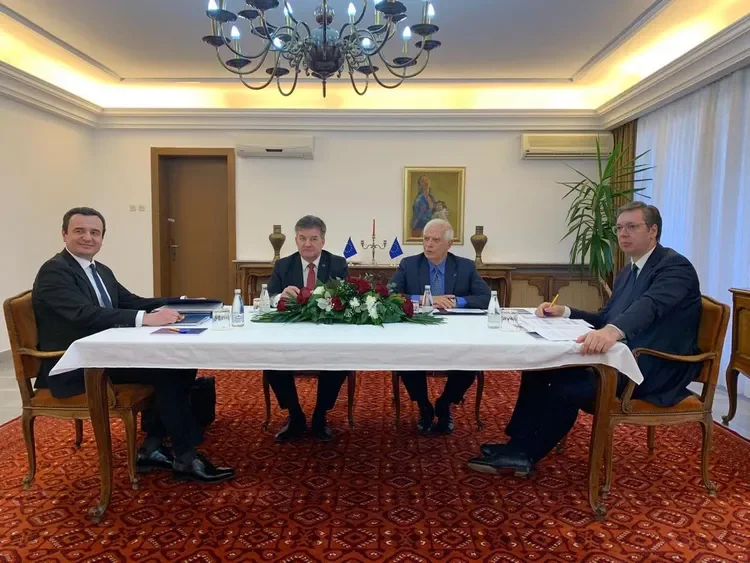
(3 years ago)The meeting between Kosovo and Serbia ended just minutes ago. Regarding what was offered to the parties, Top Channel has provided a document reportedly put on the table by the EU US. The declaration defines the fundamental principles of the agreement, which is a framework for [...]
Regarding what was offered to the parties, Top Channel has provided a document reportedly put on the table by the EU US.
The declaration defines the fundamental principles of the agreement, which is a framework for facilitating peaceful relations and co-existence, despite fundamental differences between the parties. A stable and reliable framework of integration into the European Union for Serbia and Kosovo, along with the Western Balkan countries.
And it is a process supported by all 27 EU member states, including those who do not recognise Kosovo's independence. In the statement, there are reportedly two senior diplomats capable of non-EU member states Spain and Slovakia managing the normalisation process to guarantee justice.
The final text of the Agreement is the product of a comprehensive and thorough analysis of all current and past experiences. It is a unique political product, a genuine internal compromise of the European Union, acceptable to recognise and not recognise member states. The main elements of the EU-sponsored Constitutional Agreement are the respect of the sides' red lines. To adapt Serbia's red line for not recognising Kosovo's independence, Kosovo takes a step back in its insistence on a normalisation focused only on mutual recognition. Instead of fighting with Serbia, Kosovo vows to work with Serbia in resolving the practical needs of all people and communities.
Serbia takes a step back to accept Kosovo's red line not to negotiate its independence and pledges full practical relations with Kosovo. Instead of fighting for Kosovo, Serbia vows to work with the international community to benefit all people and communities living in Kosovo. Serbia and Kosovo pledge peaceful resolution of all disputes. Serbia commits to refrain from any action perceived as diplomatic enmity with Kosovo. Kosovo commits itself to a proper level of self-management for the Kosovo Serb community in line with EU values and the best existing practices, this on general line means establishing association.
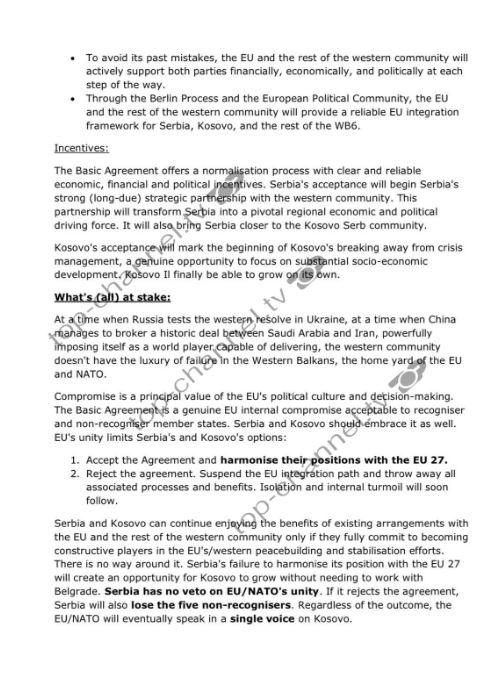
According to designers, the Constitutional Agreement will not only regulate relations between Serbia and Kosovo. In addition to the Copenhagen criteria, the Constitutional Agreement will manage the process of Serbia and Kosovo integration into the European Union. To avoid its past mistakes, the European Union and the rest of the Western community will actively support both sides financially, economically and politically at every step of the road. Through the Berlin Process and the European Political Community, the EU and the rest of the Western community will provide a reliable framework of EU integration for Serbia, Kosovo and the rest of the Western Balkans.
The foundation agreement provides a normalisation process with clear and reliable economic, financial and political incentives. Serbia's accession means the beginning of Serbia's strong strategic partnership with the Western community. This partnership will transform Serbia into a regional economic and political driving force. It will also bring Serbia close to the Kosovo Serb community. Kosovo's accession will mark the beginning of Kosovo's secession from crisis management, a real opportunity to focus on substantial socio-economic development. Kosovo can finally grow itself.
The US and the European Union also see what is at stake, at a time when Russia tests Western determination in Ukraine, at a time when China manages to mediate a historic agreement between Saudi Arabia and Iran, strongly imposing itself as a world player capable of offering, the Western community does not have the luxury of failure in the Western Balkans.
Compromise is a key value of EU political culture and decision making. The foundation agreement is a true internal compromise of the EU, acceptable to EU countries that recognise or do not recognise Kosovo. Serbia too, and Kosovo must embrace it. EU unity limits Serbia and Kosovo options: The parties must accept the agreement and harmonise their positions with the 27 European Union countries. The rejection of the agreement has consequences, suspends the path of EU integration, and the whole process and related benefits are rejected.
Isolation and internal unrest will soon follow. Serbia and Kosovo can continue to enjoy the benefits of existing agreements with the EU and the rest of the Western community only if they are fully committed to becoming constructive players in EU efforts to build peace and stabilisation. There's no way out.
Serbia's failure to harmonise its position with the EU will create an opportunity for Kosovo to grow without having to work with Belgrade. Serbia has no veto in the EU and NATO. If you reject the deal, Serbia will lose even the five countries that do not recognise Kosovo. Despite the outcome, the European Union and NATO will eventually speak in a single voice about Kosovo.
Kosovo must fully meet the expectations of the Western community, especially by respecting past agreements. Kosovo's refusal to do so could have serious consequences for Kosovo's future. Disillusioned, Western partners will be denied the incentive to support Kosovo's further growth. Without this substantial support, Kosovo can see a collapse of progress in some areas.