10 minutes ago
Weber: If they didn't agree on association, they didn't have a deal.
Periskopi(3 years ago)
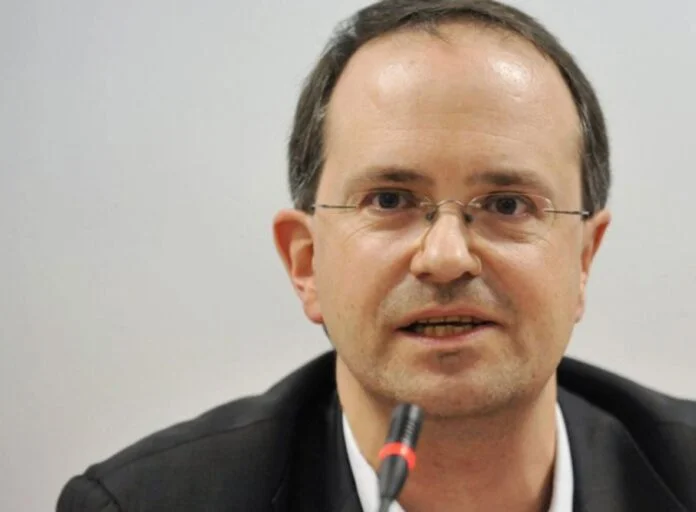
(3 years ago)The lack of clear agreement on the Association of Serb majority municipalities in Kosovo means there was no progress in talks between Kosovo Prime Minister Albin Kurti, and Serbia's president, Aleksandar Vuciq, held on 27 February in Brussels, says Balkan expert Bodo Weber. The two leaders said [...]
The two leaders said they have agreed to the contents of an EU proposal for normalisation of relations, but did not sign it.
The EU proposal, titled Agreement towards Kosovo-Serbia normalisation, requires among other things that the parties implement all agreements reached within the dialogue on normalising relations, including the one for the Association of Serb-run municipalities, which Kosovo has so far refused to establish.
EU officials, who mediated the talks, warned new meetings between Kurti and Vuciqi about modalising to implement the agreement.
That is precisely what, according to Weber, senior associate of the Berlin Democratic Policy Council, is indicative that at the February 27th meeting, there was no progress towards reaching a final agreement, “but only delayed disputes to be discussed with the annex of implementation”.
Radio Free Europe: Kosovo and Serbia reached agreement on the EU proposal for normalising relations between the two countries. Did you expect that outcome and what you think of it?
Bodo Weber: I'd say two things... First, because of pressure from Western capitals involved in negotiations and supporting Belgrade's proposal, much less for the Kosovar side, it was not surprising that EU foreign policy chief Joseph Borrell declared last night [that there was] success. And secondly, like everything with this proposal and agreement, which seems quite unclear, even the declaration [that there was] progress, seemed very unclear.
You may have noted that Mr. Borrell was not talking about reaching an agreement, but said the parties have agreed not to further negotiate the Agreement [to Kosovo-Serbia], but continue negotiations on the annex of implementation. However, if you hear the Serbian president's statement, Aleksandar Vuciq, after the meeting, could not be heard [saying] that agreement has been reached.
Radio Free Europe: The text of the European proposal is published Monday. In general, who do you think benefits most from the proposal as it is if applied?
Bodo Weber: Yes, the text is published. It's pretty much identical to previous versions that have been released, except for some details that are interesting. It is difficult to assess who will benefit at the end because of the character of this agreement.
This is a form of the intermediate agreement. It is an escape from the EU and US's earlier approach and approach to negotiate a final and comprehensive agreement directly.
There are several elements, especially in Article 6, for continuing [the dialogue] that should lead to further resolution of outstanding issues, remaining issues including bilateral issues and that should lead to a legally binding final agreement. But there is no clear master plan written for the road ahead.
So, it is very difficult to be truly confident that this interim agreement will truly mean great progress and eventually lead to a final agreement, which would include the formal legal recognition of Kosovo by Serbia. So the question is, [what will happen] if this does not lead to the final target point?
We must remember that such an approach was at the heart of the initial political dialogue in 2012 -2013. But, the EU and the US, at the time, have demonstrated that they do not have political will and capacity to lead such a long-term process.
And local parties [Kosovo and Serbia], in the end, have used the strategic vacuum to undermine and overthrow the process and make it work for them, but not to make it function in the direction of a sustainable solution.
So in this direction, if this process does not lead to a sustainable solution, then surely Belgrade will benefit in the long term, maneuvering the EU and the US in the longer term.
Radio Free Europe: The Kosovo government has trumpeted this plan as a victory, since, according to her, it has received a de facto recognition from Serbia. EU officials have confirmed this. What do you think of that?
The meeting between Kosovo Prime Minister Albin Kurti and Serbia's president, Aleksandar Vuciq, under the mediation of top European officials, Josep Borrell and Miroslav Lajcak. Brussels, February 27, 2023.
Bodo Weber: In a way, we may view this as progress in the sense of de facto recognition. The [plan] text is clearly copying not only the approach but also the formulation from the 1972 German agreement known as the basic agreement.
I mean, even the heads of governments and states of Germany, France and Italy, in their last letter sent Prime Minister Kurti, have named this agreement a base agreement. This is clearly the approach. In that sense, yes, Pristina is right. But it must be remembered that the April 2013 agreement [for normalising Kosovo-Serbia relations] was then named historic, such as yesterday's agreement. [It was estimated at the time] that a de facto recognition of Kosovo by Serbia was included, but did not lead to a sustainable solution to the status dispute.
So it can be concluded that this agreement, in the sense of a de facto recognition, in itself does not represent real substantial progress, but will depend on whether there will be a continuation up to the point of a final agreement and recognition of Kosovo by Serbia.
Radio Free Europe: Do you expect a slight dialogue in the coming days regarding the annex to implement the European proposal?
Bodo Weber: Well, frankly, if someone sees this counterspecies formulation, whether there really was an agreement yesterday or not, the impression is that there wasn't really an agreement, but that the dispute over this proposal has shifted to dialogue on the anaximity of implementation.
This particularly concerns the issue of establishing the Association of Serb majority municipalities [in Kosovo] and the issue of the implementation of this new EU agreement and previously agreed agreements, especially those dealing with association.
Radio Free Europe: Do you think there may be obstacles to implementation? Do you believe that the Association of Serb majority municipalities will be a breaking point in this agreement?
Bodo Weber: In this regard, the European proposal and [resistance] of the application annex should also be seen. So, in this direction, there was no progress yesterday. And, in particular, the issue of the Association of Serb majority municipalities remains an obstacle. There were no signs yesterday that the parties were closer to the agreement on the issue. So if there wasn't a deal for Association yesterday, de facto, there was no result.
Radio Free Europe: As for the Association of Serb majority municipalities, do you believe Kurti will change or ease his stance on the issue? Do you think this is an opportunity?
Bodo Weber: According to what Prime Minister Kurti said, there was an agreement yesterday. This agreement also includes reference for implementation of all previous agreed agreements, and this includes the April 2013 Association agreement and the 2015 agreement on Association.
So, in general, it's a change of Prime Minister Kurti's stance and [his party] Vetevendosje, regarding association. But to repeat, this will only happen if there is an agreement on the application annex, which currently does not exist.
Radio Free Europe: Kurti was also asked Monday about Association, and he has said his position on this has not changed...
Bodo Weber: Yeah, like I said, if there's no deal between Prime Minister Kurti and President Vuciq for Association, then we didn't have a deal yesterday.
We have also seen Kosovo Deputy Prime Minister Besnik Bislimi, today on the European Parliament's Foreign Affairs Committee and his statements on Association, including the repetition that there have been clear positions by previous EU envoys and by the US that association will have no executive competency.
At this moment, it remains quite unclear, including for me, if this is an acceptable position for Belgrade, on the basis of which President Vuciq can be hired for the annex of implementation, because it is not Belgrade's until now.
Radio Free Europe: You have publicly criticised the European proposal, especially in terms of the meant benefits for Kosovo, such as changing the position of the five European Union countries that do not recognise Kosovo -- Greece, Spain, Romania, Slovakia and Cyprus. Can you elaborate on that?
Bodo Weber: I mean that the very character of a temporary agreement, which does not affect the issue of the formal recognition of Kosovo by Serbia, creates many complications in this agreement, especially in the benefits for Pristina, most of which remain guarantees and promises of oral character, not guarantees written in the agreement itself that was published last night.
And, one of the problems is the issue of Kosovo's aspirations to join different international organisations and its aspirations for EU integration. Of course, this kind of agreement cannot include any written guarantees, that five non-recognitionants, or even part of them will change their attitude.
However, while there are indicators that some of them two to three can change the position, it is completely unclear whether one or two, which are not expected to change their position on [Kosovo's] recognition, will at least agree to give the green light, for example, on Kosovo candidate status for EU membership.
Plus, de facto, there is a sixth non-recognition, which is Hungary with Prime Minister Viktor Orban, which can easily block Kosovo's path towards the EU without saying it is done in Belgrade's support.
So when the agreement speaks of one that neither side should block the other's path to the EU, I cannot see how it can be measured and verified, if President Vuciq uses his special relationship with Hungarian Prime Minister Orban, to block Kosovo's path towards the EU.
We had almost identical wording in the April 2013 agreement. And, as Deputy Prime Minister Bislimi stressed today, Serbia has violated that agreement.
So, it's important when the current plan is compared to previous drafts of the agreements that have come up. This agreement, the authentic one published last night, does not speak as in previous drafts about how Serbia will support Kosovo's potential EU integration aspirations, but simply will not block it. That would be something, which would be measurable, because Serbia would be obliged to practically support Kosovo's EU path. But, in that kind of formulation, passive wording, this is almost impossible to verify by the EU.
Radio Free Europe: Since last year, EU and US officials have said that the end of March could be a good time to get tangible results in Kosovo-Serbia dialogue, for the sake of having a future in the EU. Do you think this is possible?
Bodo Weber: We have seen an announcement that Vuciq and Kurti will meet again with Borrell to continue negotiations on the annex of implementation [of the agreement] I think during Mr Borrell's future trip to the region, respectively, in northern Macedonia later in March.
So, given what we discussed right now, that disagreements have not been resolved, they have simply shifted into the application annex framework, it is really hard to predict whether a single meeting will suffice for Belgrade and Pristina to resolve the remaining substantial disputes, including the one for association.