15 minutes ago
Russians in Serbia surprised by worship for President Putin
Periskopi(3 years ago)
(3 years ago)About 200,000 Russians have fled their country to Serbia since the start of the war in Ukraine. Serbia is a close ally of Russia with which it has historical, religious and cultural ties. Russia supports Serbia's claim on Kosovo, but the Russian-Serbian connection is a complex relationship. Serbia refuses to impose sanctions [...]
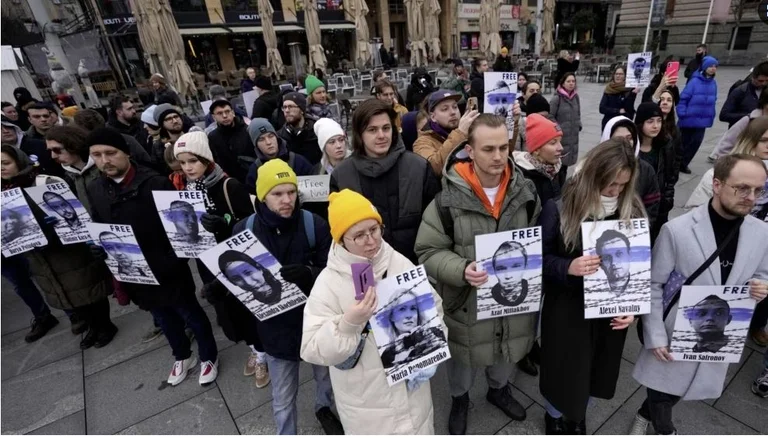
In the central square in Serbia's capital, Belgrade, dozens of Russians recently gathered to oppose President Vladimir Putin's war in Ukraine, holding photos of political prisoners from their homeland.
On the other side of the square, a large sign promotes Russian propaganda media RT, which has opened a news portal in Serbia. RT is forbidden to operate in other European countries. Through Serbia you can find T-shirts where heroic portraits of President Putin are drawn with bare breasts, but also in souvenirs and coffee cups, or painted on city walls.
These conflicting images reflect the complex and delicate relations that exist these days between Russia and Serbia.
Serbia is Moscow's closest ally in Europe, with historical, religious and cultural ties that become stronger by the Kremlin's political influence campaigns. Russia supports Serbia's claim on Kosovo, which declared independence in 2008 with Western support. Serbia has refused to impose sanctions on Moscow as punishment for aggression in Ukraine.
At the same time, Serbia wants to join the European Union. Most Russians in Serbia seek a new life in a brotherly country, but without the oppression of the Kremlin.
Anastasia Demidova, who arrived in Belgrade from Moscow three months ago, says people do not consider him an enemy.
Here in Belgrade, we are not considered enemies, and that means a lot. I've talked to many Serbs, they ask me what you're doing here, I tell them that we are against Putin and a democratic Russia, and of course we are against the war in Ukraine”, said Anastasia Demidova, Russian resident in Belgrade.
Other Russians say they left to avoid being affected by Western sanctions, which have damaged their businesses or jobs.
For this reason, Russian can be heard speaking anywhere in Belgrade, a city of about two million people. The Russians started opening restaurants and bars. Russian private companies, especially in the IT sector, have also grown to a large extent. The Russian flux has led to increased housing prices.
Some Serbs are reminded of the wave of Russians fleeing the Bolshevik Revolution in 1917, and many who remained in Serbia left their mark on Serbian culture and art.
“Russian contemporary migration, the contemporary Russian diaspora in Serbia, did not choose this country, but came here because it is the only one that accepts it. The previous immigration stayed here because they wanted to stay in the Kingdom of Serbs, Croats and Slovenians and those who did not want to, they could continue on to other countries”, says historian Alexey Timfeyev.
Russians who have now gone to Serbia cannot travel to the West due to sanctions and need visas.
Newcomers say they can still feel the fierce influence of the Kremlin, especially when it comes to the positive opinion that Serbs have of the Russian president, through propaganda media such as RT and Sputnik.
Russian activist Petar Nikitti calls this a <x0-coordinated propagandistic effort” that started for the first time in Serbia in the early 2000s.
At that time, this consent to the Russian government was less important. But it's grown enormously high. The newly arrived Russians, who did not know much about Serbia, are completely shocked by this worship, especially for Mr. Putin and for this image of Russia, which is completely separate from reality”, says Russian activist Nikitin.
Moscow empowers this feeling through pro-Russian media, fuelling Serbian anger towards the West because of Kosovo. Serbia's refusal to recognise Kosovo's independence has Moscow's support -- one of the reasons Belgrade maintains friendly relations with President Putin and has refused to join Western sanctions.
Serbian President Aleksandar Vucic has criticised the invasion of Ukraine, but every time he does so, he links the issue with the Balkans.
“We support Ukraine's territorial integrity, as we support Serbia's territorial integrity. So... when they ask me: Is Crime part of Ukraine or Russia? ) Yeah, it's part of Ukraine. Donbas is part of Ukraine. We will be more loyal to the territorial integrity of UN member states unlike other countries that changed their stance on Serbia's territorial integrity”, Serbian President Vuci said during the World Economic Forum in Davos last month.
Western officials have stepped up pressure on Mr. Vucic to make a decisive turn by leaving Moscow if Serbia wants to join the EU. They fear Russia could cause trouble in the Balkans through its Serbian representatives to avoid a portion of international attention from Ukraine.
Recently, the Russian private military group “Wagner Group” published ads in the Russian media, RT in the Serbian language, in search of recruiting Serbs to fight in Ukraine. In Serbia it is illegal for its residents to participate in conflicts abroad, though some of them joined the separatists backed by Russia in eastern Ukraine after the battles that erupted there in 2014.
Russian Activist Nikitin, who has formed a group called the Russian Democratic Community, has joined forces with a Serbian lawyer to file a lawsuit seeking investigation of the Russian mercenary group Wagner. This led to increased threats against the more liberal Russians by right-wing Serbian organisations with close ties to Wagner and Moscow.
The threats I take directly and in my mailbox are very carefully formulated, but they are quite obvious. They're from Serbia to very shameful insults involving my family. There are also threats that I will soon join the dead”, Mr. Nikki said.
He says his most liberal fellow countrymen in Serbia are eager to show they do not support President Putin's war or the crackdown on opposition groups in the country.
Stanisislav Schenkevich, 29, from St. Petterburg, arrived in Belgrade on November 1st, after he was laid off in Russia. He now works as a barber in downtown Belgrade.
I had no long-term plans to stay, but after two and a half months in Belgrade, I decided to stay. My wife will arrive soon and we will stay here”, said Mr. Schenkewich.
Artem, 33-year-old from St Petersburg, indicated that he left Russia with his wife and two domestic animals shortly after the war began. He refused to report his last name for security reasons.
For me, it was kind of a protest, because I didn't agree at all with the war, but I can't do anything in Russia, because if I try to object, it could end up in prison”, Artem said.
About 200,000 Russians have fled their home country to Serbia since the beginning of the war in Ukraine. / VOA