8 minutes ago
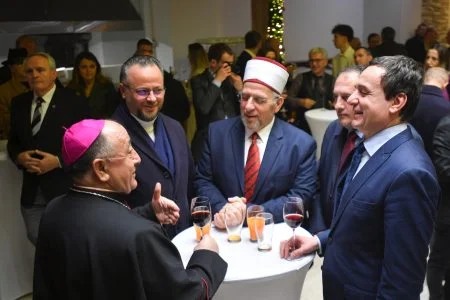
Religious communities express disappointment with the Bill on Religious Freedom
Periskopi(3 years ago)
(3 years ago)The Law on Religious Freedom, adopted by the Government of Kosovo on January 25th, contains no major and radical changes, compared to bills adopted by past governments, assessing representatives of religious communities. Read also: https://www.periskopi.com/government-fu-fu-dti-dart-religious union-resident-toy-control-raportat-financial-Dok/ Religious Sociologist Ismail Hasani, on the other hand, says [...]
Religious Sociologist Ismail Hasani, on the other hand, says there are a lot of confused terms on this bill that could later pose problems.
However, if the bill is adopted by the Assembly of Kosovo, religious communities will legally be able to secure their legal status, which with the Law on Religious Freedom adopted in 2006 has not been defined.
The recently adopted bill recognises the existence of seven religious communities in Kosovo, which constitute the country's historical, cultural and social heritage.
They are: The Islamic Community of Kosovo, the Catholic Church, the Serbian Orthodox Church, the Jewish Community, the Kosovo Protestant Church, the Kosovo Tarit Community and the Kosovo Bektasian Community.
Bills adopted in 2020, 2017 and 2014, which have not been transformed into law due to lack of votes in the Kosovo Assembly, have recognised the existence of six religious communities, not including Kosovo's Bektasian Community as special.
Most of these communities view the new bill as quite liberal. But there are also remarks and disagreements, which, they say, have also been expressed during his public review in December last year.
BIK: Bill allows factions within a community
All religious communities agree at one point that there must be a law that recognizes their legal status.
The Islamic Community of Kosovo (BIK), which aims at organising religious life of 95 per cent of Kosovo's Islamic population, considers that the bill adopted by the Government of Kosovo on January 25th is not the option expected by this community.
Ramadan Shkodra, BIK representative, says this community has demanded that the unitary system be maintained within religious communities. But according to him, the current bill, if adopted as a law, will enable the creation of many factions within a community.
“We favour that the historical side of religious communities be recognized, to recognize the way of forming religious communities. We are for every citizen of Kosovo to guarantee freedom of faith. But freedom of organization is quite another matter. With this law, we will have much trouble in Kosovo. Tomorrow we can have communities of these extremist ideology. For anachronism, the Government and Kosovo itself has banned NGOs [nongovernmental organisations] with religious grounds. Meanwhile, it now creates the comforts of creating many religious communities of a belief”, Shkodra says.
Article 7A of the new bill says that Kosovo “can also register new religious communities”, through the demand for registration, and on the condition that when “is registered, there are at least 100 members of Kosovo's” citizens of adulthood.
The Catholic Church says that this bill is in principle acceptable.
Don Shan Zefi, Kosovo Archbishop Chancellor, says the Archbishop has provided suggestions and that one of their remarks has dealt with legal cases of inspection of the church's revenues and financial exits.
There were our remarks, because, if the Government of Kosovo invests, the state of Kosovo then has the right to review revenues and exits. Meanwhile, those who are exclusively within the church, such as offerings within the church by believers... We have not accepted this issue”, says Kosovo's Archbishop Chancellor.
Article 12B of the bill, which defines financial reporting, says that all religious communities “are obliged until March 31st of next year, to submit audited financial mirrors for the preliminary year”.
COMM S: We were unable to consult the bill
The Serbian Orthodox Church (KOS), in December 2022, has sent two representatives to consultations organised by the Government of Kosovo regarding the bill, but those “have not been able to get full access to these consultations, nor do they give their suggestions”, because those “have not been provided with translation into Serbian language, as provided by law”. So says Milos Peric, secretary of Prizren Diocese, in a written statement sent Radio Free Europe.
“We are working on the analysis of the new draft and our lawyers will consult with relevant experts, as well as with international representatives. The bill our church agreed to several years ago and was current until late was changed to some important points, while we were unable to express objections or consult for it”, Periq says.
He adds that, however, it is good that in the new bill, as in 2020, the Serbian Orthodox Church is registered by its legal name, which is also accepted in the Constitution of Kosovo.
According to him, the law will ensure the invisibility of the internal structure of all religious communities, including the Serbian Orthodox Church.
“This means that the Serbian Orthodox Church in Kosovo is an inseparable entity with the Serbian Orthodox Church, whose headquarters is in Belgrade”, Periq says.
Considering that the census for traditional religious communities is automatic, he says the Serbian Orthodox Church “will not go into the registration process”, but that “subjectivity and its legal continuation in these areas will automatically be recognised”.
In the draft law, Article 4A, Article 2, states that the seven religious communities, which have been specified, are granted legal status.
Meanwhile, in Article 7A, Article 1 says that <x0 religious co-operation is not obliged to register and accept the status of the legal person against their will”.
Peric says the Serbian Orthodox Church's position on the bill will depend on the assessment of experts on legal and religious issues with which this church is consulting. This stance, then, will also be the basis for MPs representing the Serb community in the Kosovo Parliament on how they will vote.
Given that the Bill on Change and Fulfilling the Law on Religious Freedom is vitally important, it requires two-thirds of the double votes of MPs, representing non-communities in the Kosovo Assembly. The Serbian community has ten guaranteed seats in the Assembly.
KPUK: Liberal bill with scandalous <x0D”
Kosovo's Protestant Evangelist Church (KPUK) praises the Bill for Change and Fulfilling the Law on Religious Freedom as fairly democratic and liberal. But the chairman of this church, Femi Calcoli, says he does not specify who provides the parcels for all religious communities with equal treatment.
Also, Calcolly says, the bill does not suggest that non-state Kosovo members who come to the country on matters of trust be recognized as missionaries or, depending on the appointments that religious communities may give them.
The current bill, according to him, also deals with an issue, which in the form that has been defined, risks violating the preservation of belief between the Christian clergyman and believer, in the case of “repenting-conference”.
They are: The Islamic Community of Kosovo, the Catholic Church, the Serbian Orthodox Church, the Jewish Community, the Kosovo Protestant Church, the Kosovo Tarit Community and the Kosovo Bektasian Community.
Bills adopted in 2020, 2017 and 2014, which have not been transformed into law due to lack of votes in the Kosovo Assembly, have recognised the existence of six religious communities, not including Kosovo's Bektasian Community as special.
Most of these communities view the new bill as quite liberal. But there are also remarks and disagreements, which, they say, have also been expressed during his public review in December last year.
and other competent bodies participating in criminal procedures related to criminal acts (various)”.
BTK: Without registration of religious communities, Kosovo does not recognise itself
Lulzim Shehu, secretary-general of the Kosovo Tariciat Community (BTK), estimates that the current bill has no essential changes compared to the three bills adopted by Kosovo's preliminary governments.
He says there have been no problems in drafting the bill in the procedure.
I hope this law will complete a vacuum, in which Kosovo, in fact, does not recognise itself. Doesn't mean someone on the outside knows you. Kosovo does not recognise itself, with the fact that it has not been possible for religious communities to register”, Shehu says.
Hasani: Confusion of Terms and Names
The professor of religion sociologistship in Pristina, Ismail Hasani, estimates that the bill in question is only a few innovations about the way religious communities were organized does not go beyond the law adopted in 2006, as well as the bills that were passed by governments until 2020.
In the background of religious communities, according to him, the Bektasian Community community has been added, which earlier was within the framework of the Kosovo Tarit Community.
Also, according to him, there is no further step in the definition of the Serbian Orthodox Church in the current bill.
Hasan estimates that there are confused terminologys between ethnicity, religious communities and faiths in the bill.
According to him, the definition of the Orthodox Church has been confused with the term Serbian Orthodox Church, giving it an entity even the opposite of ethnicity.
He says he is aware that at this point there is the political background of this issue, due to the involvement of the Serbian Orthodox Church in the Constitutional Document on the basis of which Kosovo's independence was declared in 2008, but also in the drafting of the Kosovo Constitution.
The “would be a civilising element for the Orthodox Church in Kosovo not to take the opposite of the ethnic element, because the Orthodox Church can also meet people who are not of the ethnic Serb entity”, Hasani says.
He adds that the Jewish Community of Faith has taken the opposite of ethnic nature.
But, according to him, “does not exist Jewish faith, but only the ethnic Jewish affiliation” and “the belief is called Judaism”.
As Hasan says, the appointment to law “Catholic Church” also creates confusion because there are many Catholic churches. He says that, in this case, the state division has had to be added ~ “Cisa Catholic Church ) Kosovo Archbishop” As has been done with the Islamic Community of Kosovo or the Kosovo Protestant Church.
Moreover, Hasani says, from the Kosovo Tarik Community, another community has emerged naming Kosovo's Bektasian Community, while “bektas belong to one of the 12 Tharicats operating in Kosovo”.
Hasan also says he opposes the criterion that stipulates that 100 people are necessary to establish a religious community. According to him, the emphasis has had to decline more in meeting other criteria.
This is now a public secret, the presentation of different extreme groups, which are featured not only in Kosovo, but wherever there are crisis sites, members of different ethnic entities, different refugees, who are temporarily accommodated in Kosovo... These, then, confuse the whole situation. It means, in legal terms, we can be in order if this criterion of the 100 is fulfilled. But the question is who are those 100? This is the problem”, Hasani says.
According to him, in some points of the draft law the propensities of mixing institutions or state into certain rituals of religious communities, which are, in fact, rigorous competencies of these communities.
For this reason, says Hasan, the bill should be added preambulla, specifying that the Republic of Kosovo “is a secular state”.
Representatives of religious communities in Kosovo express sceptics about the adoption of this bill in the Assembly, because two-thirds double votes of non-US communities deputies are needed, which can hardly be sure whether the Serb community's deputies are opposed.
When the draft arrives in the Assembly, it is not yet clear.