18 minutes ago
Experts from Brussels: European plan in Serbia's favour, Kosovo recognition not envisioned
Periskopi(3 years ago)
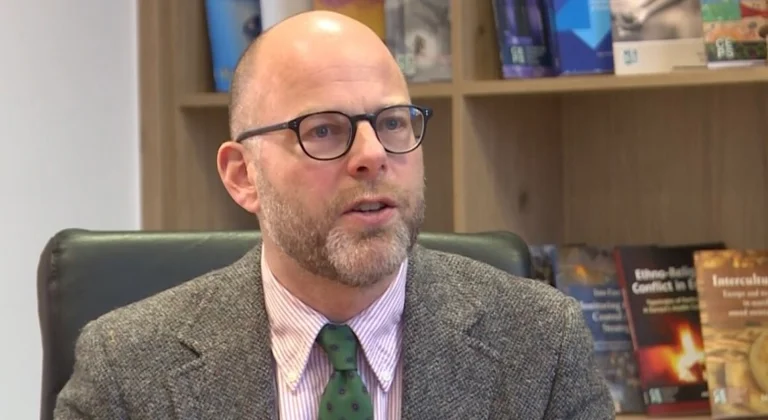
(3 years ago)Ahead of the February 27th meeting in Brussels, of Kosovo Prime Minister Albin Kurti and Serbian President Aleksandar Vuciq, the researcher from the Centre for European Policy Studies in Brussels (CEPS), Toby Vogel, said that earlier published versions of the European proposal, whose authenticity has not been proven, show that this solution could be [...]
Ahead of the February 27th meeting in Brussels, of Kosovo Prime Minister Albin Kurti and Serbian President Aleksandar Vuciq, the researcher from the Centre for European Policy Studies in Brussels (CEPS), Toby Vogel, said that earlier published versions of the European proposal, whose authenticity has not been proven, indicate that this solution could be in Serbia's favour.
Kurti and Vuciq will meet in a new round of dialogue between the two countries on Monday in Brussels, where there will be a European proposal on the table, whose aim is to normalise relations, after which the Western world remained a document still unknown to the public.
Although both (Kurti and Vuciq) showed their agreement with the European proposal for normalisation of relations between Kosovo and Serbia, Vogel said he sees no elements to reach any step forward.
I don't see elements that would contribute to an important step forward in the process. I think this is a meeting intended to maintain balance achieved over the last few weeks. The bottom line is that both sides accepted the Franco-German proposal as something to negotiate. So it's about trying to maintain balance and somehow rebuild [proposal]”, Vogel declared for the Voice of America (in Serbian language).
Further the expert from Brussels said that “can hardly see a scenario under which the parties in the process would declare they give up and that they no longer want to speak up and, on the other hand, international mediators to withdraw”.
“Anyway, if this happened I think the scenario would be similar to Cyprus. International diplomacy would draw its attention to something else, and it would take years to recreate the conditions in which the parties would participate in dialogue with the international mediation”, Vogel said, broadcast Telegrafi.
He notes that earlier published versions of the European proposal, whose authenticity has not been proven, show that this solution may be in Serbia's favour.
“I think it is quite clear that there are benefits that are closer to Serbia's stance, which is not obliged to accept Kosovo's independence. None of the versions of the texts that appeared in public envisioned recognition of Kosovo as a sovereign and independent state. This is what unequivocally indicates that the European proposal should be some sort of interim agreement because the final one should lead to the resolution of that concrete issue. This leads me to the interpretation that the final agreement on normalising relations between Kosovo and Serbia will not be reached by both sides for a future time”, he stresses.
Analyst Vogel notes that text messages from Belgrade have been sent in recent days showing a possible departure from Russian influence.
In the end, it all depends on one person and he's President Vucinic. I don't think a temporary agreement would automatically lead to the neutralisation of Russian influence in Serbia. But I think it is possible to imagine that at some point, Vuciq will arrive at the estimate that it is of greater interest to him to seek closer ties with the United States and the European Union. And at the same time, leaving Moscow. How far will it go, and would he be willing to impose sanctions on Russia? It's very hard to predict, because after all, everything goes down to the decision and will of one person”, Vogel concluded.