9 minutes ago
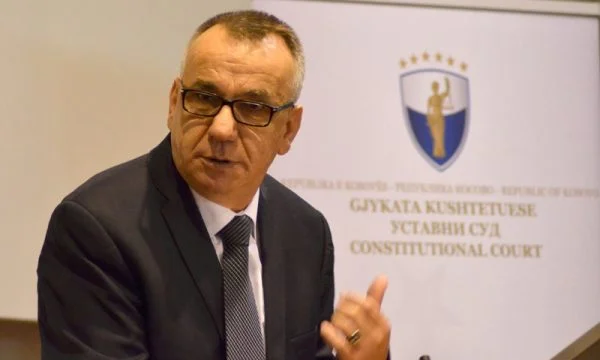
Enver Hasani: What is being sold as de facto recognition, huge Serbian success
Periskopi(3 years ago)
(3 years ago)International law professor Enver Hasani has said that what is being regarded as de facto recognition by the European plan for Kosovo dialogue Serbia is the huge Serbian “”. In a statement Friday, four days before meeting in the middle of Kosovo Prime Minister Albin Kurti with Serbia's president, Aleksandar Vuciq, [...]
In a statement for TIME on Friday, four days before the meeting between Kosovo Prime Minister Albin Kurti with Serbia's president, Aleksandar Vuciq, Hasani has said this agreement would make even more reserved for non-recognition countries to recognise Kosovo.
The main component of this plan, according to Hasani, is the lack of recognition de jure. The second component has ranked “authonomia for Kosovo Serbs”, while the third “thetority of the Serbian Orthodox Church”.
He has estimated that at the moment this agreement is signed, Kosovo will be introduced into the new phase of political development, as, according to him, there will be dense judicial infrastructure “”, as “corruption of parallel and competitive power in Kosovo”. Correcting the status of the Serbian Orthodox Church, Hasan has considered it the creation of another entity within Kosovo.
What do you expect from Monday's meeting in Brussels between Kurt and Vucciki? Will the EU proposal be signed?
The Franco-German plan has come from nothing. It is clearly the product of dialogue now two years, between Kosovo and Serbia. This is clear to everyone, because for these two years there has been no stop-through dialogue, but intense meeting between parties. When it's signed, it doesn't matter what it contains.
What is the essence of the Franco-German plan, what does it contain?
HASANIA: The plan has transformed the dialogue that started in 2011, in the sense that it has expanded the components of the agreement that teaches to normalise relations between Kosovo and Serbia. In all its versions, the plan has several components. In the first place, there is no recognition of Kosovo. What is sold as de facto recognition is, in fact, nothing other than a colossal Serbian success to testify to Kosovo's non-recognition states that it -- Serbia -- is obliged to accept a realistic situation, as something temporary and transitional, but that does not affect its title of international judicial sovereignty towards the international community. This makes nonrecognizable countries even more reserved for our recognition in Europe. Evental recognition by any of them is not the result of the plan's eventual signing, but of other geopolitical considerations of the moment. However, Spain and Cyprus are unlikely to be in the group of connoisseur countries without having a de jure recognition from Serbia. The same applies to other countries elsewhere. Second, the plan envisions autonomy for Kosovo Serbs, mostly in the north, but with territorial scope in all Serb enclaves. This is not the third power, but parallel power, competing with constitutional power in Pristina. This component absorbs the issue of Serbian association in the form that was signed in 2013 and regulates it under the governing and governing structures of political-territorial autonomy of Kosovo Serbs. This autonomy, after the extraction of its implementation acts, will be added to other members of the legal, executive-police and judicial function. Thirdly, the plan eventually creates an extraterritoriality of the Serbian Orthodox Church in the entire territory of Kosovo, so that its property and other activities gain the status of an external subject against local government in Pristina, operating outside any local jurisdiction.
What stage would Kosovo enter if you accepted the plan?
HASAN: At the moment the plan is signed, Kosovo enters a new phase of political development: the first years must become an extremely dense judicial infrastructure, which, in fact, will have other appointments, is essentially constitutional matter, because it corresponds to a parallel and competitive power in Kosovo, with the competencies and authorisations it receives from the existing central organs, in all areas of life and work. When this judicial infrastructure is completed, it will be seen as volume, it will be greater than the Constitution of Kosovo itself. The initial judicial acts are thought to have the nature of international agreements on autonomy modalities in the north, the status of the Serbian Church and Association with a physicalised and French-German plan. Let me say that the status of the Serbian Church, which will be adjusted to the plan in question, has nothing to do with preserving the secular character of the Republic of Kosovo, but with the creation of another entity within Kosovo, which is not subject to local jurisdiction. For this very reason, it is strange that this plan, thought to serve as a catalyst for producing dozens of other legal acts, with which the existing constitutional order created in the Declaration of Independence and the Constitution of Kosovo, will not be ratified in the Assembly, as the Article 18.1 of the Kosovo Constitution requires.
Can there be consequences if one party rejects signing and what might they be?
HASANIA: I see no reason or sign that Serbia will not sign the plan. The same applies to the Kosovo side. The issue of signing modalities most concerns the Kosovar side and its public outcry as a “face-saving” before average voters, not as a serious reserve for it.