8 minutes ago
Earthquake in Turkey: Anger Growing Against Building Standards
Periskopi(3 years ago)
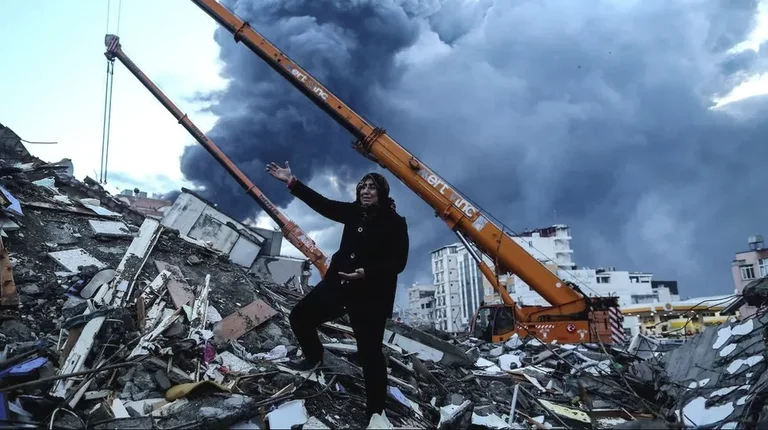
(3 years ago)Anger is growing in Turkey that poor enforcement of regulations contributed to the collapse of many buildings in recent earthquakes. The BBC has verified examples of recently constructed blocks that collapsed in the recent disaster. A building in Malatya, which ended last year reportedly was “completed in line with [...]
The BBC has verified examples of recently constructed blocks that collapsed in the recent disaster.
A building in Malatia, which ended last year, was said to be “completed in line with the latest earthquake regulations”. It said that all materials and works used were “cillals and first class”.
Another recently built apartment block in the port city of Iskerdun has been photographed largely destroyed.

The construction company for this building posted an image showing it was completed in 2019.
The BBC has verified that the image of the destroyed building (right) matches the location of the company bloc's public photo (left).
Although earthquakes were powerful, experts say buildings properly constructed should have been able to stand.
“The maximum intensity of this earthquake was violent, but not necessarily enough to tear down well-built buildings,” says David Alexander, professor of Planning and Emergency Management at the University of Colleage in London.
In most countries, the impact levels were less than the maximum, so we can conclude from the thousands of buildings that collapsed, almost all of which do not adhere to any expected reasonable earthquake building code. ”
Failure to Obey Construction Rules
Construction regulations are tightened by previous disasters, finally in 2018.
The strictest security standards were also brought in after the 1999 earthquake around the town of Izmi, northwest of the country, in which 17,000 people died.
Recent regulations require that structures in earthquake-minded regions use high-quality concrete reinforced with steel bars. Columns and beams should also be distributed to effectively absorb the impact of earthquakes.
However, these laws have been poorly enforced.
The particular problem is that there is very little renovation of existing buildings, but there is also very little implementation of construction standards in the new buildings,” says David Alexander, Professor of Planning and Emergency Management at University College London.
Why is implementation so weak?
The government has periodically predicted “construction player” practically legal exemptions for payment of the fee for those structures built without required security certificates. These have been passed since 1960 (most recently in 2018).
Critics have long warned that such amnesty risks disaster in the event of a major earthquake.
As many as 75,000 buildings across the earthquake-affected area Construction amnesty has been granted to southern Turkey, according to Pelin Pinar Giritlioğlu, head of Istanbul Union of Chambers of Turkish Engineers and architects of the City Chamber of Planners.
Just days before the last disaster, Turkish media reported that a new bill is awaiting parliamentary approval, which would provide a further amnesty for recent construction works.
Geologist Celal Sengor says adoption of such construction amnestys in a country torn apart by defects constitutes a “crem” .
Following a deadly earthquake that struck the western province of Izmir in 2020, a Turkish BBC report found that 62,000 buildings in Izmir had benefited from the latest amnesty.
The same report quoted the Ministry of Environment and Urbanisation as saying in 2018 that over 50% of Turkey's buildings equivalent to almost 13 million buildings were built contrary to regulations.
We have contacted the Ministry of Environment and Urbanisation for comments about the construction standards in Turkey following the latest earthquakes, which said: no building built by our administration has collapsed. Studies in damage assessment are continuing rapidly on the ground. ”