10 minutes ago
Developments in Ukraine, the greatest threat to Putin's rule
Periskopi(3 years ago)
(3 years ago)Vladimir Putin says he learned from arguments when he was a child in his hometown, St Petersburg that <x0...if you want to win a war, you have to take him to the end, as if it were the most crucial battle of your life”. This lesson, cited in the most recent biography of the Russian president, seems to be [...]
As he addressed his countrymen this month in the 80th anniversary of Stalingrad Battle that changed Moscow's fate in World War II, he said: “The willingness to move forward for the sake of Homeland and Truth, to do the impossible, has always been and will always remain in blood, in the character of our multiethnic people”
But so far, the danger President Putin took in his eyes to invade Russia's smaller and weaker neighbour, seems to have failed spectacularly and has posed the greatest threat to his rule for more than two decades.
LIFE AND PLANTS PANGESAT MODERNE
It began Ukraine's “special military operation” on behalf of demilitarisation and “denification”, seeking to protect ethnic Russians, prevent Kiev's membership in NATO and keep it in Russia's “sphery”. While he claims Ukraine and the West provoked Russian aggression, they say exactly the opposite. Ukrainians say it was an illegal act and presumptuous aggression against a country with a democratic elected government and a Jewish president whose relatives were killed in Holocaust.
Mr. Putin laid the groundwork for aggression with an essay of 5,000 words published in 2021, in which he questioned Ukraine's legitimacy as a nation. It was only the last chapter in a long obsession with Ukraine and a determination to correct what he believes was a historic mistake to let it slide from Moscow's orbit. He returned after three centuries in history, referring to the Great Peter in an effort to find arguments in support of aggression to recapture Russia's territory.
But the restoration of history soon faced modern obstacles.
Everything he wanted to achieve went catastrophicly”, said British journalist Philip Short, who last year published the biographic book on Russian President titled “Putin”.
Despite armed interventions in Chechnya, Syria and Georgia, President Putin overestimated his army and underestimated Ukraine's resistance and Western support. Russian media try to strengthen his authority with images of a naked Putin riding a horse, shooting a military range, but war has exposed his shortcomings and the weakness of the Russian Army, intelligence services and some economic sectors.
Ukrainian forces have liberated more than half of Russia's occupied territory. The war has caused the deaths of tens of thousands of people on both sides, caused widespread destruction and pushed not only Ukraine, but Sweden and Finland to seek NATO membership. It has stepped up Russia's security threat and turned back after decades of Russia's integration with the West, bringing international isolation.
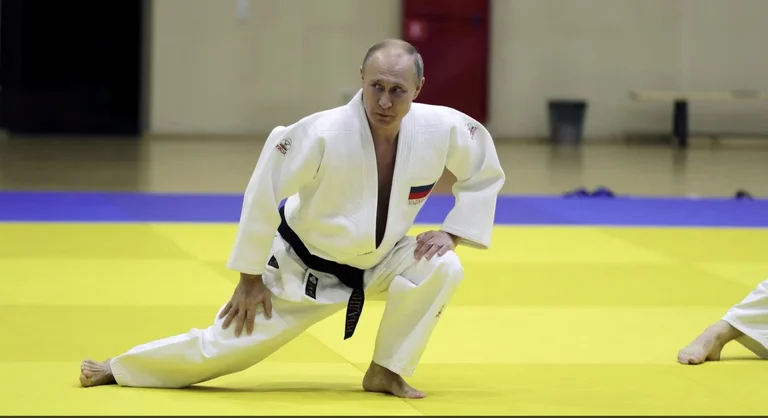
Increasingly, President Putin seems to be improvised in the much longer and more difficult conflict than he expected. For example, he has threatened to use nuclear weapons, then withdrew. This strategy comes from his eternal passion, Judo:
You have to be nifty. Sometimes you can yield to others, if that's the way to win”, Mr. Putin showed in interviews with American director Oliver Stone during 2015-2017, where he was presented in a positive light.
In President Putin's opinion, the aggressive West wants to crush Russia. His statements, along with the increasingly depressing measures to suppress internal disagreement, have increased patriotic support among many of his countrymen. But this support faces an inefficient power structure, from above and below, inherited from the Soviet Union and the sacrifices the Russians are personally suffering.
ONE WAYS CORIENT AR, UNDER POR
In interviews with the Associated Press, the biography of Russian President Short, other analysts and a former Kremlin official describe 70-year-old Putin as a disoriented, weakened, rigid leader and with an outdated mentality and refusing to admit he is facing difficulties.
They say he appears to be concerned about the declining support, though still strong, of local public opinion, though the data is from unreliable research. Mostly isolated because of the concerns of COVID-19 and his personal security, President Putin speaks with a small group of advisers, but they seem reluctant to give sincere assessments.
Observers see a long and severe struggle he is determined to win, with the way it is hard to predict.
It's not Mr. Putin who rules Russia. It is the circumstances that rule Putin”, said Tatiana Stanovaya, senior member of the non-American government organisation, “Carnegie Endowment for International Peace”.
Mr. Short believes that the leader of the Kremlin “has placed himself in a position from which it has difficulty moving... He'll look for ways to move forward, but I don't think he's found them”. He was unlikely to surrender, Mr. Short said, recalling that his <x2-calcracre was always to strengthen efforts and fight even harder”.
Fiona Hill, who served in the past three administrations of the United States and is a researcher at the Brookings Institute, believes that Mr. Putin wanted quick victory in Ukraine, to appoint a new president in Kiev and force it to join Belarus, in a Slavic union with Russia. Russia would lead another successor, she said, while Mr. Putin would strengthen his role by taking the lead in a larger alliance.
But now, according to Mrs. Stanovaya, “seems to have no hope that the conflict could be resolved in any other way than military. And that's scary. ”
CENTURAGES FOR PUT
Analysts predict several scenarios for Mr. Putin, depending on developments in the battlefield. The scenarios, which do not rule out each other, depend on what might be his biggest nightmare of a coup or uprisings like what he saw as a KGB agent in East Germany in 1989, in the Soviet Union in 1991 or Ukraine in 2004 and 2014 to a re-election this year. This would further extend the longest rule of the Kremlin by a leader, the Kremlin, since Joseph Stalin.
Dmitry Oreskin, political analyst and professor at the Free University in Riga, Latvia, said Mr. Putin could reconsider his goals in Ukraine, claiming he achieved them by creating a land corridor from Russia to Crime and by bringing the Donnetsk and Luhansk regions under control to the east. Then he can declare that: “We punished them. We showed them the people of the house. We have defeated all NATO nations,” added Oreskin.
But Kiev has refused to issue territories, and for President Putin to sell this as a victory, Mr. Orsekhkin believes that “ai has to convince himself he defeated Ukraine. And he understands better than anyone who, in fact, lost. ”
As military barriers mount, Russians are falling morally and psychologically and they think: “Yes, we are seeing something is not going to war, but we don't want to know what”, says Mr. Oreskin.
According to him, this accession, along with economic difficulties, could increase criticism of President Putin, perhaps during the summer, at a time the Russians ask “promised us victory, where is victory”?
Abbas Gallyamov, who previously wrote Mr. Putin's speeches, said the Russian president does not admit mistakes or losses and “needs the victory desperately just to prove that he is a strong man”.
Even part of the army is becoming critical, he said.
When he's hated by more than half of the army, we're going in this direction for a coup, for a coup from the military elite will grow,” said Gallyamov, setting as a 20-24 or a few more years.
But Mrs. Stanovaya and Mr. Short do not expect any imminent uprising of any kind.
“Even if people suffer, be unhappy and angry, they will not turn Stanovaya into political issues.
Mr. Gallyamov sees a way out for President Putin, if he can ensure recognition of the new <x0 arrivals, plus a NATO statement banning enlargement, for example, or the introduction of Ukraine's Constitution of neutral status... or a statement of theirs that Russian will be the second official language”.
V DEATH AND PLACE ANCIENT
Another chance is for Mr. Putin to die on duty, but CIA director William Burns is skeptical.
“There are many rumors about President Putin's health and, as it were, he is completely very healthy,” said Mr. Burns, former US ambassador to Moscow, at the Aspen Security Forum in Colorado in July.
Mr. Short said President Putin has created strong security checks and is more likely to have a heart attack than to bring people close to him down from power.
He and Mrs. Hill believe President Putin is probably looking for a successor. Mr. Gallyamov ranks as possible descendants “techncrats” as Moscow Mayor Sergei Sobyan and Prime Minister Mikhail Misustin.
Mrs. Hill said Dmitry Medvedev, whom Mr. Putin elected as president from 2008 to 2012, “seems to be on the test to regain the same role”.
For now, Mr. Putin remains in charge. In his authorized biography of 2000, he noted: “Many mistakes always become in war. ...you have to maintain a pragmatic attitude. And you should keep thinking about winning. ”
When a journalist asked him in December whether his special military operation “x1> in Ukraine has taken a long time, Mr. Putin responded with a Russian expression that major goals are gradually achieved: “Pula pecking the wheat beans one out of a”.