10 minutes ago
A anniversary of the Russian full offensive in Ukraine: Who's winning and what's expected to happen
Periskopi(3 years ago)
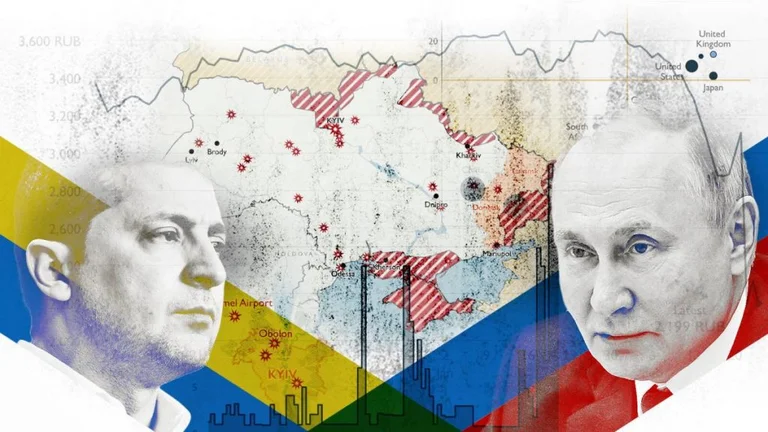
(3 years ago)As an anniversary of Ukraine's Russian occupation approaches, the view seems totally different compared to the first weeks of the war, when hundreds of Russian tanks broke the border and air forces tried to seize Hostomel Airport outside Kiev as a move to capture the capital. Below is a summary of conflict status [...]
Is Russia already conducting a new offensive?
There have been some controversial assessments about Russia's possibility of conducting a significant new offensive. Even though senior Ukrainian officials have repeatedly warned that before Christmas Russia was planning on a major new offensive this year, evidence of preparations for the February 2022 similar attacks remains dim.
Recent claims, stemming from NATO officials, which Russia was gathering fighter planes, were also rejected by the United Kingdom Defence Ministry. And as Russia has increased the number of infantry soldiers -- some measurements predict that more than 300 thousand troops are in Ukraine -- there is no evidence that hundreds of tanks are mobilizing in a region that is highly monitored by satellites and anchorages.
Secretary - General NATO, Jens Stoltenberg, named for increasing Russian efforts to the east as evidence that a new offensive has already been launched, but some consider this to be a continuation of the efforts that have taken place for months. Russian bombings are less intense than they were in summer around the Sievierodonnetsk region, when Moscow was attacking 60 thousand rockets a day.
Despite last year's mobilization, analysts believe Russian capabilities are damaged by war and that those who expect as a continuation of last year's initial invasion are mistaken.
What has happened since February 24th is that Ukraine has become stronger and has taken on better systems and is expected to receive even more”, Philips O'Brien of St Andrews University said. “The Russians have weakened. They have more soldiers but their equipment is weaker, their soldiers are less trained than they were, and their weapons supply is shrinking.
O'Brien and others say there is little evidence that Russia is less capable of carrying out complicated armed operations.
What's going on in the east?
A value of the war in the east ? which is the hottest point of conflict -- is that increased Russian efforts around the town of Bakhmut lead towards so-called operations ahead of a new offensive, perhaps in spring.
Another possibility is that Russia is fearing a large new Ukraine offensive and has increased the pace of attacks -- at extraordinaryly high cost -- to repel Ukrainian forces. Another view is that Russia wants to capture Bakhmut before February 24th for propagandistic purposes, not for any other meaningful reason.
Perhaps there is a little truth in all these views. One warning is that Russian efforts are not focused solely on Bakhmut, but on several limits on the eastern front, from the border with the Kharkiv region to the occupied south, perhaps to investigate weaknesses.
Michael Koufman, head of Russia's research at the Centre for Marine Analysis, in Virginia, has mentioned this possibility recently, saying: the Russian “Ophensisva consists of five or six weeks of attacks focusing on Donbas. Before it is a major push to just one part on the front, the offensive is a series of Luhansk-divided battles to Bakhmut and Donets in the south.
At this point it does not seem that Russia has employed militia and that it is expected to use these units to replace the losses, or perhaps it is intended to occur a breach. On the other hand, there doesn't seem to be much evidence of Russian additional forces waiting for”.
What is clear is that Russian efforts reveal the weak leadership, logistics and tactics that have been the hallmark of its operations over the past year, with significant losses for modest territorial gains.
What about a Ukrainian offensive?
Since last summer's offensive in Kharkiv and Kherson, the pace of Ukrainian operations has slowed, even though Ukraine is continuing to make efforts to score progress on the eastern side of the Dnipro River.
Moscow has also reversed Ukrainian efforts, especially in the Zaporizhja region.
Ukraine's political leadership has made public its ambitions to restore Ukrainian territories, including occupied Crimean, and most of its diplomacy is oriented towards securing Western weapons.
It has been quite influential about Russia's ill-information about its intentions, but it is clear that Ukraine has collected equipment, including war tools, and by training its forces for expected operations, while searching for tanks to lead these attacks.
While Kiev has made public its need for 300 tanks on the battlefield, it is noteworthy that it has carried out successful offensives during the summer without them.
However, some Western connoisseurs have questioned Kiev's willingness to perform so much of Bakhmut's defense and the opportunity to limit his ability to perform a counteroffensive.
This was reflected briefly in the US newspaper Washington Post earlier during this majii, who expressed concern that it was a unrealistic “to protect Bakhmut and launch a spring counteroffensive to regain what the United States describes as more critical territory”.
Who's winning?
There are many ways to appreciate that. Neither Russia nor Ukraine are close to achieving their war goals, which in the case of Ukraine include the release of all occupied territories.
During the past 12 months, however, Moscow has been constantly forced to withdraw from its maximum ambitions - not at least the collapse of the Ukrainian government and the deployment of a puppet regime - to focus on the capture of all Donbas to the east.
Moreover, Russian losses have been great. A recent assessment by I The ISS claimed Russia has lost up to 50% of the tanks fleet. Human losses have also been enzymes, claiming that last week Russia was losing about 2,000 soldiers for every 100m gained in the east. As these figures need to be viewed with suspicion, evidence suggests that Ukraine has a smaller rate of losses.
Top American General Mark Milley recently said Russia has already lost track and strategically, but said it seems little possible that neither pal was close to meeting their goals.
Maybe it's safer to say that the current conflict trajectory is going much better for Ukraine than for Russia -- and that the continued flow of weapons from the west will preserve this trajectory.
But Ukraine, as EU foreign policy chief Josep Borrell warned, is completely dependent on Western weapons, including artillery weapons, which has been exposed as a weak spot for Kiev in the east, where artillery has dominated fighting.
What is also unclear is how many weapons “game-changing” such as battlefield tanks will bring the war to completion, or how fast.
So for now, the war is marching. /Periscopi/