27 minutes ago
Kurti's Osman requires the removal of punitive measures: A tendency to misuse condition Kosovo
Periskopi(2 years ago)
(2 years ago)Kosovo leaders called on the European Union on Friday to lift punitive measures against it and punish Serbia for, as they said, hostile actions towards Kosovo and a departure from the agreement to normalise relations between the two countries. Kosovo President Vjosa Osmani said the measures imposed by the European Union following tensions [...]
Kosovo leaders called on the European Union on Friday to lift punitive measures against it and punish Serbia for, as they said, hostile actions towards Kosovo and a departure from the agreement to normalise relations between the two countries.
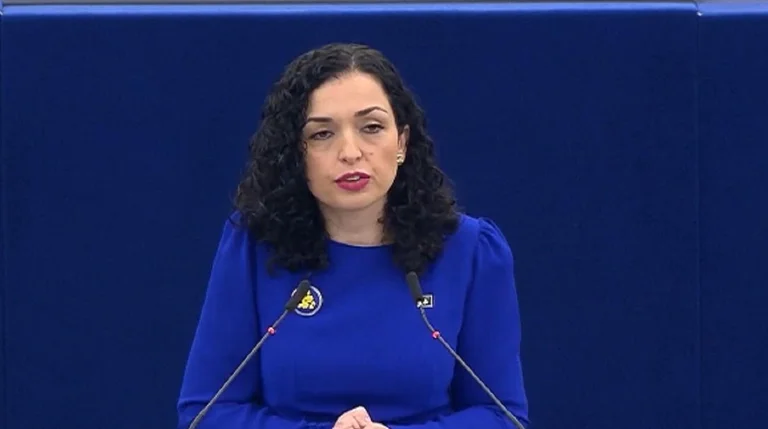
Kosovo President Vjosa Osmani said the measures imposed by the European Union following month's tensions in May were unfair, and Kosovo has already met all conditions for their departure.
“Those asked by Kosovo for what they called escalation have already occurred and measures have had to be removed already because there are measures that unfairly affect the lives of our citizens because of projects that are largely blocked by municipalities. Unfortunately, I agree that there is a tendency by some that now the measures to be misused as a way to condition Kosovo on completely different issues than those for which they are located and such an approach I have rejected”, said President Osmani.
She made these comments at a press conference with Bulgaria's President Rumen Radev, who said she would continue to support Kosovo in its integration efforts in Euro-Atlantic structures, underlining that the aspect of security is very important for this.
The achievement of a comprehensive agreement on neutralising tensions between Belgrade and Pristina is of crucial importance to security, stability and well-being in our region, especially in the complex geopolitical context in which we are currently”, the Bulgarian president said.
Kosovo Prime Minister Albin Kurti, in a post on social networks, called for the removal of punitive measures and for Kosovo to be granted candidate country status for membership in the European Union and the Partnership for Peace programme with NATO. “Precisely so our Western partners would strongly seek Serbia to implement the obligation of de facto recognition of Kosovo” he said indicating the hope that the “European Union and the United States would impose sanctions on Serbia, on hostile and aggressive acts towards Kosovo, and on the agreement to normalise relations”, which was achieved earlier this year.
The agreement requires good neighbourly relations between the two countries, recognition of documents and symbols and respect for each other's sovereignty and earthly wholeness. In an effort to boost its implementation, the top European leader urged Kosovo to establish the Association of Serb majority municipalities, while Belgrade has de facto recognition of Kosovo.
On December 14th, Serbia said the agreement is considered acceptable only in the context in which no de facto recognition or de jure of Kosovo is included.
The European Union, meanwhile, said the agreement is binding for both sides, and the bloc's Council of Ministers urged its European Commission to inclusion under Serbia's membership negotiations and Kosovo steps towards integration.
The European envoy for talks between the parties, Miroslav Lajcak, said in an interview with Gazeta Express that before the end of January 2024 the formalisation of the agreement as part of the criteria for Serbia's membership.
The proposal for the draft Association statute has been handed over to Kosovo and Serbia on 21 October by American and European envoys. Prime Minister Kurti said he was willing to sign the proposal, but accused Serbian President Aleksandar Vucic of refusing to sign. The Serbian president, meanwhile, said the proposal provides good basis for further talks.
European envoy Lajcak said the signing was not necessary since the draft statute is meant to be Kosovo's internal document.
Prime Minister Kurti wrote on Friday that in such a case, next year he could draft a modern European statute project, while suggesting that the Ohrid Agreement be signed at the European Council meeting, held on March 21st and 2024.
He called for Brussels and the European envoy to deal more with Belgrade instead of making public pressure with options that turn democratic and pro-European Kosovo into problematic issues. / VOA