16 minutes ago
Without dawning Banjska, unimaginable dialogue
Periskopi(3 years ago)
(3 years ago)The September 24th attack on Banjska speaks little of talks between Kosovo and Serbia that the European Union intercedes with, except for the international community's calls for the parties to return to this process. The first case they had was at the European Political Community Summit, which was held on 5 October in Granada, Spain, [...]
The September 24th attack on Banjska speaks little of talks between Kosovo and Serbia that the European Union intercedes with, except for the international community's calls for the parties to return to this process. The first case they had at the European Political Community summit, which was held on 5 October in Granada, Spain, but without any results. Both Kosovo President Vjosa Osmani and Serbia's president, Aleksandar Vuciq, have attended.
While Vuciq, without giving too much detail, has said he has tried to explain Serbia's position to European representatives, Osman has been more direct.
There is no reason to meet before sanctions against Vuciki are adopted. First the sanctions and then we can talk about the rest of the”, she said.
Kosovo Prime Minister Albin Kurti has said dialogue cannot continue as if nothing happened in Banjska.
Kosovo accuses Serbia of attacking the Zvecan municipality Banjska, where armed groups have attacked Kosovo police, killing Sergeant Africa Bulnjak. Three supporters of Serbian nationalism have also been killed in the subsequent shootout.
Serbia has denied it has a role and, like Kosovo, has launched its own investigation into the attack. Analysts say the event has largely damaged the process even difficult to dialogue Kosovo- Serbia and does not expect it to continue in the same format.
Maja Pishchevic, from the Atlantic Council, tells of Radio Free Europe's Expose programme that, initially, the truth should be investigated and taught after the attack on Banjska.
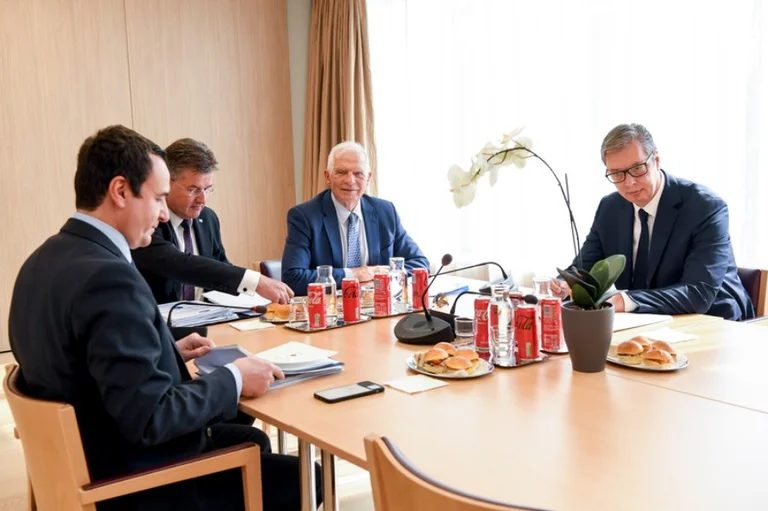
It's hard for me to imagine that the parties can now come back to the negotiating table. Those meetings, neither in the past months nor in previous cases, have looked good. The two leaders have never shook hands. And, can you imagine something like this happening now?
The same arguments protect Marina Voulovic from the German Institute for International Affairs and Security. According to her, the attack on Banjska has been unprecedented since the war in Kosovo in 1999.
We do not know the true motives of the attack. We do not know who specifically ordered it. We know that some actors, at least, have taken responsibility for it, but the command line is still an open issue. The financing is an open issue, the supply of weapons is also an open issue”, Voulovic says of Expose.
Authorities in Kosovo have labeled Milan Radociqi as the mastermind of the attack, but have said he acted on the order of Serbia's state camera. Radovac, close to Serbian leaders, has accepted responsibility.
He has been questioned by the Serbian Prosecution and charged with several criminal acts, including arms trafficking and causing general danger.
Vullovic says the international community should take the case very seriously and send relevant political signals to Serbia before inviting the parties to the talks. According to her, the target should be the Serbian regime, not the people.
“I seriously think in punitive measures against Serbia to signal that such attacks will not be tolerated. Even if no concrete responsibility is proven, or no connection is proven between the head of state [Serbian] and the paramilitary attack, there should be some kind of political responsibility for supporting those actors who, in fact, have admitted to stand behind the” attack, Voulovic says.
Vullovic adds it is now up to the European Union to persuade the parties to implement the agreements they have agreed on. But, according to her, forming the Association of Serb majority municipalities is not a priority now, as Serbia insists. She says the signals needed for Kosovo to return to the negotiating table should be -- punishing Serbia, security in the north and a more unified voice of the EU when it comes to recognising Kosovo's citizenship.
I really don't want to believe that dialogue is dead, because the only way to achieve a sustainable solution to the situation is through dialogue and reconciliation for a mutually constructive agreement. We have such an agreement [for normalising Kosovo relations- Serbia] from March 2023, originally achieved in February, Brussels. But it has not been implemented”.
Now, I think the European Union and the US should find out how to convince the parties to implement that agreement. I think the main thing here is the steps to start with. And the attack on Banjska has really shown us which steps it should start with”, Vullovic says.
Pishchevic, from the Atlantic Council, says one thing is certain -- the up-to-date format of dialogue must be changed. Before the parties sit at the negotiating table, whenever they sit, they must have some things clear: what they want to achieve, what the timetable is, what the rules, what the punishments are and what the motives are.
“Einstein said: you can't keep doing the same things and expect different results. I think, so far, everyone has realized that this is not the way forward, because there is no political will. There is no will on either side I'm talking about both sides to find a lasting solution. And the victim of this is the people”, says Pishchevic.
Asked where the current situation could lead, she answers:
This is a fantastic and terrible question, because I really think this can lead to anything. But if you ask me if there will be a new war, I don't think that will happen. Although, I'm not allowed to think that something is impossible at this point”.
After the attack on Banjska, Serbia has gathered military troops at the border with Kosovo, which has been condemned by the European Union and the United States, which have seen as the highly destabilising “action”.
However, Serbia's president, Aleksandar Vuciq, has made efforts to assure the West that he has no intention of ordering military forces to cross the border, saying it would be counterproductive to Serbia's aspirations to join the EU. Vucinq spoke of the Financial Times:
“Why would this be useful for Belgrade? What would be the idea? Destroy our position that we built in a year? Destroy this in one day? Serbia does not want war”.
Despite these guarantees, some officials say the situation in the region has potential to be lit with even the smallest spark. Kosovo Prime Minister Albin Kurti has said this week there is increasing risk of repeating violent attacks by, as expressed, Serbia's <x0 criminal structures in Kosovo”.
Speaking at a forum in Montenegro last week, the European Union's special representative in the Kosovo-Serbia dialogue, Miroslav Lajcak, has said that “should be working for normalisation and dialogue, but on the other hand, we have escalation. There is no European future without good relations between Kosovo and Serbia”, Lajcak has said.
On October 21st, in Pristina and Belgrade, representatives of the states of QUINT, the US, the United Kingdom, France, Germany and Italy, as well as representatives of the EU, will stay to discuss the issue of Kosovo-Serbia dialogue.
Kosovo Prime Minister Kurti, and Serbia's president, Vuciq, have met for the last time in Brussels on September 14th, ten days before the Banjska attack.
After Banjska, Kosovo President Osmani has said leadership in the dialogue should take over the United States.
According to REL's conversationaries, only US and EU pressure can lead to a solution between Kosovo and Serbia. On the contrary, Russia, which continues to target the Western Balkans, can benefit from the crisis, they say. / REL