21 minutes ago
Bild newspaper: Serbia should be stopped even militarily by NATO
Periskopi(3 years ago)
(3 years ago)Fear of war has turned into Europe's powder barrel: Serbia has deployed its troops on the Kosovo border, which it hates. Is there a danger of a new Balkan war? Tensions in the former war zone (1998-1999) escalated last week when 30 heavily armed Serb paramilitaries in the north [...]
Fear of war has turned into Europe's powder barrel: Serbia has deployed its troops on the Kosovo border, which it hates.
Is there a danger of a new Balkan war?
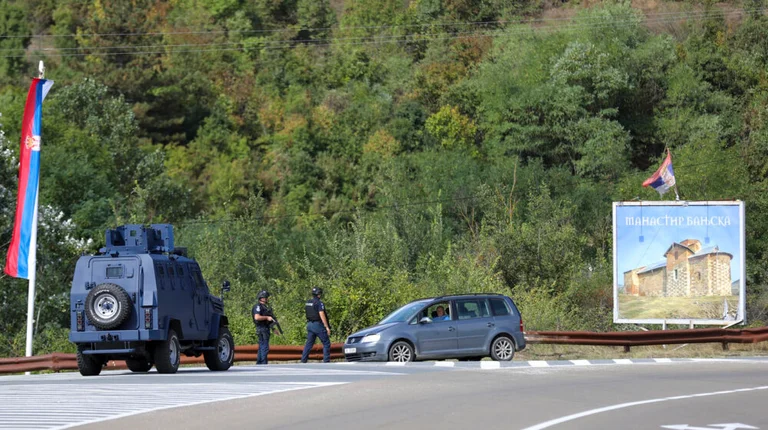
Tensions in the former war zone (1998-1999) escalated last week when 30 heavily armed Serb paramilitaries in northern Kosovo attacked Kosovo police officers in a predominantly Serb village. One policeman was killed and another was seriously injured. Three Serb attackers died. Serbian leader Aleksandar Vucic, who has close ties with Russia and China, deployed troops on the border with Kosovo - more threatening and massively than he has for many years!
BILD interviewed senior experts in the region and brought the most important answers to the current crisis.
How heavy is the situation at the border?
The deployment of Serbian troops was a show of force and prevention against Kosovo, which began to deploy its special police in the north a few months ago, says Jakov Devcic, head of the office for Serbia and Montenegro at the Konrad Adenauer Foundation.
Former German head of KFOR troops in Kosovo, retired General Erhard Buehler tells BILD that current developments at the border are disturbing.
He says President Vucic holds the main blame. It's the third time in two years that Vucic dislodges his troops -- but it's never been more threatening and massive than it is now. This should be over,” says Buehler.
Even Konrad Clewing from the Leibniz Institute for Central and Southeast European Research said also of BILD: this time the situation is more dangerous. Because troops can certainly be used for attacks on Kosovo territory”.
Is there now a threat to a new war in the Balkans?
Experts argue on the war issue:
-A hot fight is probably impossible, according to Balkan expert Devcic: “Most Serbs do not want to recognise the state of Kosovo in any form, but are also not interested in going to war for it”.
-Leibniz's Expert, Clewing opposes it: “Today I consider a war as possible for the first time, but not as likely as”.
Clewing's reasoning: In a speech to the nation Sunday morning, Vucic said it was about Serbian sovereignty and territorial integrity (including Kosovo!), and that Serbia would win. If Vucic appears tempted by the possibility of moving forward, an attack could occur in the coming days and months in northern Kosovo. Vucic has been under considerable pressure within the country for months.
The fact that the NATO-led KFOR force has been deployed since 1999 and is allowed to intervene militarily immediately means that the Serbian border crossing in Kosovo by the Serbian Army inevitably leads to war between Serbia and NATO, says Clewing.
Does the Kremlin tyrant Vladimir Putin have a finger in the game?
Serbia is close to Russia and may be sure of Moscow's support.
Former KFOR Commander Buehler says: “Russia and Serbia, Putin and Vucic rely on frozen ethnic conflicts in the Balkans, which could be revived at any time”. Putin is certainly an active part of the conflict.
Leibnis historian Clewing is sure: “for Russia, in addition to its fight against Ukraine, any weakening and distraction of the West from problems anywhere in the world and especially here in Europe, is very welcome”.
What should the EU and NATO do now?
Former General Buehler requires serious consequences -- “Serbian Lider, Vucic, should be shown that this was the end. The EU and NATO must impose sanctions against Belgrade”. Kosovo Prime Minister Albin Kurti has previously requested it.
The Serbian Army is listed as a partner from NATO and is invited to the exercise. But Buehler says: “Politically we must continue to talk, but military partnership now must freeze”.
What does actual escalation mean for Europe?
The crisis in the Balkans also has a clear impact on Central and Western Europe.
Balkan expert Devcic warns of another open crisis spot in Europe that will strike us shortly before the European elections and the US presidential elections in 2024.
A power vacuum surrounding elections in the West that will limit our ability to act.
- The EU and KFOR had to act more strongly: “part the Western presence, and therefore Germanly in northern Kosovo, there will be no peace and security”.
Historian Clewing warns of a EU integration and a major EU tour: “The so-called EU dialogue between Serbia and Kosovo has not led anywhere”.
The result comes from Clewing: “Serbia must stop -- first diplomaticly and politically. But in an emergency case, even militarily through NATO”.
BILD