24 minutes ago
The Washington Post article that discovered how Serbs tried to hide Recak's Massacre, had three scenarios
Periskopi(3 years ago)
(3 years ago)After the Recak massacre, Serbian leaders had tried to bridge what had happened and present it as a battle between the Serbian Army and the Kosovo Liberation Army. They had produced several scenarios to present as the alternative truth of the situation to create confusion. But despite the internationals who had seen what had happened, [...]
After the Recak massacre, Serbian leaders had tried to bridge what had happened and present it as a battle between the Serbian Army and the Kosovo Liberation Army. They had produced several scenarios to present as the alternative truth of the situation to create confusion.
But despite the internationals who had seen what had happened, a great service to the truth of the situation had made journalist Jeffrey Smith, in a Washington Post article on January 28, 1999.
The article revealed calls between senior Serbian officials and their conversations on how to hide what had happened.
“In a series of Serbian Deputy Prime Minister Nikola Sainovic and Serbia's Minister of Internal Affairs Sreten Lukic had voiced concerns about the international reaction to what had happened in Recak and had discussed how to make the killings appear after a battle between Serb troops and KLA”, Smith's article indicated.
The objective was to challenge information from those who had survived that the victims were executed and massacred and to avoid NATO military response”.
As stated in The Post article “Sainovic is the highest official in Serbia's government responsible for Kosovo and has witnessed most negotiations with Western diplomats; some Western officials have said they know he reports to Milosevic. We often see it as the link between the government in Belgrade and the Serbian administration in Kosovo”, an international official had shown the journalist.
While a source close to calls between Serbian military leaders in Kosovo and officials in Belgrade who were held on January 15th, but who had continued a few days later, had said that the “was intended to go seriously (at Recak)”, to find three KLA soldiers that Serbia accused of an attack by a Serb interior ministry convoy on January 8th in the southwestern Recak, where three Serb soldiers were left dead.
“was a search for destruction mission”, with direct approval from Belgrade, the source had said.
Until the sound of tanks and the echo of bullets continued to be heard in Recak's hills, Sainovc had called Lukic from Belgrade”, according to a newspaper source.
Suovovic knew that the attack had begun and he wanted the general on the phone to understand how many people were killed. Lukic had told him that at the moment there were 22 people killed”, the source indicated.
“On a phone call in the coming days, Sainovic and Lukic had voiced concerns about the international response and had discussed how to make the killings look like an armed battlefield. Their attempt to cover up what they had done continued. One of the measures Sainovic had said to take on his calls was to close the border with Macedonia to stop Louis Arbour, the UN's top war crimes investigator from entering Kosovo”.
"Arbour" had to go back. Another was to wage war again to gain control of that section again and to take the bodies of the massacre”.
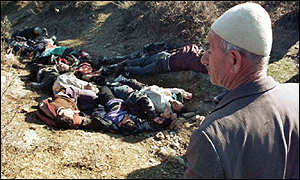
Serbian forces had launched a second attack on the village on January 17th, and had taken troops from a mosque in the village and sent to the monk in Pristina.
Another idea was to see if it is possible to gossip that they have been killed by a third independent group, who allegedly came to the region and attacked the residents of Recak after the official Serbian troops had already left”.
Shortly after the attack, a Serbian government spokesman had said troops in the hills were armed, uniformed KLA soldiers.
But this had been rejected by international inspectors and journalists who were on the ground at the scene on January 16th, and had seen the bodies of murdered civilians. Everyone was in civilian clothes.
Another Serbian official had later said some of the victims were killed that they were introduced amid the shootout between the armed forces. However, survivors, international monitors and the KLA had shown that very few shots were fired at the village at the time and that there had been a battle going on at that hour, about 13: 00 p.m., when most victims were killed.
A Finnish Forenzica team that had arrived in Kosovo a week after the killings had found nothing of what Serbian officials had commented on.
“A view has begun to give us evidence from the autopsy and it's tragic view”, had said a source explaining that the kind of wounds of victims showed that they “were humiliated” before they were killed.
What they had found of the last 40 autopsys was that the conclusions gave what they had told them on January 16th, 32-year-old Imri Jakupi, resident of Recak, who had shown that he hurried to death by fleeing to the mountain.
He had claimed that he and other men were lined up by Serbs after they had gathered them home and forced them to walk in front of troops “until they started shooting at us... shooting coming from all sides”.
Most Serbian troops who had participated in the massacre had faces covered in black masks, but survivors indicated they had recognised some of them who were local Serb police and Serb civilians wearing uniforms.
Jakupi and Rem Shaban, also from Recak, had claimed to have heard some of the talks of Serbs performing the operation.
“How many of them are?”, one party had asked, while Shaban recalls that the last sentence he had heard was “Okay, bring it up”.
Shaban claimed that he had then heard another sentence by using his phone to “correctly, now get ready to shoot”.
Right now, he was running away. /Alabanian mail