6 minutes ago
Serbia's reports with Croatia and B-H: warm and cold!
Periskopi(3 years ago)
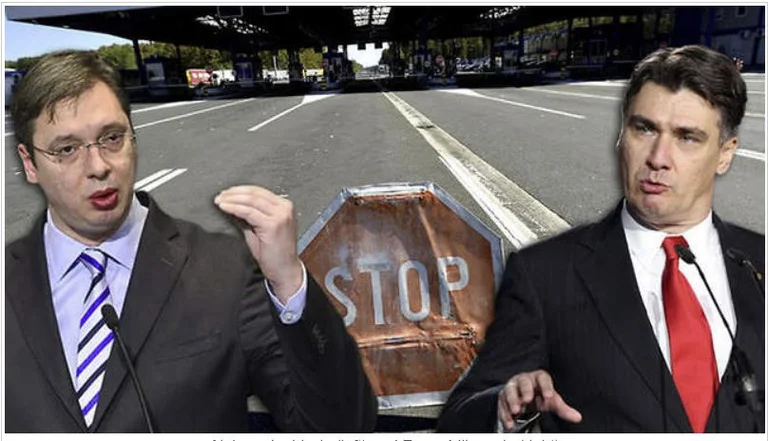
(3 years ago)Belgrade's relations with Sarajevo after January 9th became even more complicated. What about Croatia? The toilet requires improvement. Serbia's state leaders suddenly decided that the time has come for improving relations with Croatia. The order President Aleksandar Vuciq gave his associates was to launch the action, as stated, for [...]
Serbia's state leaders suddenly decided that the time has come for improving relations with Croatia. The order President Aleksandar Vuciq gave his associates was to launch the action, as told, for the recovery of strained relations with Croatia. The task was entrusted to Foreign Affairs Minister Ivica Dacic. His visit at the time of Orthodox Christmas to Zagreb on January 6th was the first step in that direction.
Relations between Serbia and Croatia have been low for years and have been characterized mainly by stinging statements by politicians on both sides. Classical diplomatic communication was replaced by confrontations via the media. At the same time, Croatia is almost an obsession topic of the president of Serbia and his voters: comparing the successes and economic failures, measuring who did best in the vividian epidemic, assessing the amount of evil that the two nations have caused each other, assessing who has better/worst music and musicians, constant comparisons in sports... A somewhat unhealthy rivalry between the two countries marked years of governing the Serbian Progressive Party and Aleksandar Vucinqi.
Hanging On to the European Union
As noted by DW Sonja Biserko, chairman of the Helsinki Committee for Human Rights in Serbia, “is too early to assess whether this goal to improve relations is genuine or not”. However, at the same time that Ivica Dacic was visiting Croatia, BIA chief Aleksandar Vulin and Prime Minister Ana Brnabiq spoke for Croatia as the “country of the Ustashes”, our co-chamber recalls.
It can be said that the aim to improve relations is part of politics and the desire to move towards the European Union, Biserko adds. “We should not forget that we are not only talking about relations between Serbia and Croatia, but we have other nerve points in Kosovo, Montenegro and Bosnia and Herzegovina. Perhaps it is now considered that a good will should be shown regarding the region in view of the pressures coming from Moscow and the idea of a Serbian robot that has not been abandoned”.
“I think, however, this is a good moment for such a step”, the Faculty of Political Sciences told DW Zoran Stojiljkoviq. “Lipset that Serbia does not enter into some kind of European isolation. Relations in the region are important for the process of European integration, but I think this kind of politicisation of mutual relations has lost the power of gathering and mobilizing right forces in both countries”, Stojiljkovq estimates.
Daciqi as a factor of reconciliation
It is difficult to overlook the symbolic fact that Ivica Dacic is dealing with the addition of relations, which was certainly noted even in the words of Croatian Prime Minister Andrej Plenkovic, who stressed that “Croatia was the victim of the aggression of Milosevic's 55x1> regime.
War heritage and war policies are still a problem for all relations in the region”, says Sonja Biserko. Serbia in that sense is unwilling to accept any responsibilities, and this is clearly the continuation of Milosevic's policy, because all the carriers of that policy are now in important positions and interpret what has happened in their own way”, the head of the Helsinki Committee for Human Rights in Serbia stressed.
The authentic representatives of that policy have always understood each other better, estimates Zoran Stojeljjvik. In such situations, you have no one to protest against you on the right political side. Such an agreement between the Croatian Democratic Union (HDZ) and similar parties in Serbia was somewhat more permanent and more successful. All this was put into doubt less than when the Social Democrat Party of Croatia was in power (SDP) and the Democratic Party (DS) in Serbia”, Stojiljjvik notes.
„Republic Serpska as war spoils”
Sonja Biserko, president of Helsinki Committee for Human Rights in Serbia
At the time Croatia's hand is extended, relations between Serbia and Bosnia and Herzegovina are in the phase of deterioration. Belgrade ignored invitations coming from Sarajevo not to participate in the Republika Serpska Day celebration on January 9th, which has certainly complicated the reports between them.
The reason for this is that Croatia, as a member of the EU and NATO, emerged from the Serbian “bot”, notes Sonja Biserko. “While Republika Srpska remained as a spoils of war that will not be delivered”. The removal of the January 9th commemoration from Banja Luka to East Sarajevo is also an additional provocation, because I don't know what else needs to be manifested other than the readiness for conflicts”, Biserko points out.
Zoran Stojiljkovq says that “in Sarajevo has a reserve to Zagreb and Belgrade's policy, which sometimes raise their voices to voice fears for the position of members of their people in Bosnia and Herzegovina”. Therefore, even if we have some kind of normalisation of relations between Serbia and Croatia, on the other hand, we have a nervous reaction in several circles in Bosnia and Herzegovina. “can thus be seen some fear of the threat of Serbia and Croatia's joint tunnel over Bosnia and Herzegovina”, Stojiljkovq concludes. / DW