4 hours ago
Serbian List Officials at Dodik's Antistate Festival in Bosnia and Herzegovina
Periskopi(3 years ago)
(3 years ago)At the festival, which Bosnia and Herzegovina's entity -- Republika Srpska (RS) -- celebrates with persistence, although it is unconstitutional, there were also representatives of the leading Kosovo Serb party, the Serbian List. While Republika Srpska leader in Banja Luka, Milorad Dodik, on January 8th was announcing the decision on the award for president [...]
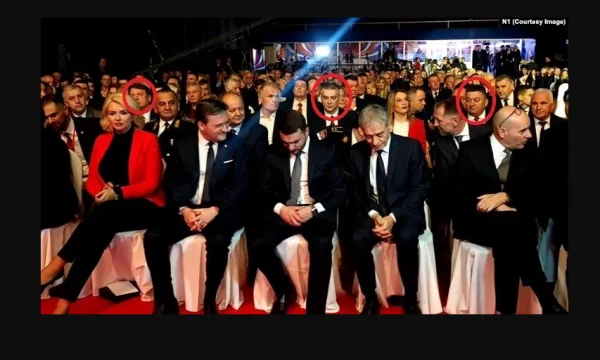
While Republika Srpska leader in Banja Luka, Milorad Dodik, on January 8th was announcing the decision on the decoration for Russian President Vladimir Putin, who has been isolated from most of the international community, representatives of the Serbian List were not sitting in the first row.
This line was reserved for guests representing the authorities of Serbia. Meanwhile, Dragisa Milovovic, Vucinina Jankoviq and Ivan Todosijevich were sitting in the third row.
These three Serbian List officials are engaged in Serbian institutions in northern Kosovo, which are considered parallel and unlegal by authorities in Pristina.
Milovic is deputy director of the Clinical Hospital Centre in Northern Mitrovica, Vucinina Jankovijq is chairman of the “Mitrovica administrative environment” working in the Serbian system, while Ivan Todosijevic is chairman of the interim municipal body in Zvecan, which is also financed by Belgrade.
Five days later, responding to Radio Europe Free Radio questions (REL), the Kosovo Government stressed that the participation of the Serbian List in the festival organised in Republika Srpska is powerful evidence that Serbia intervenes in the “internal affairs of neighbouring countries through its tentacles such as Serbian List”.
Kosovo executive added that Serbian List officials are increasingly moving to “illegal and unconstitutional ways”.
“From illegal barricades in Kosovo to unconstitutional events in Bosnia and Herzegovina. From the Association of barricades to Republika Srpska. From fighting rule and law in Kosovo to honour Russia's president, Putin”, said Kosovo Government spokesman Progress Kryeziu.
He also praised that the presence of former mayors at the January 8th ceremony in Republika Srpska could be interpreted as an expression of the project to implement the Association of Serb-run municipalities.
The association of Serb majority municipalities is envisioned to be formed in line with the agreement reached in Brussels negotiations between Serbia and Kosovo. But, the Kosovo government opposes this, among other things, because of the risk that the institutional union of ten municipalities where the majority Serb population lives would carry with it the risk of creating an entity that would destabilise Kosovo, such as the position Republika Srpska has within Bosnia and Herzegovina, which is one of the limiting factors of its functioning.
Roles in Kosovo institutions
Milovic, Jankovic and Todosijevic were also engaged in Kosovo institutions until recently.
Dragisa Milovic was chairman of the Zvecan municipality, according to the Kosovo system. But, in early November of last year, he resigned as part of the collective resignation of Serbs from Kosovo institutions in the north of the country, as a sign of opposition to the Kosovo government's decision regarding the re-registering of Serbia's license plates to Kosovo.
Vucinina Jankoviq was also chairman of the Zvecan municipality until October 2021, while Ivan Todosijevic was part of Kosovo's government and Assembly.
In the northern part of the bridge over the Iber River dividing Mitrovica, the flags of Serbia are seen.
Free Europe Radio attempted to receive comments from Milovovic, Jankovic and Todosijevic for their participation in the Republika Srpska Day celebration, but without success.
The Serbian List has issued no declaration concerning its officials' participation in the holiday in Banja Luka on January 8th, on the eve of the organised parade in eastern Sarajevo.
The Serbian list, since its founding in 2013, has participated in Kosovo's local and central institutions. She enjoys the authorities' support in Serbia and currently has nine deputies in the Kosovo Assembly, while the ministerial post was lost after party chairman Goran Rakic resigned.
Why is the presence of the Serbian List controversial at the festival?
Republika Srpska marks January 9th as the date on which the Declaration for the Republic of the Serbian People was proclaimed in 1992 as an independent entity in Bosnia and Herzegovina in order to unite Yugoslavia.
Two months later, the internationally recognised referendum for Bosnia and Herzegovina's independence was held, meanwhile four months later, this former Yugoslav republic plunged into bloodshed lasting for three and a half years.
The holiday is opposed by European Union institutions, the Office of the High Representative in Bosnia and Herzegovina (OHR) and Western countries, because the January 9th celebration presents an attack on the Constitution of Bosnia and Herzegovina and the Dayton Agreement for Peace.
Also, the gesture of decorating Putin on that day was condemned by the United States and the European Union.
Milorad Dodik's decision to share the decoration Vladimir Putin, the person who began the unprotested invasion of Ukraine that has resulted in the death of thousands of civilians and massive destruction of infrastructure, is the condemned decision. The decision was contrary to the values of the Euro-Atlantic community and the international order”, the US Embassy's statement in Sarajevo, published on January 9th, said.
Serbian List Links to Republika Srpska
Politologist Ognjen Gogic said the close relationship between the Serbian List and Republika Srpska has been encouraged by Belgrade and that it has been developing for years.
He added that the presence of political representatives of Serbs from Kosovo at Republika Srpska's Day is not something new, but stressed that this is also about the policy of Serbian “ ”, which is promoted by official Belgrade.
“As part of this, the event has been presented in eastern Sarajevo [the celebration of Republika Srpska's Day], where representatives of the Government of Montenegro, from Kosovo and Serbia were present. So, this is where Serbian unity is demonstrated”, Gogic said.
He also stressed that Republika Srpska's policy towards Russia and Vladimir Putin does not have Belgrade's full support.
Serbia is balancing at this point, condemning Russia's aggression against Ukraine, is against the war, but does not want to impose sanctions on Russia. What happened, which was given the decoration [Vladimir Putin], is more political of Republika Srpska. He [Millorad Dodik] made trouble for Serbia and Kosovo Serbs. Serbia and the Serbian List do not need anything like this -- such an open stand on Putin's side of”, he said.
Gogic added that “overlaps” of the Republika Srpska leadership should be tolerated because of close relations, but not “why they have no sympathy for Putin, but because the official policy is not to support it openly”.
Serbian List Links to Russia
Speculations about the Russian services' involvement in recent events in Kosovo have not been confirmed officially, but some sources from Kosovo's security institutions have told the REL that members of Russian services and organisations are involved in the latest crisis in northern Kosovo. Moscow has denied accusations of its involvement in those events.
In mid-December last year, local Serbs erected barricades due to the arrest of their countrymen Dejan Pantic, whom Kosovo authorities accused of participating in the attack on the Kosovo Central Election Commission target. Meanwhile, Pantic has been assigned home arrest measures and barricades have been removed.
In 2017, Serbian List Chairman Goran Rakiq, together with the then director of the Office for Kosovo in Serbia's Government, Marko Djuric, met with Russian ruling party Secretary General Sergei Jelesnyak.
United Russia has officially supported the Serbian List for participating in Kosovo's 2017 local elections, as well as its participation in Kosovo institutions.
For more, Russia's representatives have been present at the barricades, which have been located in northern Kosovo since 2011.
In 2011, Russia sent “humanitarian aid” to Serbs at the barricades, as a sign of support. Parasely, Russia's then ambassador to Belgrade, Aleksandar Konuzin, had personally visited the barricades in northern Kosovo along with Misha Vacicin, who founded the Serbian right-wing “” movement in 2017.