9 minutes ago
Montenegro's new government formation bid fails
Periskopi(3 years ago)
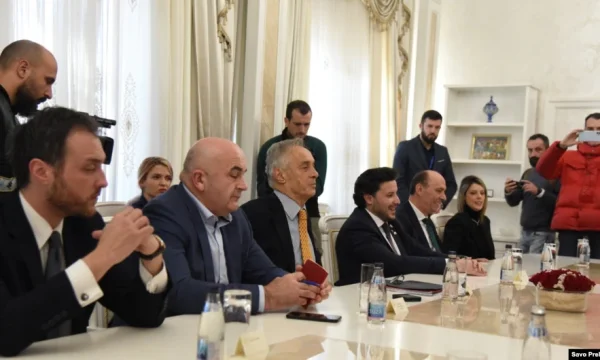
(3 years ago)Parliamentary majority composed of the pro-rus Democratic Front, Democrats and Movement U Dritan Abazovic has failed to reach an agreement on forming a new government, led by Miograd Llekq. After a meeting with representatives of the parliamentary majority on 4 January, Llekic announced there will be no new executive. “I said [...]
Parliamentary majority composed of the pro-rus Democratic Front, Democrats and Movement U Dritan Abazovic has failed to reach an agreement on forming a new government, led by Miograd Llekq.
After a meeting with representatives of the parliamentary majority on 4 January, Llekic announced there will be no new executive.
“I said either there will be a serious government, or there won't be at all. There will be no Government and let citizens interpret for themselves who was serious”, Llekic said after the meeting, where he was expected to be deployed for the new government and the plenary session date for the executive's election.
Similarly, Llekic had announced that the new government would be formed on January 20th.
On December 29th, the parliamentary majority gave Miograd Llekici the mandate to form the new Government, based on controversial changes to the Law for President.
Under this law, the parliamentary majority attempted to assume the competencies of Montenegrin President Milo Djukanovic, because he refused to mandate Llekiqi for the formation of the new executive.
International partners, namely the United States and the European Union, have repeatedly called on the parliamentary majority not to try to form the new government based on the Law for President, warning that such executive would have conflicting legitimacy.
Despite that, Miograd Llekic insisted on forming the government.
One of the leaders of the Democratic Front, Andrija Ma persecuted, said after the January 4th meeting that parties that are part of Dritan Abazovic's current technical government have not presented the signatures for the first plenary session, where the government and the new head of Parliament would be elected.
“We failed to succeed in what we started on September 1st [after the 2020 elections]. I'm sorry to say that we have invested more energy in reaching a” agreement, Ma persecuted.
He said that Danjiela Djurovic's Parliament Speaker, and the president of the state, Milo Djukanovic, must agree to call new presidential and parliamentary elections.
Djukanovic's mandate ends this spring.
In September, parliamentary majority parties rejected President Djukanovic's initiative to disperse parliament and call new elections in order to form the new executive.
Dritan Abazovic's government has been on technical mandate since August last year, after the executive was voted no-confidence motion in Parliament. The motion was prompted after the signing of the basic agreement with the Serbian Orthodox Church. The government is controlled by Abazovic's party and Vdalmir Jokoviq, who has only nine deputies in Parliament. There are also some minority parties at the executives.
The parliamentary majority consists of parties that won in the 2020 elections, which defeated Djukanovic's party, sending it to opposition after three decades. Zdravko Krivokapic's first government worked for 14 months, and then executive management took over Abazovic, who ruled for over three months before the no-confidence motion in Parliament was filed. / REL/