3 hours ago
Interview/ How single Albanian deputy chairman works among Serbs in Gracanica
Periskopi(3 years ago)
(3 years ago)When high-level politics are not involved, Serbs and Albanians in Kosovo can co-exist and interact without any problems. This is so far witnessed by the small municipality of Gracanica, located just a few miles from the capital and dominated mainly by the Serb community. In a small space, on the third floor [...]
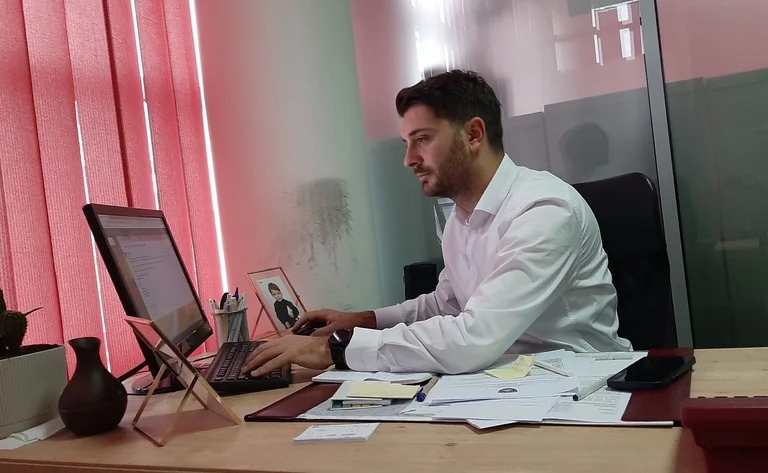
In a small space, on the third floor of the Gracanica municipality facility is the Leutrim Ajjet office, deputy mayor of the municipality. He is the only Albanian in the cabinet of Gracanica chairman, who is packed with Serbs.
Mayor Ljiljana Subaric decided that for the first time he will get an Albanian cabinet since the establishment of this municipality in 2010. Albanian parties were together a year ago and Ajeti was appointed to that position by the communities, as the legal condition for this was met.
In which language he speaks to the head's directors and staff, do they delegate competencies to him when the mayor is missing, what his relationship with the directors, are the demands of the Albanians involved in the budget... for all of this, we have an exclusive interview for Periscope.
Total interview:
Periscope: How many Albanians are at Gracanica's executive?
Ajeti: All directors are of the Serb community. Of the Albanian municipal executives I am and this is legal duty, which has not been implemented before. So for the first time an Albanian is in the executive, I'm in the position of deputy chairman. In the elections we have become all Albanian parties together, originally elected to the municipal assembly, then appointed as deputy mayor for communities.
Periscope: Besides you, are there other Albanians in the municipality, for example, in other positions, as in administration?
Ajeti: Admistrata has about 70 employees, of which I know there are 4 or 5 Albanians. Likewise, the municipal assembly is represented by a municipal assemblyist, since I was elected, after my appointment, an assemblyist has arrived.
Periscope: Are you participating in cabinet meetings holding President Ljiljana Subaric with the directors?
Ajeti: I usually attend, but when I can't meet with the chairman, I have meetings at an informational day basis and for day or week's and longer work plans.
Periscope: In what language do you communicate with the mayor and directors?
Ajeti: We do our communication in Serbian-Croatian. I worked as an official in the Gracanica municipality earlier. About 10 years I've been in a community and return office and this has made it easier for me to know all the problems and to have more cooperative approaches with everyone in the municipality.
Periscope: What's your relationship with the directors?
Ajeti: I have a great relationship with everyone. We look at the local level problems and we try to be together with the demands of citizens every day.
Periscope: What exactly is your role in the municipality, what do you do during your eight-hour working hours?
Ajeti: I usually meet with the president once, and then with another official to see how we have our daily agenda. For example, we have jobs on the ground, where we inspect infrastructure works, then during the day we can have different meetings with government officials, other municipalities. But often we get more than 16 o'clock, which I had a meeting yesterday with the citizens of Kishnices, who are mostly Albanian. I discussed their concerns and requirements for the coming year.
Periscope: When the mayor is missing in the municipality, do you get your jobs, or someone else from the cabinet?
Ajeti: From the beginning we've been told that when she's missing, I'll sign her papers. So it's a kind of replacement. I make signatures even when she's very busy.
Periscope: Since you are vice president of communities, who is more active and comes to the municipality?
Ajeti: Every two weeks I have meetings with the Roma community. They come to the municipality and present their demands, or what they have to discuss. They're a very active community and they have very clear demands, I can say.
Periscope: How many opportunities have you had to include the demands of Albanians in next year's budget?
Ajeti: In fact, we have earlier demands that we could not include this year. We have made public hearings, and requests have come from the councils of the villages of Kishice, Swadol, and several other settlements. We could only include the most necessary requests. Otherwise we have signed a memorandum with the Ministry of Infrastructure on asphalt and sidewalks in some areas where there are even more Albanian settlements.
Periscope: What are the biggest demands of the Albanian community?
Ajeti: They're looking for health problems. We're taking steps to solve this problem, for health items and for increased staff. Then public transportation is a problem in itself, mainly in the Kisnica settlement. We have signed a memorandum with the Pristina municipality for urban traffic to go there.
Periscope: What are the biggest demands the Serb community addresses?
Ajeti: But infrastructure issues are constant demands. Then there is a huge demand for employment, perhaps even the biggest problem they present. We also have many demands on residential settlement issues that are very pronounced in the Serb and Roma communities. This remains challenging to address even for us, but the municipality is engaged at this point. We have discussed finding a solution to social residence even for the Albanian community, we are making efforts to find a space to become a social residence for them as well.
Periscope: Besides leaving Albanians, have you noticed the departure of the Serb community in Gracanica?
Ajeti: As far as I have observed, even in the Serb community, but in the Albanian community, there are young people leaving the country for a better life. In the Serb community, there are young people continuing their studies in Serbia and stopping there after they find a job.
Periscope: What are the biggest projects you intend to implement in Gracanica during this mandate?
Ajeti: On this mandate, we're aiming to build a bypass, we're thinking of connecting it to Heival-Pristina, in order to keep this part here that's extremely frequented, especially by heavy motor vehicles. It is a very high cost, as there will be a need for many expropriations, but we will also talk to the government. With the realization of that shitbag, it would be downloaded a lot of communication that's too heavy during the day. The situation gets heavier because there is no square where citizens could go out and walk. /Mentor Buzhala - PERISCOP/