a few seconds ago
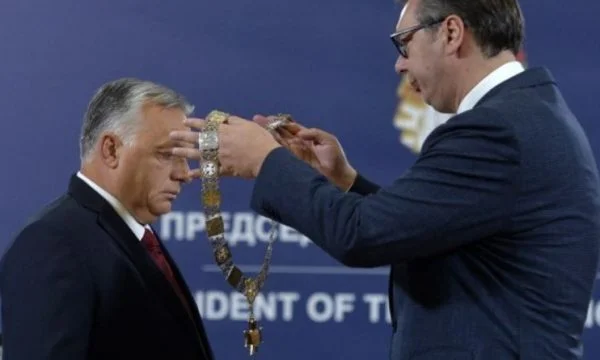
German newspaper: Orban is Vuciki's teacher
Periskopi(3 years ago)
(3 years ago)The increasingly good relations between Belgrade and Budapest rely on a similar government system, writes German journalist Neue Zürcher Zeitung. The war in Ukraine, according to the paper in question, has further strengthened the alliance between Serbia's president, Aleksandar Vuciq and Hungary's prime minister, Viktor Orban. When Kosovo Prime Minister Albin [...]
The increasingly good relations between Belgrade and Budapest rely on a similar government system, writes German journalist Neue Zürcher Zeitung.
The war in Ukraine, according to the paper in question, has further strengthened the alliance between Serbia's president, Aleksandar Vuciq and Hungary's prime minister, Viktor Orban.
When Kosovo Prime Minister Albin Kurti submitted the necessary documentation for membership in the European Union during December, none of the five Union member states who have not recognised Kosovo have expressed controversy, but Hungary has, the German newspaper recalls.
Hungary's diplomatic chief, Peter Szijarot, said that Kosovo's rush for EU membership could prevent a compromise solution between Kosovo and Serbia, and that is why he indicated that if Hungary is necessary at this stage it could veto Kosovo's EU application.
Belgrade and Budapest, the German newspaper writes, have had good relations over the years, and the war in Ukraine has made Victor Orban and Aleksandar Vuciq real allies.
That friendship is not based on traditionally good relations, rather”, the paper writes, recalling the result of World War I, when Vojvodina was annexed by Serbia.
Today, most Vojvodina Hungarians have dual citizenship and their associations receive massive subsidies from Budapest.
This does not bother Belgrade. Because with this comes Orban's message to Vojvodina Hungarians to support Vucic's Serbian Progressive Party”, the paper further writes.
According to text author Andreas Ernst, a similar attitude toward Moscow is hidden after never better.
“They are trying to save as much of their lucrative relationship with Moscow as possible, but in such a way as not to fully disrupt relations with the EU. This walk on the rope is obviously more difficult for Hungary as an EU member than for Serbia as a candidate with uncertain chances of joining Union”, Ernst adds.
But what makes Orban and Vucic real political friends is the system of government they share. Orban is Vucic's teacher, the latter has begun to copy with some success the Hungarian system”, the Swiss newspaper estimates.
German journalist adds that democratic deficits in former Soviet countries have long been viewed as a “wrestling” that can be overcome with EU assistance and reforms.
“In Hungary and Serbia elections are organised regularly, but the state camera makes sure that the race is set almost in advance. Public administration works directly for the benefit of the ruling party. The executive power intervenes in the media system by specifying frequencies and co-finance, until most media convey only the government's” position.
The Orban Party and Vucic's are also ideally related. They claim that their nations are threatened by Western views”.
Tandem between Hungary and Serbia, according to the paper, is unique in Europe for pro-Russian foreign policy and non-liberal governance model. /Albanian mail