9 minutes ago
We're going to have a follow-up called a Dayton, or Ahtisaari.
Periskopi(3 years ago)
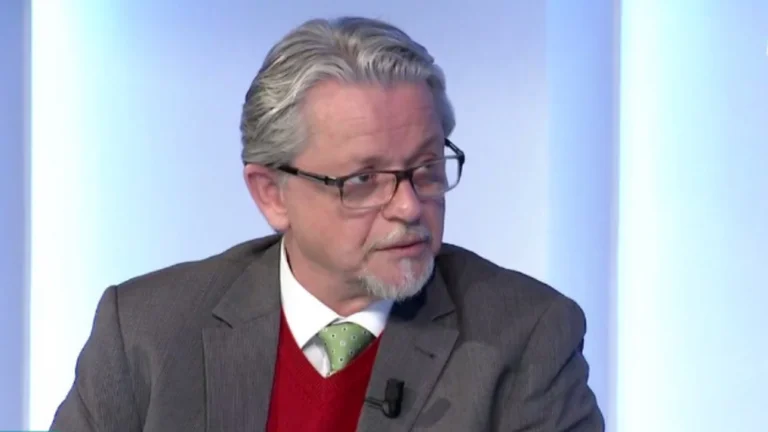
(3 years ago)The premature epidemic in political power positions or “infantocracy” in Kosovo reached its highest point with the triumph of political forces that emerged from the February 14th 2021 elections, says sociologist, journalist and political commentator Dukagjin Gorani, in an interview for the Albanian Post. According to Gorani, Albin Kurti with Vetevendosje Movement and Vjosa [...]
According to Gorani, Albin Kurti with the Vetevendosje Movement and Vjosa Osmani with the GUXO List came to power, promoting mainly the populist Narrative with the deployment of “people against a corrupt and selfish elite.
The unbearable feeling, the unmarked view in Kosovo society that “this” could not continue, for Goran, represents the eventual removal of society from “the reality of reason”.
Gorani, in this long interview for the AP, has also commented on Kurti's cause about “National Union”, the nationalist idea of the territorial union between Kosovo and Albania, which he considered only a “an ideological lie”.
For the situation in northern Kosovo, which Goran is referring to as <x0melash”, Kosovo and Serbia themselves have options, no knowledge of the solution.
Therefore, from experience, Goran knows that “is hard to predict any solution, apart from the traditional ones imposed as obligations by the international community, what it is of Dayton or Ahtisaari”.
In fact, governments in Kosovo and Serbia would like one, since they believe that this could thus avoid decision-making responsibility in front of their societies and before history”
Of course, the bad news about such solutions is that it doesn't work”.
Full interview with Dukagji Gorani given to Albanian Post:
Albanian Post: Mr. Gorani, you are a sociologist embedded with the resistance of Kosovo and its war. You also had an experience with the Vetevendosje Movement as deputy. Kosovo has a government that is headed by Vetevendosje and by over 50 per cent. What do you think, the February 14, 2021 elections were an electoral accident, or a change that brings hope?
Dukagjin Gorani: I view the 2021 elections as a culmination of a world of modern perspective in our society, which was constantly marginalized during the post-war struggle with political gullibility and social infertility.
Vetevendosje parties/ They fought to promote peace stories and promise impossible things. And they won, encouraging its electorate to target two things: the right to have political opponents appoint enemies of the nation, and the right to believe that fairy tales can be lived. Today, these two rights are integrated into narration of current power as the norm of governing logic and public communication. Today, it's normal to hear phrases like traitors, 20-year-old destruction or absolute sovereignty. An infantile society will sometimes produce child rule.
Of course, our situation should be viewed as a change. Above all, it's about the eventual departure of our society from the hope of reasonableness, the obligation of pragmatic action.
Albanian Post: How did the Vetevendosje Movement and List Guxo, Albin Kurti and Vjosa Osmani respectively, mark this electoral success, passing over 50 percent of the general vote?
Dukagjin Gorani: Historically, our tradition of public thought and action has been structurally different from rationalistic logic that we tried to implement through administration, and, later, international supervision without any great success.
That period was experienced severely, even as identity suppressors, so shortly after its completion, we began to reproduce a more acceptable social order for us, more open to provincial and more universalized world views. This process ended symbolically with recent elections when we were finally relieved of the obligation to see and appreciate ourselves in relation to the world.
Today we are accrued within life in social and political absurdities that reproduce a collective condition of cognitive dissonance. We don't see the inability to reconcile big desires and small opportunities; we no longer get upset with the huge discrepanza between how we view ourselves and how others value us. We live free in our isolation, free from terror of the need to conform to the world and the century we live in.
Albanian Post: Is the middle class being destroyed, to set up a new class on behalf of social equality, with a tendency to capture the state or create a party-state?
Dukagjin Gorani: Kurt is the first representative of political - minded groups to experience the threat of any social group that aspires to what is especially the middle class. Of course, we can only hope for him to be the last. But before I answer the question, I think I should try to define the middle course at least, as I understand, in the Kosovo context.
So it's a segment of the growing society, without any specific geographical concentration, which is marked by the willingness to advance its socio-economic position and socio-cultural status, always in search of new areas of engagement and in a progressive departure from domestic, tribal, and regional traditions. Made up of businesspeople, public servants, politicians, journalists, IT-specialists, education workers and professionals in various fields, all under the endless process of material-and-terrestrial, winning and losing and, on the way, learning from mistakes this presents the most dynamic and traumatic layer of our society. It is a social group in permanent transformation and, therefore, acts with variable and fragile logic.
As such, it is the most inappropriate layer for all political groups since it is structurally unfaithful. This year to support one party next year. Today you appreciate one leader, tomorrow. The invisibility of its political preferences is also the basis for democratic change in society, but also the great threat to day power.
Hence, disinforming this layer, naturally unpredictable, is the goal of all power. Usually, this is done through clientization, when a certain group within this layer is privileged by power and thus hardened and obsessed with maintaining its acquired status and exercising it by monopolizing the space of competitive action, thus damaging developmental dynamics. On the surface, such a situation paints a social comfort picture for political groups, but in reality it causes severe trauma in advancing society.
Albanian Post: Did Kurti call for strengthening the party and weakening the governing structures when he said that the most important “is the post of member of party leadership than the minister's in government”, or was he talking about something else?
Dukagjin Gorani: To this day, all powers had created their clientele from the middle class. Nor does Kurt's current power stand out here: the past power continues to be oligarchy even during his power. What makes Kurt distinguish from the predecessors is the unusual dissonance between his ideological narrative and the power reality: he and his political group continue to speak in the name of the elite, but their actions prove otherwise.
The economic policies of his government at the time of the global crisis are making this very thing Kosovo. It's a macabre experience to see how brutal decisions -- "neo-liberal" (execution, approach to strikes, etc.) are easily implemented through a gross egalistic and social democrat disk.
Albanian Post: How do you assess the fact that four activists from Albania take place in the LV's leadership and do you think Kurti will return to integration, which he calls the National Union? Is there any conviction that this ethnic integration divided Kosovo, while the territorial division of the North breaks down the aftisa project, making the existence of an independent Kosovo unnecessary?
Dukagjin Gorani: What you're calling "integrism," which Kurti's party defines as national reunification, was an ideological lie that turned it into a political show on the day Kosovo was declared an independent state. Since then, national reunification was used only as a means of denouncing day powers and as a mobilizing slogan for a naive society. Kurt and LV/Guxo should not be taken seriously in context of this aspirations: their goals have always been local and provincial, not distinguishing at all from other political groups.
The privileges of public power and the employment of party structures were and main goals of political groups remain in Kosovo, including Kurti and LV/Guxo. Like other parties, Kurti and LV/Guxo have anxieties about the national union scenario through any redefining of borders with Serbia.
Similar to many others, they see this from a psycho-Social defanziv angle: that of being afraid of losing individual, group and regional importance, of being afraid of degrading identity as a result of melting into greater national and state construction. In recent years they testified that these identifiable provincial anxieties brutally prevented the discussion of the national union in realistic context, insisting that it not get out of the folklore frames and periodic performance of national-Romanism.
Albanian Post: For a considerable part of Kosovars, now members of the liberation war are viewed only as corrupt structures. Moreover, today its top leaders are being held in prison at The Hague. Do you think Kosovo's history is being rewritten, targeting a third “Republic”?
Dukagjin Gorani: Throughout the post-war period, we constantly forgot to take into account the traumatic effects of the great social, cultural and economic collapse that produced liberation from the state and power hierarchy of Serbia/Yugoslavia, which had lasted nearly a hundred years.
Among other things, today's political polarizations are also seen as a delayed consequence of the fact that freedom and freedom were experienced (even) as deep social slides, as a brutal transformative évent, which, above all, was spread with the destruction of the social and social order, socio-cultural and socioeconomic status, whether individual or regional group.
The first effect of freedom in Kosovo was the structural collapse: new individuals and social groups from the margins took place of the up-to-date elites; the chaotic dynamics of international administration, combined with large village/city influxs and the new and aggressive socio-economic undertakings all produced a new cultural and status situation in society, which for many was traumatic.
So, even the irreverent phrase 20 years old... patented late as the electoral slogan from LV/Guxo has its source on this transformative slide of liberation and postwar. To this day, this phrase is mostly repeated by individuals and social groups who supported popular liberation in the belief that social reports will remain the same.
In itself, such belief meant definition of political gullibility and structural brevity. Today, however, these angry social groups are used as electoral assets especially by Kurti and LV/Guxo. They are kept mobilised by accounts of loss and revenge: They are estimated that liberation and liberation war was nothing more than expropriation by the economic standard and social status they had 20 years ago and that they have a moral right to pay back through political retaliation.
The sense of historical defeat can easily be transformed into powerful political institutions, when ideological fuel has no imagination of the former status order and today's aspirations for its return.
Albanian Post: Association as a constitutional solution seems to remain the only mechanism for the integration of Kosovo Serbs into the new state?
Dukagjin Gorani: Probably, yeah. The association or Zajednica is the result of our first-day post-war lack of freedom, freedom and independence will come without cost. According to the international community, Kosovo was meant to develop into a new multiethnic and multicultural state. This did not happen since the ethnic community in Kosovo does not understand anything from ethnic and political tolerance.
Over the years, ethnic divisions went so far that for a brief moment the international community expressed readiness to accept even the exchange of territories if effective solutions for continued hostilities were proved.
However, this little window of opportunity soon closed, mostly because of the provincial fears of our political elites and contradictions that this could cause even in the context of international law. Today, I fear that Zajednica is imposed on us as an advanced form of territorial autonomy for the Serbs in Kosovo's northern municipalities.
Albanian Post: In the country's north, the sides are struggling to create new realities, to strengthen the position in negotiating the Franco-German plan. Will this deal be yours until March? Are you optimistic?
Dukagjin Gorani: I don't know if it's about strengthening negotiating positions. I'm more likely to be referring to the expected passage of well - thought - out actions. From today's tangle in the north of the country it is difficult to predict any solution, apart from the traditional ones imposed as obligations by the international community, what it is of Dayton or Ahtisaari.
I think the current leaderships in Kosovo and Serbia would welcome such imposed solutions as they believe that they can thus avoid decision-making responsibility before their societies and before history. Of course, the bad news about such solutions is that they don't work on the problem, but they just push it for another period. The Franco-German plan, which is very popular, can also be met.
Albanian Post: Mr. Gorani you are a veteran journalist. What should be the role of the media in democracy, and why is the media stigmatizing for its critical attitude towards power? Have you feared that Kosovo democracy could slip into autism like Hungary, Turkey or Serbia?
Dukagjin Gorani: I don't know what it means to the age of social networks and endless platforms of global communication, or even to the term "journalist" at the time of bloggers, influentials, commentators and opinionists.
But, at least, I think we can still talk about the nature and dynamics of public communication. In Kosovo, this is hyper-active and entirely unstructed domain, and I think it will remain that way for a long time. The combination of new technologies with the local culture of public communication in recent decades is aggressive, voluntary and brutal. They're reproducing this situation today: social depression caused by disinvention.
However, the generation of discurzie violence in us is structurally different from the similar cases in history since it is spread as a result of the individual's powerlessness or specific groups to influence changing the order of things, not as a consequence of some supreme and exclusive outlook. It's about the screams of a traumatic society that can't find the courage to take the lead and get away from the identifying crossroads where it is now two decades.
Otherwise, Kosovo is too small a society to be transformed into real autism. The odds are greater for it to become an uninhabitable space, among other things, because of continued polarisation among rival groups aimed at political power, which have already staberized contentiousness as the standard of public communication. By all means, even public strife can be interpreted as a state of democracy, but it's a annoying, tiring, unproductive and unconstructive democracy. /Albanian Post/