10 minutes ago
FAZ for dialog: Western mediators come empty-handed
Periskopi(3 years ago)
(3 years ago)Representatives of Germany, France and the EU want agreements between Pristina and Belgrade, but do not offer real European prospects, estimates the German newspaper Frankfurter Allgemeine Zeitung (FAZ), and adds that the question is whether Serbia's president, Aleksandar Vuciq, and Kosovo Prime Minister Albin Kurti, will be “re-compatible to their own political capital. According to FAZ, there are not many chances [...]
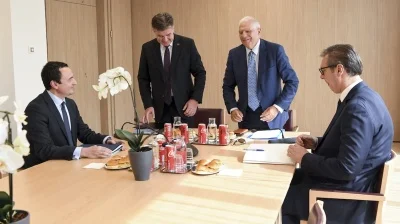
Representatives of Germany, France and the EU want agreements between Pristina and Belgrade, but do not offer real European prospects, estimates the German newspaper Frankfurter Allgemeine Zeitung (FAZ), and adds that the question is whether Serbia's president, Aleksandar Vuciq, and Kosovo Prime Minister Albin Kurti, will be “re-compatible to their own political capital.
According to the FAZ, there is not much chance that the West will end the dispute between Serbia and Kosovo, because mediators in Pristina and Belgrade are leaving “empty”
Germany, France, the US and the EU are said to be lifting “gas” to close the vulnerable “wall in the Balkans, while the war in Ukraine continues.
Representatives of Germany, France and the EU want agreements between Pristina and Belgrade, but do not offer real European prospects, estimates the German newspaper Frankfurter Allgemeine Zeitung (FAZ), and adds that the question is whether Serbia's president, Aleksandar Vuciq, and Kosovo Prime Minister Albin Kurti, will be “re-compatible to their own political capital.
According to the FAZ, there is not much chance that the West will end the dispute between Serbia and Kosovo, because mediators in Pristina and Belgrade are leaving empty “”, Paparaci broadcasts.
Germany, France, the US and the EU are said to be lifting “gas” to close the vulnerable “wall in the Balkans, while the war in Ukraine continues.
“Threats for stability in Europe are also coming because of the life-long conflict between Belgrade and Pristina, which has been reanimating at irregular intervals for years. The last time it seemed that a bloody conflict was near dangerous was December of last year”, the paper said.
Journalist Michael Martens, author of the text, recalls that the Franco-German proposal is based on an agreement between two Germanys of a half century ago. According to her, as it says, Serbia would actually accept Kosovo, though it would not recognise it in an exclusive way.
Besides details of a possible agreement, whose traps should not be underestimated, the principled issue was primarily: Are Serbia and Kosovo willing to accept the Western proposal as the basis of solution? Are they willing and able to make rapid progress? Then they would certainly engage directly both Olaf Scholz and Emmanuel Macron”, Martens said.
According to the newspaper, Western citizens have ambitious ideas and the issue would not last for years, but perhaps just a few months until an agreement is reached.
Citing sources, the paper writes that Kosovo Prime Minister Albin Kurti has welcomed the proposal and the accompanying request for the formation of the Serbian Communists Association at the request that the five EU members that have not recognised Kosovo.
According to the FAZ, Brussels, Berlin or Paris cannot provide these guarantees in the name of Spain, Greece, Cyprus, Slovakia or Romania.
It's no wonder Kurt refused to accept the European proposal with a handshake. In Pristina, as well as in Belgrade, mediators are viewed as empty-handed emissaries. They cannot offer the prospect of EU membership -- a goal that once aroused many energy reforms in the region”, the paper writes, records Paparaci.
Recalling the various obstacles of Balkan countries to the EU, The FAZ writes that in Pristina and Belgrade do not believe Russian aggression against Ukraine has suddenly brought EU enlargement into play.
“Undoubtedly, Vuciq never gave up the goal of EU membership. He wants to preserve the attractive status of an EU candidate Serbia has since 2012. But it has been negatively expressed (and behind closed doors almost sarcastically) for years for the real state of enlargement policy”, Martens writes, Paparaci reports.
According to the paper, the European perspective in the Balkans seems much less attractive than is thought in Brussels, because, as noted, no one knows what it means, except the new “epoca, declared rhetorically”.
The paper estimates that the current situation is “very comfortable” for Vucicin, because “as Kurti is considered a party fraction, Vuciq can claim to agree with the” proposal.
“But as it is heard in Belgrade, even Vuciq will not invest political capital in a project, whose lawyers cannot firmly say what will benefit from it,” concludes FAZ.