4 minutes ago
Danas publishes 10 points of the Franco-German plan: Kosovo, Serbia recognise symbols, documents
Periskopi(3 years ago)
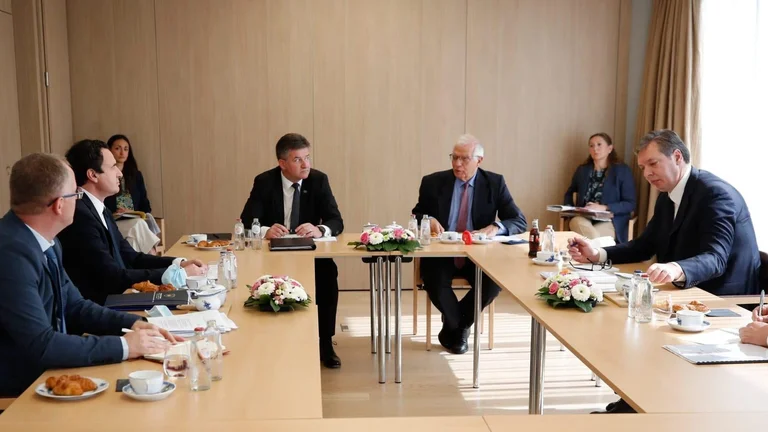
(3 years ago)Kosovo and Serbia were handed over at the end of last year to the up-to-date version of the Franco-German proposal for the basic agreement intended to be reached soon. The Serbian newspaper Danas reports it has secured this proposal through diplomatic routes. It says that Kosovo and Serbia cannot represent the other side in [...]
Kosovo and Serbia were handed over at the end of last year to the up-to-date version of the Franco-German proposal for the basic agreement intended to be reached soon.
Serbian newspaper, Danas It has provided this proposal through diplomatic routes, reports the report. There, according to the newspaper, Kosovo and Serbia cannot represent the other side in the international sphere.
Serbia will not object to Kosovo's membership in any international organisation”, it is expressed in the ten-point proposal.
The association of Serb majority municipalities is not specifically mentioned in this document, which is already being circulated on social networks, but its establishment can be indirectly concluded through other members.
Thus, point 10 reads: “Both sides confirm their obligations to implement all previous agreements”.
Text of the “ropian” basic “agreement between Kosovo and Serbia”, 20.1.23:
Aware of the responsibility of maintaining peace;
Dedicated to contribute to regional co-operation and security in Europe;
Understanding that the invisibility of borders and respect of territorial integrity and sovereignty, as well as protection of national minorities, are fundamental conditions for peace;
Acting on historical facts and not judging the different views of the parties on fundamental issues, including the status issue;
With a desire to create conditions for party co-operation in behalf of the people,
The following is agreed on:
Article 1
The sides will jointly develop normal, good neighbourly relations on the basis of equal rights.
Both sides will mutually recognise relevant documents and national symbols, including passports, diplomas, vehicle plates and customs stamps.
Article 2
Both sides will be guided by the purpose and principles defined in the United Nations Charter, especially those for sovereign rights of states, respect for their independence, autonomy and territorial integrity, the right to self - determination and the protection of human rights and non-discrimination.
Article 3
In line with the United Nations Charter, the parties will resolve all disputes between them only by peaceful means and refrain from threatening or using force.
Article 4
The sides point out from the assumption that neither of them can represent the other side in the international sphere or act on its behalf.
Serbia will not oppose Kosovo's membership in any international organisation.
Article 5
Both sides will support their aspirations to become members of the European Union.
Article 6
While this basic agreement represents an important step in normalisation, both sides will continue the process of EU-led dialogue with new momentum, leading to a legally binding and comprehensive agreement on normalising relations.
The sides agree that in the future they will deepen co-operation in the field of economy, science and technology, traffic and connection, justice relations and law enforcement, mail and telecommunications, health, health, culture, religion, sports, environmental protection, found persons and other areas similarly through reaching specific agreements.
Article 7
The two sides need to achieve concrete agreements, in line with relevant instruments of the Council of Europe and the use of existing European experiences, in order to ensure a proper level of self-government for the Serb community in Kosovo and access to services in Kosovo in certain specific areas, including the possibility of financial assistance from Serbia and direct communication channels between the Serb community and the Government of Kosovo.
The sides will formalise the status of the Serbian Orthodox Church in Kosovo and ensure a high level of protection of Serbian religious and cultural heritage, in line with existing European models.
Article 8
The sides will exchange permanent missions. They will be deployed at the headquarters of the relevant government.
Practical issues related to the deployment of missions will be addressed separately.
Article 9
The commitment of the EU and other contributors to creating a special package of financial assistance for joint parties' projects for economic development, co-operation, green transition and other key areas was noted by both sides.
Article 10
The sides will establish a joint commission, led by the EU, which will monitor the implementation of this agreement.
Both sides confirm their obligations to implement all previous agreements.