14 minutes ago
Cholls: Final agreement to call for difficult elections, political courage
Periskopi(3 years ago)
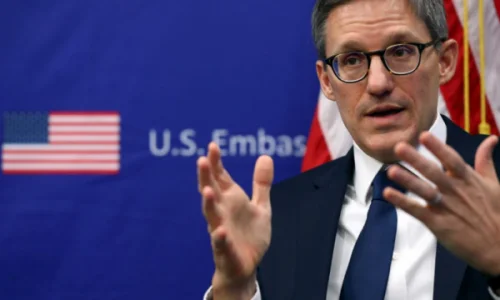
(3 years ago)US State Department adviser Derek Chollet says the final agreement between Kosovo and Serbia will require difficult “selection” and “political treatment”. The two governments should be able to show readiness for compromise. We think these compromises are possible. We're trying to find creative solutions, to make [...]
The two governments should be able to show readiness for compromise. We think these compromises are possible. We're trying to find creative solutions, to help them make those compromises”, says Chollet for the REL.
Speaking the day before the visit of five international Emisaries to Kosovo, Chollet says this is an important moment and demonstrates hope that there will be progress in the dialogue process for normalising relations between Kosovo and Serbia.
He says the Association of Serb majority municipalities in Kosovo should be formed, but stresses that “Association in the form of Republika Srpska is a red line that the US são will allow”.
The United States would not accept this and this would not be something we would forward to”, Chollet says.
Commenting on the Government of Kosovo's recent decision not to allow the flow of Serbian illegal license plates, KM, registered in December and here, Chollet says this “is exactly the kind of step the US has not wanted to see”.
Total interview:
Mr. Chollet, how did you comment on the recent decision by the Kosovo authorities not to allow the flow of cars with Serbian illegal KM plates, and with renewed registration?
Derek Chollet: Unfortunately, that's exactly the kind of step we didn't want to see. When I was in the region last week, I made it very clear that the United States, working with European partners, wants to get out of crisis diplomacy business, we simply, from one crisis to another and move forward in dialogue that is guided and mediated by the EU, towards normalization based on mutual recognition.
I think the steps of the last 24 hours, which Pristina has declared, are not in line with either the letter or the spirit of the agreements in late November, which have avoided an earlier crisis. We think neither side should take unilateral action now.
We must have a coordinated road forward so that these things do not accelerate the kinds of crises that we really need to avoid. [They] divert our attention from the important work of dialogue. On Friday, this week, there will be important meetings [v.j.]. In Pristina and Belgrade], where councillors for national security will be gathered for Germany, France and Italy, along with EU representative [Miroslav Lajcak] and State Department for the Western Balkans representative Gabriel Escobar.
We have talked a lot about the importance of these meetings and some details when I was in the region last week in Pristina and Belgrade. We really want this to work. And this kind of announcement creates a distraction and can lead to a crisis that makes all this progress much more difficult.
We are speaking the day before the visit of [Western] special envoys to Kosovo and Serbia. What do you expect from this visit? Are they bringing a solution to bring the two sides back to the table?
Derek Chollet: Again, it is very important that visits are made and that the parties talk. This visit is a continuation of previous visits late last year. It's a very important moment. The reason the United States is joining this visit is about the importance we give to this process and our support for this process. We don't expect this situation to be resolved during these meetings tomorrow. But it is an important turning point.
We hope in this process in the coming weeks, we hope to see real progress.
After the most recent visits to Kosovo and Serbia, can you share your impressions on whether the two countries are ready or can agree on anything in terms of the final agreement?
Derek Chollet: Yes, I have seen reasons for hope in conversations in Pristina and Belgrade. But this will require difficult elections and political courage. And what I have wanted to make clear to leaders, both in Pristina and Belgrade, has been the importance that the United States costs this process, the hopes we have for this process and potential opportunities for both Kosovo and Serbia, if they are able to find a way to normalise relations.
We think that the Euro-Atlantic route for Kosovo and for Serbia exists. And, we want to see them walk that way. But it will be difficult, as long as this issue remains unresolved. And that's why we're going to do everything we can to promote this forward movement.
What are some of the difficult choices that both sides must make?
Derek Chollet: Look, I don't want to go into details. It would be unwise by me to speak publicly about those choices. That said, both governments should be able to show readiness for compromise. We think these compromises are possible.
We are speaking the day before the visit of [Western] special envoys to Kosovo and Serbia. What do you expect from this visit? Are they bringing a solution to bring the two sides back to the table?
Derek Chollet: Again, it is very important that visits are made and that the parties talk. This visit is a continuation of previous visits late last year. It's a very important moment. The reason the United States is joining this visit is about the importance we give to this process and our support for this process. We don't expect this situation to be resolved during these meetings tomorrow. But it is an important turning point.
We hope in this process in the coming weeks, we hope to see real progress.
After the most recent visits to Kosovo and Serbia, can you share your impressions on whether the two countries are ready or can agree on anything in terms of the final agreement?
Derek Chollet: Yes, I have seen reasons for hope in conversations in Pristina and Belgrade. But this will require difficult elections and political courage. And what I have wanted to make clear to leaders, both in Pristina and Belgrade, has been the importance that the United States costs this process, the hopes we have for this process and potential opportunities for both Kosovo and Serbia, if they are able to find a way to normalise relations.
We think that the Euro-Atlantic route for Kosovo and for Serbia exists. And, we want to see them walk that way. But it will be difficult, as long as this issue remains unresolved. And that's why we're going to do everything we can to promote this forward movement.
What are some of the difficult choices that both sides must make?
Derek Chollet: Look, I don't want to go into details. It would be unwise by me to speak publicly about those choices. That said, both governments should be able to show readiness for compromise. We think these compromises are possible.
Will there be any measures or sanctions for both sides if they refuse to accept the EU proposal?
Derek Chollet: I don't want to talk about the negatives, but I can say we're being very clear with both sides, about the high expectations we have of this process, about our willingness to be active partners in this process.
It's not like we're just saying this, we're doing this. Therefore, my colleagues will be part of the talks tomorrow and then, be it alone, or in co-operation with EU colleagues. We see many potential here, in terms of the circulation of all that the Balkans can offer. It is no secret that there are big economic challenges, there are challenges related to energy security, challenges that have only been exacerbated by the war in Ukraine. We want to help these people and leaders to overcome these challenges, but to see the potential. The key to this will be finding a way to normalize.
You have said in Pristina that you are waiting for the Government of Kosovo to present some proposals for the Association of Serb majority municipalities. Have you seen any movement in this direction?
Derek Chollet: Not yet, unfortunately. However, we have been very clear in public and in private that we believe that the Association of Serb majority municipalities should be formed. There are some details I need to deal with. However, we think that this is a pledge that has been made in the past, we believe that the creation of Association is in accordance with the Constitution of Kosovo and we are very clear with our colleagues in Pristina that this is not something like Republika Srpska, like entity. The United States would not accept this, and this would not be something to move forward.
But I have heard directly from Kosovo Serb leaders the importance they see in association, how they feel somehow avoided by decisions made for their community and want to be part of the process, even by taking more responsibility for their future.
This is something we promote, is in line with the Constitution of Kosovo, and is implementation of a decision that has been taken long ago.
The Kosovo government has not moved, as you said this week. They also said they do not support the establishment of association. Is there any way out of the Association for the current Government of Kosovo?
Derek Chollet: Again, I do not want to speculate about possible breakthroughs, because we believe that the vows made must be implemented. We believe they are applicable and we believe they should be implemented. We, United States of America, will do our part in trying to make sure what Association is and what it isn't. But we think it's time for the Association to be implemented.
Last time, Mr. Escobar told us that if the Kosovo government does not get involved in establishing association, the US could start discussions with alternative partners. Would this be the next step for the United States?
Derek Chollet: Again, I don't want to speculate about the next steps. All I can say is that we, the United States, will continue to make very clear to our partners in Pristina publicly and privately, the importance of association for us, our view that this is an earlier pledge that is in accordance with the Constitution of Kosovo and that it is not creating a Republika Srpska. We're going to do our part in trying to demit association in some ways, because I think there's a lot of uncertainty about what Association is and what it's not.
We will be very clear for our views on this, the importance it has for us, and also, that will not create an entity like Republika Srpska within Kosovo.
Has the United States started looking for alternative partners? Who are they for this matter?
Derek Chollet: Again, I don't want to go into detail about these things right now. All I can say is that we will continue to make it clear, publicly and privately, the importance it has for us and the red line that this is not a Republika Srpska. / REL