2 minutes ago
Cholls: Association is a priority for US, Kosovo, Serbian leaders expect difficult decisions
Periskopi(3 years ago)
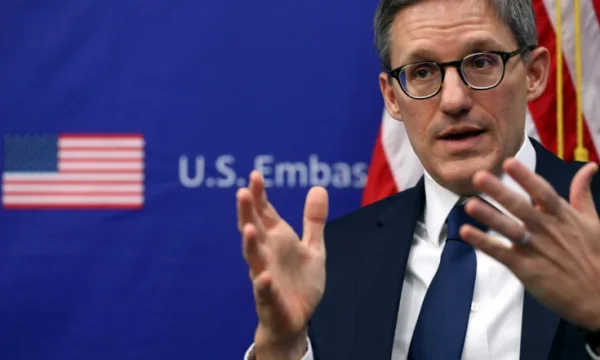
(3 years ago)State Department adviser Derek Scholet has been talking about priorities during the visit he will soon make to Kosovo, Serbia and Northern Macedonia. Asked about the issue of association, Chollet said it was a priority for the United States of America. “is a priority for us, United States. We were [...]
Asked about the issue of association, Chollet said it was a priority for the United States of America.
“is a priority for us, United States. We were very clear about this. We believe that it is a commitment that has been undertaken and that must be raised. It's clearly a key step. But there are many other issues. Both sides here have obligations. Both sides have things we would like to see them move forward. So we have to have these conversations as early as”, he said Cholls.
As far as the French-German proposal is concerned, adviser to The UN has said that it is “a accessible direction”, but that it will take a lot of hard work and decisions by leaders of the two countries.
I don't want to deal with the details of what the EU has proposed. I think sometimes, in any negotiations, it's best to leave these details behind closed doors until they are ready. But we think that the EU has provided a accessible direction, a good direction. Again, it will be difficult. It'll take a lot of work. It will take difficult decisions and courage from leaders to set aside divisions and do what is in their country's best interests. And the two leaders -- in Kosovo and Serbia -- have expressed their desire to be on the path towards greater integration into the Euro-Atlantic community. We highly support that desire. We want to see them take steps to achieve this goal and we want to do what we can to help them accomplish this”, he said in an interview for the Voice of America.
Total interview:
Can you first tell us what you hope to achieve during your visit to Serbia, Kosovo and North Macedonia?
Derek Scholet: Thanks first for the interview. I wanted to visit the region just before the holidays, but unfortunately that trip was postponed. So I can't wait to get back there soon. It is a very important moment for the region, in particular between Kosovo and Serbia. Over the past few weeks, there has unfortunately been an increase in tensions between them. It is good news that in the last 48 hours we have seen barricades removed, we have seen border crossings reopen between Kosovo and Serbia. It's good news. I hope we haven't spent the last few weeks focusing on this crisis, but the EU-mediated dialogue, which we, the United States, fully support. It's something my colleagues and I will talk about when we're in the region.
So, what would be your message to the leaders of Serbia and Kosovo following the recent crisis in northern Kosovo where there was a settlement and removal of barricades?
Derek Scholet: For one thing, it is important not to see a repeat of this crisis. Much of what was needed by our energy has been spent over the past few weeks to avoid the worsening crisis and escalating it into something that no one wanted to see, in violence. Instead, diplomatic energy should focus on the future of Kosovo and Serbia should be discussed for the normalisation proposal, which the EU has submitted, which will have mutual recognition based. This is the direction for Kosovo and Serbia to reach their Euro-Atlantic destination. Sadly, however, recent frustrations have increased tensions in the region and taken all our time. It's good news we avoided this crisis. What we don't want to see is a repeat of this crisis within weeks for something else. So we want to move forward now and therefore come to the region soon, as I intend to do together with my colleagues, is a good time to try for a fresh start to this effort in the new year.
So, what should be the future movements by the parties in this EU-mediated dialogue, in particular considering the concerns of the EU and the US, as it was recently told of the constantly tense situation in northern Kosovo. What are the concrete steps needed by Serbia and Kosovo?
Derek Scholet: Again, we want both sides to talk. It has already been weeks since the two sides have had the opportunity to meet together and we are there present, working together with our EU colleagues in an effort to facilitate this. We think it is important that the parties discuss the essence of the EU proposal and not take measures only to escalate or potentially trigger a crisis. So there's a lot to talk about. We have a lot of work to do. But we look ahead and we will do what we can to ensure that Kosovo and Serbia move in that direction.
What about the association of Serbian municipalities...?
Derek Scholet: It's a priority for us, United States. We were very clear about this. We believe that it is a commitment that has been undertaken and that must be raised. It's clearly a key step. But there are many other issues. Both sides here have obligations. Both sides have things we would like to see them move forward. So we have to have these conversations as soon as possible.
Do President Vucic and Prime Minister Kurti have the sincerity needed in this process, as they seem to shift from one crisis to another without progress and short-term consequences offered by the EU and US engagement?
Derek Scholet: I think so, I have personally engaged with both of them in the past few weeks. I met them. I talked to them on the phone. So do many of my colleagues here in Washington. We want to continue these EU-mediated dialogue talks. Again, we have spent a lot of time talking to them about the current crisis, avoiding things from control, which is dangerous, it's unnecessary, and it's a distraction from what we think should be the real job, which is the dialogue mediated by the EU.
Is the EU proposal, based on the Franco-German plan, a kind of base for a binding legal agreement between Serbia and Kosovo?
Derek Scholet: I don't want to deal with the details of what the EU has proposed. I think sometimes, in any negotiations, it's best to leave these details behind closed doors until they are ready. But we think that the EU has provided a accessible direction, a good direction. Again, it will be difficult. It'll take a lot of work. It will take difficult decisions and courage from leaders to set aside divisions and do what is in their country's best interests. And the two leaders -- in Kosovo and Serbia -- have expressed their desire to be on the path towards greater integration into the Euro-Atlantic community. We highly support that desire. We want to see them take steps to achieve this goal and we want to do what we can to help them do that.
It seems so that Serbia continued its campaign to undo Kosovo's recognition. Serbia's President Vucic recently announced that nine other countries withdrew Kosovo's recognition as an independent state. This opposes Washington's agreement, which was signed by the parties in 2020. What is the position of the United States?
Derek Scholet: I don't have anything specific to add to what President Vucic said. What I can say is that for us this is a distraction, it is not in the spirit of trying to find a way to move forward under what the EU has proposed. We are not getting closer to achieving Euro-Atlantic aspirations that leaders of both countries have said they want to meet. And yet, I think that's what we should focus on and not on these distractions.
Over 300 days after Russian aggression in Ukraine, Serbia is still unwilling to impose sanctions for Russia and maintain close relations with Putin's government. Will there be a turning point where the United States and Western allies will no longer tolerate this?
Derek Scholet: It's something we've talked a lot about with our colleagues in Belgrade. It is important to note that Europe, and indeed the world, has united in a truly impressive way over the past 11 months to impose an unprecedented number of sanctions on Russia. We've never really seen anything like this before in world history as far as the number of sanchions that have been set up, towards an economy the size of Russia's. We think Serbia should become part of this. Clearly, Serbia's desire to get closer to the EU will be difficult to meet if it is not ready to join the sanctions the EU has imposed. So it's something we've been very open about, which we've been talking about with our colleagues in Belgrade, and we would like to see Serbia become part of.
What would be the consequences for Serbia, in terms of relations with the United States and partners, as well as also for the EU membership process, if it continues not to adapt to EU positions on sanctions?
Derek Scholet: The last part of your question refers to the right answer, meaning it is difficult to see progress in the membership process, if Serbia stays out of consensus on that. Therefore, we would like Serbia to move forward on this. But look, we understand this is a difficult decision. There is a long story in relations between Serbia and Russia. So when we talk to Serbian counterparts, we have full awareness of this story. We know that these are very difficult decisions. Many countries worldwide have sacrificed their economies, the state of their economies, to ensure that Russia is not rewarded for what it is already doing in Ukraine every day.
In recent reports, the State Department noted that Serbia faces human rights problems and cited important nongovernmental organisations for worsening the media and freedoms situation in Serbia. Independent media, civil society members and some of the opposition members have signalled that they are under constant pressure, or threats, in some cases even by government officials. What would be your comment on this, and do you intend to discuss these matters?
Derek Scholet: Absolutely. I stand by the reports the US government has published about our concerns. It's something we constantly raise with our colleagues in Belgrade and find out where we have such concerns. Again, we know these are difficult issues, but we believe that the health of democracy is measured by the force of its civil society, the freedom and the opening of its media, by the possibility of people expressing themselves freely. These are the fundamental freedoms we believe in and found in strong democracies.
How do you view the situation with anticorruption efforts in Western Balkan countries, in particular in northern Macedonia? The impression among citizens of northern Macedonia is that much is spoken up, but that there are not many results in this area.
Derek Scholet: We see tremendous potential throughout the Western Balkans, economically, in terms of demographics, the great talent that exists in the Western Balkans. Our disappointment is that there are many things that are an obstacle to this great potential. And corruption is one of these issues. So we see so many young people in the Western Balkans moving away to other countries, as they do not see a bright future because of some of the challenges many Western Balkan countries are facing because of corruption. Northern Macedonia is certainly one of those countries facing this challenge. We're doing what we can to help. We had a new team to talk about these issues. Fighting corruption is a priority for Secretary of State Blinken, my superior, the entire administration. We have a new senior co-ordinator for anti-corruption activities, headquartered here in the State Department, but it works globally to help countries fight corruption and take measures to make sure their economies can function open, clean, and this is something that we think is important, because it will attract economic investment, attract talent, create a good and healthy workforce. So it's a privilege of ours. It's a disturbance and it's something we're raising all the time.