3 minutes ago
BBC: Bees and Nemuna, Europe's most misunderstood country
Periskopi(3 years ago)
(3 years ago)Albania's Alps have become part of the well-known BBC Travel magazine, Slowcomotion. Where the reader is invited out and connected to the world in a safe and stable way. Details from Malta, meetings with hospitable residents, personal stories and few stories about a misunderstood Albania. Below: [...]
Where the reader is invited out and connected to the world in a safe and stable way.
Details from Malta, meetings with hospitable residents, personal stories and few stories about a misunderstood Albania.
Below:
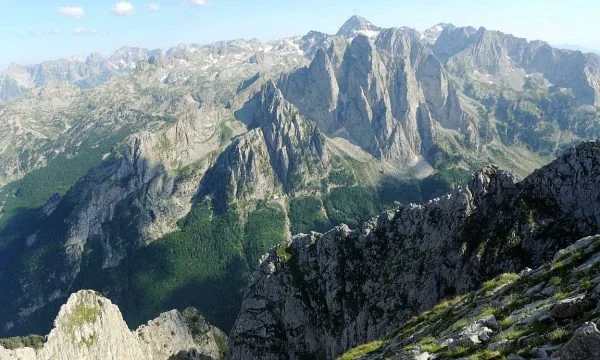
Walking through green valleys and meadows filled with wildflowers under the flaming sun, with the Albanian Alps rising up high, I was struck by the full distance of the landscape.
Unlike Europe's most famous alpine resorts, there were no hotels or elevators.
Instead, the environment aroused a surprising feeling of isolation and could not help but feel that you had entered a secret room in the back of the wardrobe.
With the expansion from northern Albania to southern Kosovo and northeast of Montenegro, the Albanian Alps are better known by their local names (Bjeshks and Nemuna).
However, the question of how these jagged limestone slopes took their unusual name remains a mystery.
According to local legend, the devil escaped hell and created steep glacier cards on a single bad day.
Some say that the name of the alpes is derived from a woman who cursed the mountains as she walked through them with her children on a hot day and could not find water.
Others claim that Slavic soldiers gave the mountains their names while trying to march through them.
In a way, the strange history of Maya origin is something like a metaphor for Albania as a whole.
Long called Europe's <x0mengma” by the authors of books and tour guideships, Albania is probably the most misunderstood country in Europe.
Its language is a semantic abnormality without any known relatives in the Indo-European language family.
After World War II, authoritarian ruler Enver Hoxha effectively shut down the mountainous nation from the outside world for four decades.
He banned religion, travel and, therefore, Edi Rama, the country's current prime minister, was forced to say that Albania was once the “North European Assembly”.
During the Cold War, Hoxha convinced the nation that the rest of the world wanted to overthrow their communist state, so he filled the country with up to 500 thousand concrete bunkers so that people could hide in the event of attack.
Surprisingly, the communist raid was never part of the Eastern Block, and since its transition to democracy in 1991, it has never been a member of NATO or the European Union.
Instead, it exists as a kind of continental paradox.
It is one of the only two majority Muslim countries in Europe (with neighbouring Kosovo), more Albanians live abroad (approximately 10 million) than in it (2.8 million), and it is a country where yes means no and no means yes.
For decades, few travelers knew something about Albania's golden beaches, the wild mountains and the Roman and Ottoman ruins.
But in the years when the Balkan nation opened carefully to the world, it has drawn eager travellers to discover one of Europe's last wildest and underexplored corners.
One of his most bold projects in recent memories is the Balkan Maya -- a 192km circular walk path connecting Albania, Montenegro and Kosovo through a series of trails extending into the Bjeshks and Nemuna.
The vision for this cross-border project came in 2013, but its roots date back well.
Many Albanians and Kosovars refer to their close relationship as “one nation, two states”.
In fact, 93% of Kosovars are ethnically Albanian and speak Albanian.
Kosovo and Montenegro were anchored in newly formed Yugoslavia in 1918, but the country's breakup in 1992 triggered a series of bitter ethnic conflicts, as Serbia and Montenegro are mostly Christian Orthodox.
As a result, hundreds of thousands of kossavana fled their country, with the passage of the Nemuna Bees in Albania far too.
In 1999, NATO air strikes ended a war between Kosovo Albanians and Serbs.
Kosovo eventually gained independence in 2008, but tensions along these borders continued.
In an effort to restore peace, leaders of the three nations suggested a walking path linking Muslim, Catholic and Orthodox communities (Serbia and Montenegro were a nation until 2006), with Albanian and Kosovo guide walking in partnership with Montenegrin hotels.
Since its opening, the road has encouraged local rural economies and helped establish a greater link between these remote enclaves.
The creation of the path meant designing roads known only to shepherds and encouraging farmers to open the town.
The final stamp of approval came when trail planners persuaded authorities from all three countries to give up passport checks at a time when free movement across borders was unimaginable.
To learn more, I decided to walk in a five-day section, 59km of the path from the Albanian village of Valbona to the village of Theth.
My adventure began in Albania's capital at the Tirana airport, where my guerrillas (Mendi from Albania and Agon from Kosovo) greeted me with smiles and introduced me to a dozen other climbers from Britain, Germany and New Zealand who formed our group.
After a four-hour trip to the north, we arrived at Lake Koman, a large emerald-style reservoir over the Drin River.
To enter the Nemuna Bjeshks, we boarded an old ferry for a three-hour passage into the Valley of Valbon, and the eagles lifted up.
We walked along the crystal river of Valbona through an ancient ahu forest filled with strawberries and sweet, wild berries that I stopped to enjoy.
After three hours, our hotels appeared - a collection of huts in front of the Nemuna Bees, which would appear toward the sky with the sharpness of a crocodile's teeth.
Mustafa, a former shepherd, runs the huts with his two sons and asked him why he gave up the shepherd to run a guesthouse.
In my previous work, I had many traveling travelers who stayed with me, but I never got any money. A shepherd cares not only about animals but also about people”, he said.
Later, Mandy explained that Mustafa had so many guests who had stayed one night that he convinced him to change his job.
So Mustafa used his savings, built more hotels, and has since devoted himself to caring for full - time travelers.
The next morning, a two-hour soft climb saw us reach the top of Mount Trefitri (2,366 m).
Here, the natural borders of Albania, Kosovo and Montenegro joined in a deepening panoramic view.
A weather - beaten sign welcomed us to Albania, and within minutes, my mobile phone provider received me to Montenegro.
Today, these signs are the only indicator of international borders, but they have not always been so.
When I was growing up, the walk in the mountains felt like freedom, but the war meant I couldn't always get there”, Agon told me, as we passed a stream fed by the icy peaks of the mountains.
When the war ended, I wanted to become a walking guide and help children in my town (Gjakovs near the border with Albania) explore their beautiful homeland” which is now possible since the introduction of this path.
In 1998, when Agon was 13, his father had to protect his family from Yugoslav forces coming from Serbia and Montenegro, while tensions arose between ethnic Albanians, ethnic Serbs and the Yugoslav government.
We were scared, nobody was coming to help ... we had to protect”
Agony suddenly became too emotional to talk about what happened next.
This story is inevitable along the trail, shortly after on a lonely path between the villages of shepherds, he showed a memorial dedicated to three members of the Kosovo Liberation Army killed there by Serb forces.
We crossed into Montenegro through moss - covered rocks in the icy waters of the lake of Hrid, its peaceful area similar to the glass, which reflects with thorns and pines surrounding it.
As the afternoon sun went through the thorn tent, we slowly chose the way to the mat.
Suddenly, our accommodation appeared in an idyllic space that allowed us to see the impressive views of Mount Bogicelica.
The Balkans are famous for its hospitality and for serving generous food packages.
Our hosts in the village of Babano Polje were Mihajlo and Jelena, a married couple.
Although Mihajlo was proud of his home - made breast and plum jam, Jelena prepares all their meals.
They are both Orthodox Christians, and Jelena explained that Babano Polje was relatively peaceful until the 1990s.
Our politicians wanted a conflict and made religion a problem”, she said.
If this road had been built 30 years ago, there probably wouldn't have been a war. The Balkan Maya trace offers hope to our communities”.
The accommodation along the path ranges from smooth houses to simple huts, and in the small Albanian village of Doberdol, near the border with Montenegro and Kosovo, cold showers and residential toilets are the norm.
Margaritha helps run the zoo in Doberdol.
Drinking coffee, she explained it is old enough to remember when the village was communist.
It also reminded of the disabled poverty and prejudice associated with Hoxha's regime.
“Life was difficult, but escape was never an option for me. If the authorities found out, my family would be in jail, or worse”.
On our last day, we set out for our most expected trip to the karst ike towers of Karanfili (2,461m).
French geologist Ami Boué described this part of the Nemuna Bees as the “vargolin most inexplicable, most elusive and vicious in the Balkans”.
We climbed by skillfully crossing a narrow ridge before reaching the twin peaks, which offered spectacular views of the limestone peaks and the Grebaja Valley.
At the top, we could take the Bjeshca and Nemuna with all their glory. The mountainous verse resembled a forbidden fortress.
We move to Theth, an Albanian village surrounded by green pastures and imposing mountains, whose cold mountain streams ran under bumpy Ottoman bridges.
In the early 1900 ' s, English traveler Edith Durham wrote about the village.
I think that no country where human beings live has given me such an impression of the great isolation from around the world”.
If Albania is the enigma of Europe, walking in this path helped me to understand the amount of its parts.
It seems that this former totalitarian state, which once tried so desperately to keep the world out, is using the slow journey as a way to invite people inside and teach them something about how a country can heal and change.