28 minutes ago
New York Times: At one end of Kosovo, there is still cheer for Putin
Periskopi(4 years ago)
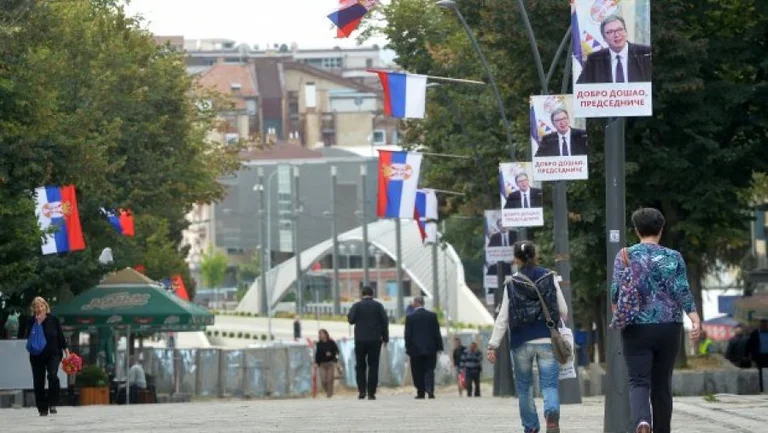
(4 years ago)On the main road in the northern part of Mitrovica beyond an American troop guard post a billboard assures local Serbs that they are not alone against the West and that they still have influential friends: President Vladimir V's photos are presented. Russia's Putin, President Aleksandar Vucic of Serbia and Serbian tennis star, [...]
Mr. Putin has not appeared to receive this honorary title, but he figures in the minds of many residents as potential and multi-repressive rescuers, the most recent in the long line of Russians who, according to Serbian estimates of the past, have worked unhindered for the slave brotherhood to hostile foreigners, in particular Muslims.
Russia has fought more than a dozen wars with the Ottoman Muslim Empire, which defeated the Serb ruler Orthodox-Christ, Prince Lazarus, in the Battle of Kosovo in 1389. This ancient restoration constitutes a large part of Serbian nationalism, fuelling a great grudge against the majority of Kosovo's predominantly Muslim population, even though some Albanians had fought on the Serbian side.
At the centre of Mitrovica stands a statue honouring Prince Lazarus and Grigori Sherbina, a Russian emissary in the region who was killed in the vicinity of the city by a Muslim soldier in 1903. An inscription on the statue of emissary writes that: “a spilled drop of brotherly Russians is spilled into Serbian blood that has been flowing for centuries”.
It is not mentioned that the Russian emissary was of Ukrainian origin.
History, its bloody majority, and dominated by acts of male bravery, are found throughout the Balkans, especially in the celebration of ʹ or denial of brotherly ties “” between Russia and Serbia, both mainly Orthodox Christian nations.
“We have stories of too much and too much maleites in the Balkans”, says Ljiljana Drzeevic, who runs a wool scarf sale business. Sceptic that Mr. Putin has offered rescue, she says that <x2 people are desperate, but I never hoped we'd get anything from Russia”.
In addition to supporting Serbia in the United Nations and giving diplomatic weight that Kosovo still belongs to Serbia, Russia has given too little of any concrete aid. And, constantly citing the Western intervention in Kosovo to justify Russian crime taking and other Ukrainian lands, Mr. Putin has eroded to lower the principle of territorial integrity on which Serbia bases its claims to Kosovo.
Albin Kurti, Kosovo Prime Minister, a state which most Serbs insist does not exist, lamented that Mr. Putin has become a kind of patron saint for most non-recognition Serbs: “For groups of extremists, Putin is their idol”, Mr. Kurti said in an interview in Pristina, in the capital of Kosovo.
Most ethnic Serbs, whether they live in Serbia or in enclaves in Kosovo and Bosnia and Herzegovina, Russia choose to shophi as friends, not necessarily because they like where Mr. Putin has led his country, but because they feel disgusted with Natos. This is particularly pronounced in the northern part of Kosovo, when the nato bomber campaign that broke Serbian grip on Kosovo is seen as the ultimate source of all problems in the enclaves.
Mr. Damjanovic, the historian, said that he would rather live in “the free world”, not in a “world without rights like Putin's Russia”, but because of Natos, <x4 minus we have no choice. Our only solution remains Russia”.
Before the intervention of Nato, a storekeeper, who did not want to tell his name, said that the dark road with potholes outside her shop was well paved and well lit. She said she regretted Ukrainians killed by Russian troops, but wondered why the West “did not cry for us” during the NATO bombing campaign.
Asked by pollsters last year who was “the best defender of Serbian interests”, more than 65 per cent of residents in northern Kosovo chose Russia and only 3 per cent of the United States.
The role of North Mitrovica as a stronghold of pro-Russian sentiment has created a problem for Mr Vucic, the Serbian president. He has refused to impose sanctions on Moscow for the invasion, and for years, he has promoted the sense of victimising Serbs. At the same time, however, he has worked to convince the West that it is not in the Kremlin's pocket.
For Mr. Vucic, a leader trying to put his country into the European Union, the inculcating of ethnic Serbs for Russia in a Kosovo region that is under his finger is a bad look.
Mr Jovic, the organiser of the pro-Moscow protest, complained that local Serbian president's loyal officials strongly controlled all political activity in the region and had made it difficult to show open support for the Kremlin.
Mr. Vucic, according to Mr. Jovic, does not want to complicate his already stumbling efforts to join the European Union. "The West" said Mr. Jovic, “thinks anyone who supports Russia is a fanatic. ”
In some cases, this may be true, but for most of Russia's many followers in northern Kosovo, Moscow simply offers a refuge from feelings of isolation and despair, from which there are many in these areas.
Careful to be named extremists and to disrupt Mr. Vucic's balanced act between East and West, ethnic Serb officials in northern Kosovo offer only silent support for Russia and refuse to seek support from Moscow. “Russia has sympathy here, but we are not seeking its help,” said Igor Simic, deputy leader of the main political party representing Serbs in Kosovo.
Even Mr. Damjanovic, anti- historian - NATO admitted that Russia had often disappointed them. One example was in June 1999, he said, when Moscow sent troops to Kosovo just hours before NATO forces arrived. Despite a reception in ecstasy by ethnic Serbs waving Russian flags, Russian forces did nothing to prevent the majority of the ethnic Albanian population from retaliated violently after the departure of the Serbian police and military. NATO troops, too, mostly stood aside.
But that, Mr. Damjanovic, was when Boris N. Jelcin was in charge of the Kremlin. “Now is Putin. The stronger Russia is, the better it is for Serbs”, he said. “I don't know anyone in Kosovo who is supporting Ukraine,” he added, bypassing almost universal support for Ukraine among ethnic Albanians.
The fact that so many ethnic Albanians in Kosovo are cheering for Ukraine is enough for many ethnic Serbs to do the opposite.
Ethnic Albanians “fully emigrate Ukraine for no real reason, so we all support Russia”, said Milan Dobric, a young Serbian artist in northern Mitrovica. I'm not saying Putin has the right to kill Ukrainians, but Russia has its reasons and I'm totally against it. NATO.
Milos Milovanovic, a researcher working in a nongovernmental organisation in Mitrovica and who is a rare ethnic Serb critic of Moscow, said: “I personally feel zero sympathy for Russia” in Ukraine. As a result, he noted, “I am always debating with my friends”.
Hardly anyone in Kosovo, he added, has given much thought to the war in Ukraine, but almost everyone has sided “at an emotional level” depending on their ethnic affiliation.
“unfortunately,” noted Mr. Milovanovic, “emony and rationality do not go together”.